10 Most Hospitable Towns In Hawaii
Hawaiian hospitality goes by the name aloha. The small towns scattered across the four main islands carry it more visibly than the resort corridors do. Pāʻia and Hanalei pull the surf and beach crowd. Volcano Village and Waimea pull the ranchland and rainforest crowd. The ten towns below split across all four islands with two each on Oʻahu and Maui plus three each on Hawaiʻi Island and Kauaʻi. Each one rewards travelers who slow down enough to actually meet the place.
Hale'iwa, Oʻahu

About 35 miles north of Honolulu on the North Shore of Oʻahu, Hale'iwa has roughly 4,000 residents and draws a steady winter tide of fans pulled in by the island's famous winter surf coast. The plantation-era wooden storefronts along Kamehameha Highway have been preserved through deliberate zoning that has kept chain stores and high-rise development out of the historic core.
Most visits start at Hale'iwa Beach Park, which sits on the protected Hale'iwa Harbor and offers calm year-round swimming on a coast otherwise known for winter waves. A short walk away, Matsumoto Shave Ice has served rainbow-colored shave ice cones since 1951 from a wooden storefront, where the line typically winds out the door regardless of the season. Just up the coast, the Banzai Pipeline at ʻEhukai Beach Park hosts the world's premier winter surf competitions between November and February, when waves can break over 20 feet. Closer to the historic core, the Liliʻuokalani Protestant Church on Hale'iwa Road, founded by missionaries in 1832 and named for the queen who donated its distinctive seven-dial clock in 1892, gives a quieter counterpoint to the surf-driven main strip.
Kailua, Oʻahu

Across the Koʻolau Mountains on Oʻahu's windward side, Kailua sits about 12 miles east of Honolulu with a population of roughly 38,000 across the broader Kailua-Lanikai area. Local zoning has kept resort towers off the beach corridor, and the residential streets that fan out from Kailua Beach Park retain a low-rise, locally focused character.
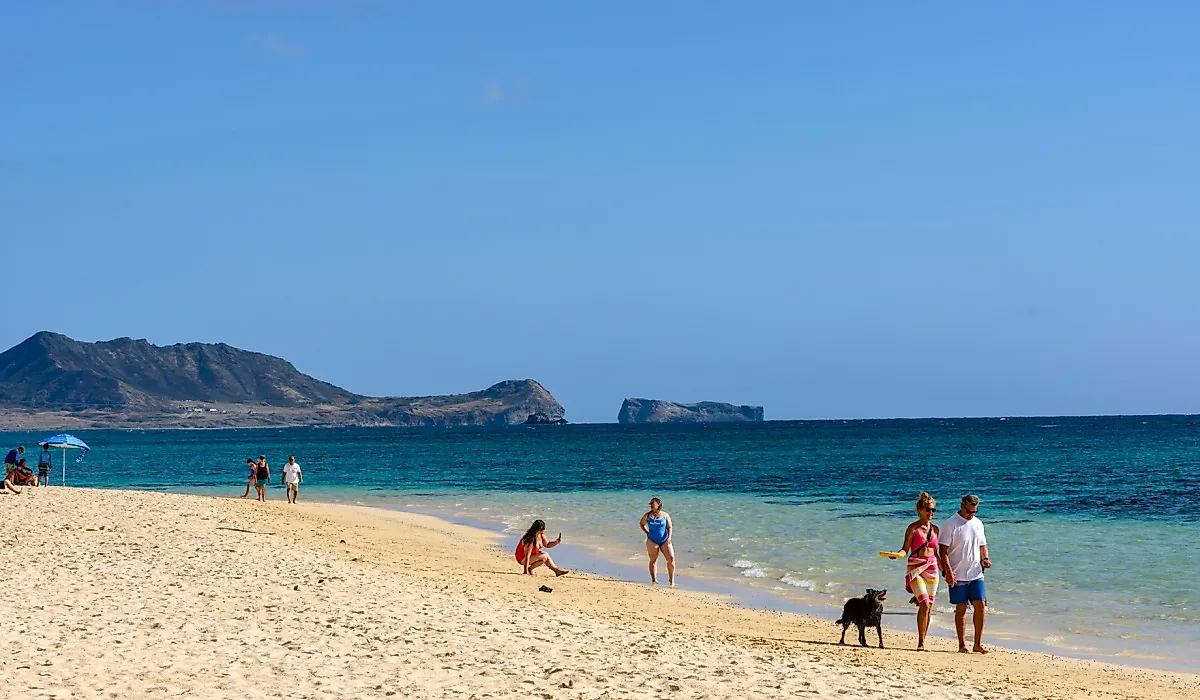
Most visits center on the two-mile crescent of Kailua Beach Park, which has calm water suitable for swimming, kayaking, and standup paddleboarding year-round. A short drive south, Lanikai Beach is the postcard photograph that brings most first-time visitors to the windward side, with the Mokulua Islands forming the iconic twin-island silhouette offshore. Back inland, the Kailua Town Center along Kailua Road clusters locally owned restaurants, including Buzz's Original Steakhouse, which has served meals since 1962 in a converted plantation home. Kailua Beach Park is also one of the more pet-friendly stretches of coast in the state, with leashed dogs welcomed along the sand.
Pāʻia, Maui

At the start of the Road to Hāna on Maui's North Shore, about 7 miles east of Kahului, Pāʻia draws roughly 2,700 residents and a longer reputation as the island's bohemian beach town. The plantation-era core along Hāna Highway runs three blocks of weathered wooden storefronts that survived the closure of the Pāʻia sugar mill in 2000 and have since filled with surf shops, art galleries, and restaurants run by people who live within walking distance.
Most visitors start at Hoʻokipa Beach Park, two miles east of town, which is widely considered the windsurfing capital of the world, with steady trade winds drawing professional competitors from late spring through early fall. Back in the commercial core, Mana Foods, a natural foods store in the heart of Pāʻia, has been the town's gathering point since 1983, drawing a steady flow of locals and visitors through its narrow aisles. A few blocks from the main strip, Pāʻia Bay Beach offers gentler swimming during the summer months. For dinner, Mama's Fish House on the eastern edge of town has served fresh-caught local fish from a beachfront dining room since 1973 and remains among the hardest dinner reservations to land in the state.
Makawao, Maui

Inland from Pāʻia at 1,600 feet in elevation, Makawao is Upcountry Maui, about 13 miles east of Kahului, with a population of roughly 7,600 and a heritage built around the paniolo cattle culture introduced by Mexican vaqueros (cowboys) in the early 19th century. The commercial core along Baldwin Avenue retains plantation-era storefronts, hitching posts, and wooden sidewalks that recall Makawao's working-ranch origins.
Most visits begin at the Hui Noʻeau Visual Arts Center, which occupies the 1917 Baldwin estate just outside town and runs gallery exhibitions, classes, and an annual juried exhibition that draws Maui's best ceramicists, painters, and printmakers. Back on the main commercial strip, Komoda Store and Bakery on Baldwin Avenue has sold its famous cream puffs and stick donuts since 1916, with lines often forming before the doors open at 7 a.m. The town's biggest annual event is the Makawao Stampede each Fourth of July weekend, when the paniolo tradition fills the streets with rodeo competitions, parades, and traditional Hawaiian-style cooking. For a quieter outdoor stop, Polipoli Spring State Recreation Area, accessed by a high-clearance road from town, opens onto cool eucalyptus forest at over 6,000 feet of elevation.
Volcano Village, Hawaiʻi Island

At the eastern entrance to Hawaiʻi Volcanoes National Park, Volcano Village sits on the slopes of Kīlauea at 4,000 feet of elevation, with a population of under 1,000 and a climate cool enough to support temperate-zone plants that cannot survive at sea level. The village is home to a few blocks of low-rise commercial buildings strung along Old Volcano Road, with most lodging spread throughout the surrounding forest in small bed-and-breakfasts and vacation rentals.
The natural anchor sits at the western edge of the village. Hawaiʻi Volcanoes National Park contains both Kīlauea and Mauna Loa, two of the world's most active volcanoes, and Crater Rim Drive offers views of the Halemaʻumaʻu lava lake, which has experienced intermittent eruptive activity in recent years. A few minutes east of the park entrance, the Volcano Art Center Gallery in the historic 1877 Volcano House Hotel building runs rotating exhibitions of work by Hawaiʻi Island artists. Closer to the village proper, Volcano Winery on Pi'i Mauna Drive operates as the southernmost commercial winery in the United States, growing grapes and tropical fruits at 4,000 feet of elevation, with tastings offered daily.
Waimea (Kamuela), Hawaiʻi Island

Waimea, also known as Kamuela to distinguish it from the Kauaʻi town of the same name, sits in the saddle between Mauna Kea and the Kohala Mountains on Hawaiʻi Island, with a population of roughly 9,000 and a cool, often misty climate at 2,700 feet of elevation. The town serves as the headquarters of Parker Ranch, one of the largest privately owned cattle ranches in the United States, and the paniolo culture remains as visible here as anywhere in the state.
Most visits begin at Parker Ranch Center on Mamalahoa Highway, where you can tour and trace the ranch's nearly 200-year history alongside a cluster of locally owned shops and restaurants. A short drive away, the Anna Ranch Heritage Center occupies the 1908 home of Anna Lindsey Perry-Fiske, one of Hawaiʻi's most famous paniolo women, and runs guided tours of the original ranch buildings. For dinner, Merriman's restaurant on Opelo Road, opened by chef Peter Merriman in 1988, is widely credited as the founding restaurant of the Hawaiʻi regional cuisine movement and still draws diners from across the island. For travelers heading farther afield, the Mauna Kea visitor information station is 30 minutes south at 9,200 feet and serves as the staging point for summit trips up the dormant volcano.
Holualoa, Hawaiʻi Island

On the slopes of Hualālai above Kailua-Kona, about 4 miles east of the Kona coast and 1,400 feet above it, Holualoa is home to a community of roughly 3,400 people with an identity built around coffee farming and the artist community that has settled in the surrounding hills since the 1970s. The two-block commercial strip along Mamalahoa Highway features wooden storefronts housing galleries, coffee tasting rooms, and the working studios of resident artists.
Most visits start at Holualoa Coffee Company on Mamalahoa Highway, where tastings of single-estate Kona coffee feature beans grown within walking distance, with bags often available straight from the morning's roast. A five-minute drive up the street, Studio 7 Fine Arts has operated since November 1979 as the gallery and working studio of artists Hiroki and Setsuko Morinoue, making it one of the longest-running art galleries on the island. The Morinoues went on to co-found the nearby Donkey Mill Art Center, which has become one of the state's busiest community art education hubs. The annual Holualoa Coffee and Art Stroll, held each November, draws visitors and locals for an afternoon of open studios, live music, and tastings at over 20 farms and galleries. For an overnight stay, the Holualoa Inn, a 30-acre estate above the village with views down to the Kona coast, runs as the area's most established lodging.
Hanalei, Kauaʻi

On Kauaʻi's North Shore, about 32 miles north of Lihuʻe, Hanalei has roughly 450 residents and is the smallest town on this list. The village runs a few blocks along Kūhiō Highway between taro fields and a two-mile crescent of beach, with the cliffs of the Nā Pali Coast rising directly behind it.
Most visits begin at Hanalei Bay, where calm summer water is ideal for swimming, and the historic 1912 Hanalei Pier extends into the bay, making it the island's most photographed landmark. Just inland, the Waiʻoli Mission House, built in 1837 by Protestant missionaries, has been preserved with original furnishings and offers free guided tours weekly. For dinner, the Hanalei Dolphin Restaurant on Kūhiō Highway has served fresh local fish from a riverside dining room since 1976. For a longer outdoor stop, the Hanalei Valley Lookout on the way into town opens onto over 60 acres of working taro fields that have been cultivated continuously for more than 1,000 years.
Kapaʻa, Kauaʻi

About 8 miles north of Lihuʻe along Kauaʻi's east shore, Kapaʻa is one of the larger towns on this list, with a population of roughly 10,700. However, the historic Old Town district along Kūhiō Highway retains a clear small-town character. The main commercial strip runs a few blocks of wooden storefronts and converted plantation buildings, with the Coconut Coast stretching north and south.
Most visits start with the Ke Ala Hele Makalae coastal path, which runs nearly 8 miles along the shoreline through Kapaʻa, with paved sections suitable for walking, jogging, or cycling and direct ocean views the entire length. Just south of town, Lydgate Beach Park offers protected swimming inside two rock-walled ocean pools and is widely considered the safest swimming beach for families on the east shore. Closer to downtown, a Wednesday afternoon farmers market draws producers from across the east shore and offers visitors a window into the local food economy.
For food across the day, three local spots cover most appetites along Kūhiō Highway. The Musubi Truck serves spam musubi and other rice-and-fish staples until 6 p.m. on weekdays and 5 p.m. on weekends. Chicken in a Barrel runs barrel-smoked chicken and brisket until 7:30 p.m. most evenings, and Fish Bar Deli plates fresh local fish and poke until 9 p.m. Thursday through Monday.
Waimea, Kauaʻi

On Kauaʻi's south shore, about 23 miles west of Lihuʻe, Waimea sits at the mouth of the Waimea River with a population of roughly 1,800 and a history that traces directly to Captain James Cook's first European landfall in the Hawaiian Islands in January 1778. The town runs for a few blocks along Kaumualiʻi Highway, well removed from the resort development of the south shore proper.
Most visits begin at the Captain Cook Monument on the western edge of town, which marks the spot where Cook came ashore and remains one of the most historically significant sites in the state. Just up the highway, Waimea Canyon State Park, often called the "Grand Canyon of the Pacific," opens onto a 14-mile gorge cut roughly 3,600 feet deep through volcanic rock, with several lookouts accessible by a paved road from town. Back near the river, Hofgaard Park anchors the small downtown with shaded benches and views back toward the water. For dinner and overnight stays, the Waimea Plantation Cottages on Kaumualiʻi Highway runs an on-site beachfront restaurant inside a complex of restored 1880s plantation cottages that also serve as the area's primary lodging.
A Welcome That Holds Up
The ten towns share what most visitors to Hawaiʻi actually look for once they get past the airport: locally owned businesses run by people who live within a short drive of where they work, food sourced from the surrounding ocean and ranch land, and town centers where a morning walk passes more shopkeepers than tourists. None of these places exists as resort destinations the way Wailea or Waikīkī do. That difference is the reason travelers who want to feel like guests rather than customers tend to find their way back.