10 Indiana Towns With Unforgettable Main Streets
A 70-foot Civil War obelisk rises from Angola's town square. Indiana's first state capitol still stands at the center of downtown Corydon. Amish buggies roll up and down Shipshewana's main road most days of the week. What makes a Main Street unforgettable here is rarely just architecture. It's the specific thing each town has held onto. Wabash kept the courthouse where the world's first electrical street lighting was switched on in 1880. Madison kept 133 blocks of intact 19th-century buildings, the largest National Historic Landmark district in the state. Vincennes kept the 1805 territorial capitol and the 1809 French House from its days as the seat of the Indiana Territory. The ten Main Streets ahead each carry something the rest of the country has mostly lost.
Wabash

Sitting on the Wabash River, Wabash claims a specific superlative: on March 31, 1880, it became the first city in the world to be entirely lit by electricity. Charles F. Brush mounted four 3,000-candlepower carbon arc lamps on the dome of the Wabash County Courthouse, and a crowd of more than 10,000 watched the lights come on. The courthouse still stands at the top of the hill on Main Street, and one of the original Brush lamps is displayed inside. Paradise Spring Historical Park preserves several log cabins and the location of the 1826 Treaty of Paradise Spring that signed regional land away from the Miami and Potawatomi. Visitors can catch touring musicians at the Honeywell Center or order from the menu at Habanero Grill and Cantina nearby.
Corydon

Many of Indiana's most memorable downtowns also have notable state histories, especially Corydon. The community was the state capital from 1816 (when Indiana joined the Union) until 1825, when the seat of government moved north to Indianapolis. The original federal-style limestone capitol building still stands at the Corydon Capitol State Historic Site at the center of downtown. Nearby, the Harrison County Discovery Center holds artifacts covering both the written and natural history of the region. After exploring, visitors can stop in at Frederick's Cafe & Grill across the street or settle in at The Old Capitol Tea Room.
Nashville

Nashville shares the name of the city in Tennessee but is a different kind of place. Nashville sits in the hills of Brown County with the 16,000-acre Brown County State Park reachable via hiking, biking, and horseback trails. Downtown carries a small artist-colony feel evident in its shops, restaurants, and galleries. Several galleries line S. Van Buren Street, including the Brown County Craft Gallery, the Brown County Art Guild, and the blown-glass work at Quintessence Gallery. Just off S. Van Buren Street, the Artists Colony Inn & Restaurant serves comfort food for breakfast, brunch, and lunch in a setting that reflects the town's early-20th-century artist heritage.
New Albany

New Albany sits across the Ohio River from Louisville, Kentucky, with its Main Street facing the river. What makes the metro-area small town memorable is its walkable historic downtown. Right off Main Street is Mansion Row, a series of 19th-century mansions built by some of Indiana's wealthiest residents of the steamboat era. The best-known is the Culbertson Mansion State Historic Site, known for its marble staircases, frescoed ceilings, and Halloween-season haunted tours. Also in downtown New Albany is the Carnegie Center for Art & History, with a contemporary art gallery and a permanent exhibit on the Underground Railroad's role in the city. The Ohio River Greenway, a paved trail of about seven miles, lets walkers explore the surrounding waterfront and reach the nearby communities of Clarksville and Jeffersonville.
Shipshewana

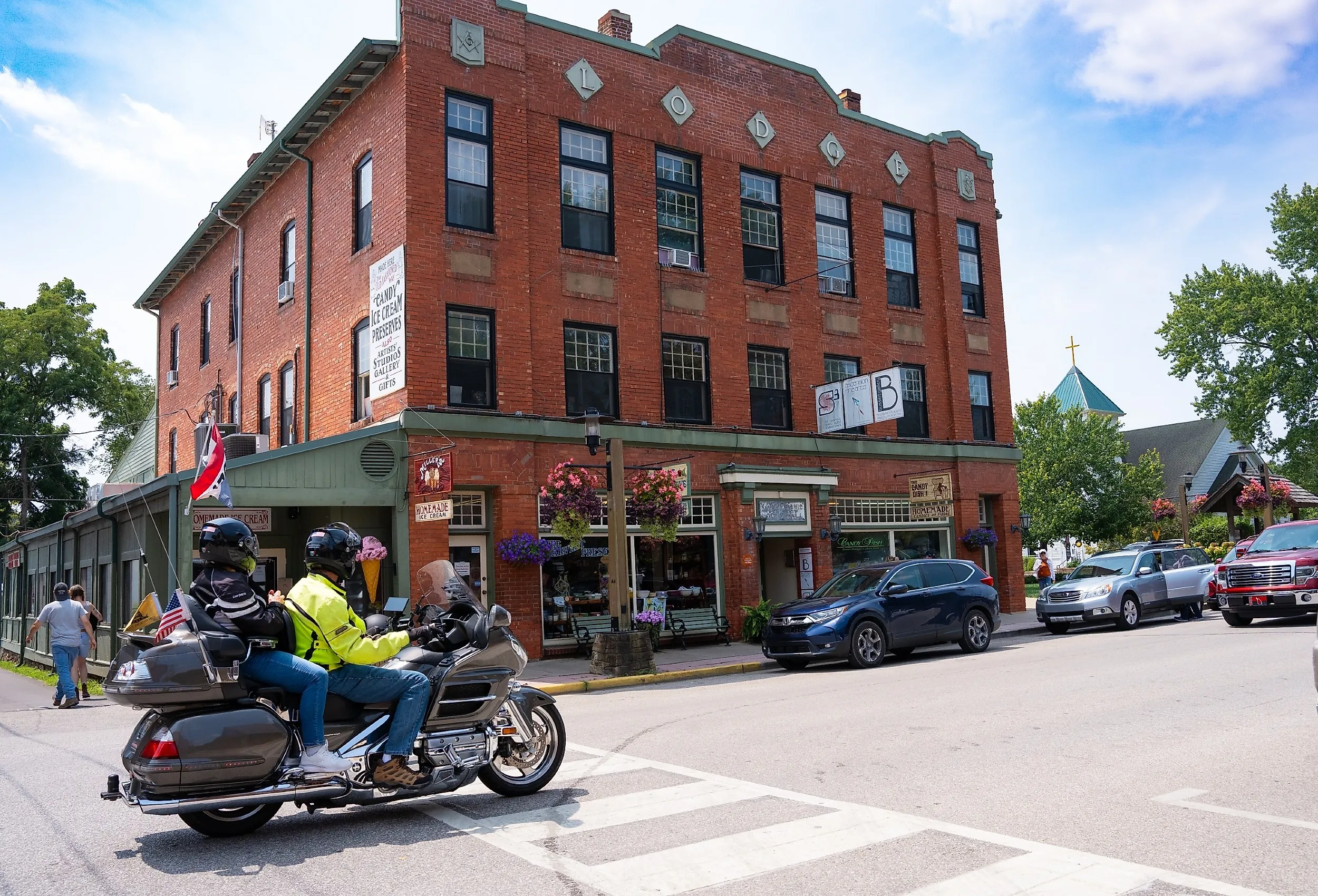
Shipshewana's downtown has the most rural character of any of these Indiana communities. Amish buggies regularly roll up and down the main roads. Visitors can take a buggy tour through Buggy Lane Tours, try Amish cuisine at Blue Gate Restaurant & Bakery, or go deeper into local Amish culture at the Menno-Hof interpretive center. Housed in a red barn, Menno-Hof walks visitors through the differences between Mennonite and Amish communities, with exhibits on the Amish kitchen and how the community has adapted to life in America. Not far from the bakery is the largest outdoor flea market in the Midwest, the Shipshewana Flea Market, open Tuesdays and Wednesdays from May through September.
Madison

Madison's downtown is one of the Midwest's most impressive historic districts. At 133 blocks, the Madison Historic District is the largest National Historic Landmark district in Indiana and one of the largest in the country. The district holds a wide range of architectural styles and building types. Greek Revival buildings include the three-story Shrewsbury-Windle House and the 1844 Lanier Mansion State Historic Site, with a long view of the Ohio River from its riverside portico. Older Federal-style structures include the Jeremiah Sullivan House, built in 1820 for the Indiana attorney and legislator who was behind the decision to move the state capital from Corydon to Indianapolis.
Franklin

Just a half hour south of Indianapolis, Franklin is the seat of Johnson County. Community events fill the heart of downtown including the Canvas Clash in June, where artists compete to finish a painting in 20-minute rounds, and the Hops & Vines Festival in September celebrating the area's wine and beer scene. For those who come in the fall, Young's Creek Park hosts the Fall Vintage & Handmade Fest in October, featuring antique and handcrafted goods from local vendors. Plenty of green space sits in and around downtown Franklin for a walk in any season, including Province Park with its small waterfalls along Youngs Creek.
Angola

Angola has one of the most striking town squares in Indiana, with a towering monument at the center. The Steuben County Soldiers Monument was erected in 1917 to honor the 1,278 Steuben County men who served in the Union Army during the American Civil War. Of those, 280 died in the conflict. The monument rises 70 feet, with a 10-foot female figure holding a wreath and flag and four soldier statues placed around the base. The square also holds a smaller sculpture of Sojourner Truth, the abolitionist and Underground Railroad activist. Around the square, the Barley Boo & Co boutique and The Rooted Vegan restaurant round out the downtown.
Vincennes

Vincennes stands out for both its age and the people who founded the city. It is the oldest continuously settled town in Indiana, established by the French in 1732. The land passed to the British after the French and Indian War and was conquered by George Rogers Clark and his frontiersmen for the American cause in February 1779. Downtown Vincennes preserves several layers of that history. Vincennes State Historic Sites holds the red-timber Original Territorial Capitol Building from 1805 (when Vincennes served as capital of the Indiana Territory) and the 1809 French House, noted for its French Creole upright-post construction. Next door, Grouseland is the mansion home of William Henry Harrison, the territorial governor and future ninth President of the United States. The George Rogers Clark National Historical Park nearby holds a domed neoclassical memorial that ranks among the largest federal monuments outside Washington, D.C. On Main Street itself, the Vincennes Pub 'N' Grub serves pub-style food.
New Harmony

New Harmony's downtown carries a different atmosphere than anywhere else in Indiana. Sitting near the border with Illinois on the Wabash River, the community was founded by a utopian society known as the Harmonists (or Rappites) in 1814. The highly regimented religious society lived communal lives in anticipation of the Second Coming of Christ. They sold the community to the Owenites, a secular socialist utopian group led by Welsh industrialist Robert Owen, in 1825. Echoes of both settlements run throughout downtown including the Harmonist Labyrinth on Main Street, a hedge maze with a stone building in the center, and the Roofless Church with its open-air sanctuary and sculptures by Jacques Lipchitz. The best way to explore historic downtown New Harmony is to book a tour at the Atheneum Visitors Center, which offers guided walking tours of several structures including Community House No. 2 and Thrall's Opera House.
Striking Town Squares And Old Capitols
Indiana's Main Streets carry striking symbols of state history. Some of that history sits in town squares like the Steuben County Soldiers Monument in Angola. Other parts run through downtowns like Corydon with its preserved 1816 state capitol. The streets do not run only on history: Franklin's festival calendar fills all four seasons. With that mix of culture and heritage, these ten towns are worth visiting year-round.