The Key West Of The North
Put-in-Bay has been compared to Key West for so long that the comparison now runs both ways. This picturesque village on South Bass Island, off the Ohio shore of Lake Erie, can only be reached by ferry, private boat, or small plane. It has swim-up bars and a fleet of golf carts in place of cars.
The New York Times called it the "Key West of the Great Lakes" in 2008, and a Key West bar has since returned the favor with its own Put-in-Bay Days.
Downtown Put-in-Bay

Put-in-Bay's downtown is built around DeRivera Park, a five-acre waterfront park on Bayview Avenue that has been run by a trust since 1866. José de Rivera, a Spanish-born New York importer who bought South Bass Island and five neighboring islands in 1854, sold the park to its first trustees for a dollar. Three trustees are still elected for life by island voters.
Across the street, the Round House Bar opened in 1873 as the Columbia Restaurant, serving beer, wine, and ice cream. The McCann family bought it in the 1950s and painted the formerly white building red. Each spring, the switching on of its "whiskey light," a red neon sign in the arched front window, marks the official start of party season.
Next door, the Park Hotel, also dating from 1873, overlooks the park. A block away on Delaware Avenue, the Beer Barrel Saloon has a bar measuring 405 feet 10 inches long, which Guinness World Records lists as the longest permanent bar in the world.
Gibraltar Island

Look across the harbor from the docks and a few hundred yards out you'll see Gibraltar Island. Named for its resemblance to the Rock of Gibraltar, this 6.5-acre rock was bought in 1864 by Jay Cooke, the Philadelphia financier who sold the bonds that financed the Union during the Civil War, as the site of a summer home.
That house, now known as Cooke Castle, still stands. In 1925, the industrialist Julius Stone bought the island and gave it to The Ohio State University the same day, and it has been home to Stone Laboratory ever since.
The oldest freshwater biological field station in the United States, the lab's roots go back to 1895, and these days it provides Lake Erie's annual harmful algal bloom forecast. Its Aquatic Visitors Center on the main island displays live Lake Erie fish.
Ohio State also owns the South Bass Island Lighthouse on the island's southwest corner. The 60-foot lighthouse tower was first lit in July 1897 and had ten keepers before the Coast Guard automated it in 1962. The federal government transferred the property to the university in 1967, and Stone Lab staff give free guided tours in summer, including a climb of the tower.
Wine, Caves, And Geodes

Island wine is not a new idea here. Heineman's Winery was founded in 1888 by Gustav Heineman, an immigrant from Baden in Germany, and is the oldest family-owned winery in Ohio. Dustin Heineman, the fifth generation, now helps run it alongside his father, Ed. During Prohibition, when the island's other wineries closed, the family survived by selling grape juice, running a cab company, and charging admission to what was underneath their property.
That something is Crystal Cave, found in 1897 by workers digging a well 40 feet beneath the winery. Rather than a true cave, it is a single geode, a hollow rock lined with crystals. Measuring 35 feet across at its widest point and ten feet high, it has walls covered in blue-white celestite, a strontium mineral, with individual crystals ranging from hand-sized to larger than a football.
Gustav and his crew removed 150 tons of crystal to level the floor and raise the ceiling, and some of it is thought to have gone to fireworks makers, since strontium burns red. Cave tours run as an add-on to the winery tour from late April through late October, and it's worth doing for the bragging rights, as Guinness World Records lists Crystal Cave as the world's biggest geode.
The Battle of Lake Erie

The Battle of Lake Erie is the reason most Americans know of Put-in-Bay. It was fought on September 10, 1813, during the War of 1812. Commodore Oliver Hazard Perry had been sent to Erie, Pennsylvania, that February to build a squadron from scratch, and by early fall he had nine vessels carrying 54 guns. The British squadron that appeared northwest of the island numbered six ships with 63 cannons.
The British flagship, Detroit, crippled Perry's flagship, the Lawrence, forcing him to row across to the Niagara and carry on the fight from there. When it was over and the Americans had won, Perry sent General William Henry Harrison the message that still gets quoted in school: "We have met the enemy and they are ours."
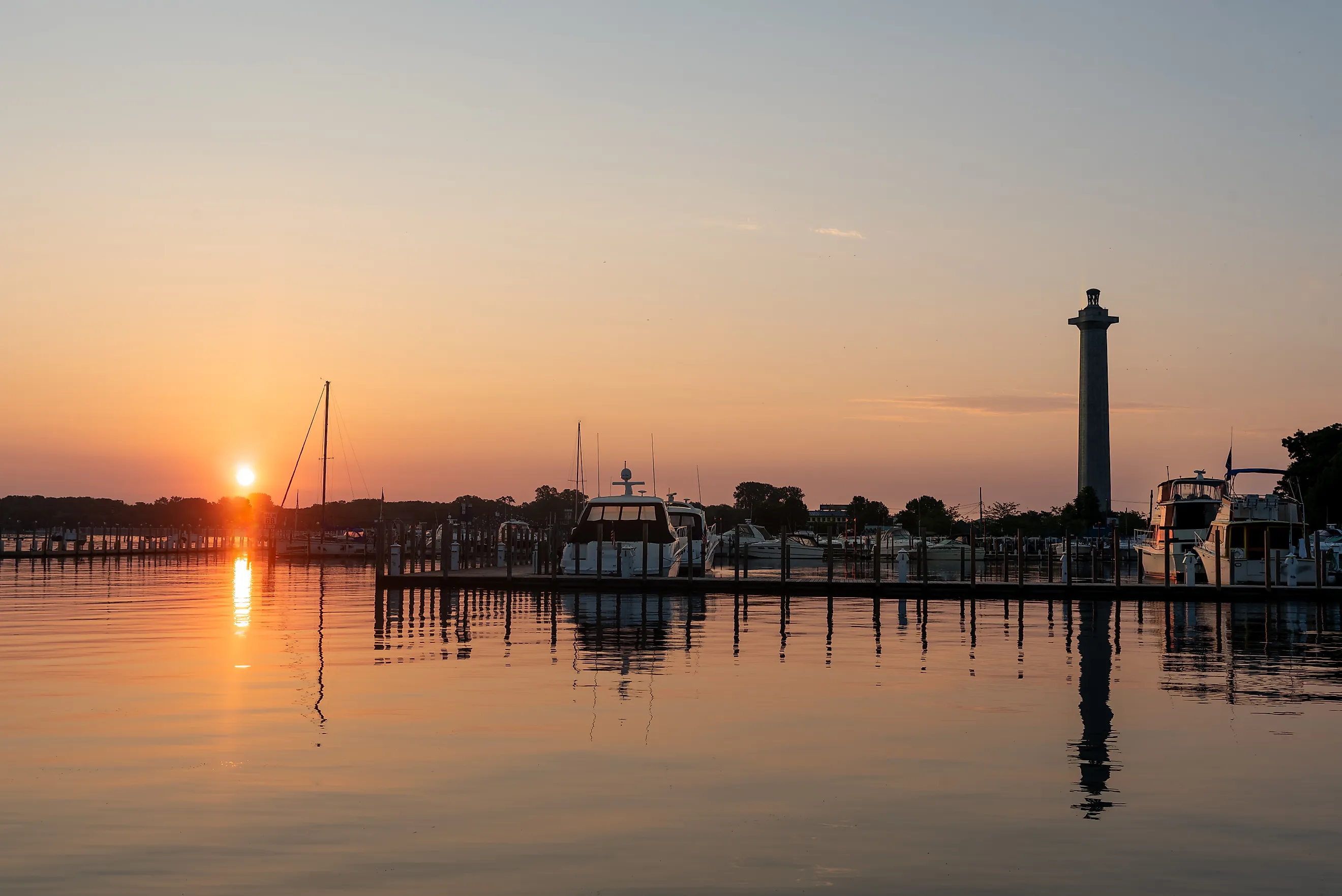
America's victory is commemorated by Perry's Victory and International Peace Memorial, a granite column rising 352 feet above lake level and set on 25 acres of parkland between the village and the airport. Assembled from 3,084 granite blocks in 78 courses, the column is 45 feet across at the base and tapers to 35 feet 6 inches at the top, and a bronze lantern weighing 11 tons caps it. The memorial was formally dedicated in 1931, and it is the only international peace memorial managed by the National Park Service.
Beneath the memorial's rotunda floor lie six officers killed in the battle, three American and three British, buried side by side. The rotunda walls, cut from Indiana limestone, are engraved with the names of the dead and wounded from both sides. The open-air observation deck, 317 feet above the plaza, is normally reached by elevator after a climb of 37 stone steps. The park's Historic Weekend, held in September, is the annual commemoration of the battle.
Why The Key West Comparison?

Put-in-Bay's Key West nickname has less to do with the weather and everything to do with the similarities in how South Bass Island behaves in summer. And the Key West parallels are easy to spot.
Visitors arrive by boat, dress in flip-flops, Hawaiian shirts, with their straw hats, and spend their afternoons at bars (poolside or otherwise) like the swim-up Blue Marlin at the Put-in-Bay Resort & Conference Center. The MIST Pool Bar at the Commodore Resort adds a waterfall to its drinks experience.
Then, of course, there are the specialty drinks themselves. Mojito Bay replaces its bar stools with swings and sand, and Margarita's On the Rock serves 30 margarita flavors under a thatched roof.
Singer-songwriter Ray Fogg, known locally as the "Northern Jimmy Buffett," plays the island all summer and, naturally, spends his winters in Key West. No doubt he visits Sloppy Joe's, the Key West landmark bar on Duval Street, that has hosted "Put-in-Bay Days" in honor of its northern counterpart.
The connection has only gotten stronger since The New York Times ran a column in 2008 titled Key West of the Great Lakes, which quoted the war correspondent Ernie Pyle writing more than 70 years earlier that "Put-in-Bay lives off wine and summer excursionists." Pyle was writing in the era when Caribbean-style cruise ships worked the Great Lakes and made the island a regular stop.
Ohio's Answer To Key West

Sure, Key West may have the longer season, but Put-in-Bay matches it in most other respects between May and October. You can get to either by boat-in arrival (well, you have to in Put-in-Bay; in Key West it's an option), their bars have been pouring drinks for well over a century, and they even share a Jimmy Buffett soundalike. So, grab a margarita and visit them both.