The State Parks With The Strangest Rock Formations
Earth's rocky wonders aren't limited to national parks. Less crowded but no less imposing, these state parks showcase millions of years in stone. In Utah's Kodachrome Basin, hikers can explore a box canyon cave and color-changing spires. Four hours north, Goblin Valley has thousands of sandstone columns to hike among, much like New Mexico's tall pinnacles in the City of Rocks. Meanwhile, Valley of Fire State Park in Nevada is a stone zoo, with an elephant boulder, sandstone beehives, and an animal-print hillside.
Goblin Valley State Park, Utah

Goblin Valley State Park has thousands of hoodoos in Utah's San Rafael Desert. The stone spires took form about 170 million years ago when mud and sand hardened into Entrada sandstone. Wind and rain carved these towers into the anthropomorphic "goblins" we see now, hence the state park's name. Parkgoers can roam the 3 sq mi Goblin Valley floor to see these otherworldly formations. A Goblin Overlook can also be hiked for a bird's-eye view of the strange hoodoos.
A row of hoodoos known as the Three Sisters can be reached on a short 250-yard hike. These are the most recognizable formations in Goblin Valley, and their proximity to the main entrance makes this a great hike for families. For adventurous hikers, the trail connects to more challenging hikes like the Carmel Canyon Loop and Goblin's Lair. Morning is the best time to take this second route, as its slot canyon fills with sunlight and dramatic shadows. Alternatively, nighttime transforms this International Dark Sky Park into a stargazing site back on the main valley floor.
Valley of Fire State Park, Nevada

Valley of Fire State Park is a geologic wonderland, spanning 46,000 acres in southern Nevada. Shifting dunes, tectonic activity, and erosion from wind and water created the Valley of Fire's surreal rock formations. Red sandstone from the Jurassic period rests against limestone mountains from when a sea covered this Mojave Desert region. Some formations also depict early human history. The Atlatl Rock is a massive red sandstone formation with Indigenous petroglyphs that parkgoers can see up close.
Near the Valley of Fire's east entrance, Elephant Rock forms the animal's body with a natural stone arch as the trunk. Keeping with the animal imagery, the Fire Wave is a sandstone hill with a zebra-like swirl of pink, orange, red, and white stripes. Close to the Valley of Fire's west entrance, the Beehives also depict geologic cross bedding. Named for their similarity to a beehive, the rounded sandstone mounds have exposed grooves, each representing the angle of a different geological layer.
Mushroom Rock State Park, Kansas

Just 5 acres in size, Mushroom Rock is the smallest state park in Kansas, yet it proves great things can come in small packages. The park is considered one of the "8 Wonders of Kansas Geography" due to its unique toadstool-shaped boulders. Dating back to the Cretaceous Period, these rare and unusual formations are made of sedimentary rock and Dakota Formation sandstone. Cemented by calcium carbonate, the 2 rock types eroded at different rates, creating the iconic top-heavy mushroom shape.
Mushroom Rock is a key stop on the Prairie Trail Scenic Byway. Two short and easy trails lead to its 2 mushroom rocks, with other sandstone concretions to spot along the way. Unlike most state parks, Mushroom Rock is completely free to visit. Neither entrance fees nor vehicle permits are required as of 2026, and the park is open year-round. Still, since Mushroom Rock is small, people often pair their visit with a day at nearby Kanopolis Lake State Park.
City of Rocks State Park, New Mexico

The City of Rocks formed about 35 million years ago, after a volcano erupted in southwestern New Mexico. In its wake, hot ash packed together to form the tall volcanic pinnacles we see today. Even after being sculpted by water and wind over millions of years, some of the formations still stand up to 40 ft tall. With natural "roads" dividing these high-rise rocks, the park truly looks like a stone city.
City of Rocks State Park is located in the Chihuahuan Desert. There are only 6 other known places like it on earth, making the stone cityscape that much more fascinating. A 3-mile Hydra Trail loops through the landscape, showcasing its rock towers and surrounding valleys. For panoramic views, the 5-mile Table Mountain Trail leads atop a rocky ridge for a different perspective. Rock climbing also grants a higher view of the pinnacles. However, only free climbing is allowed, as fixed hardware is prohibited to preserve the formations.
Kodachrome Basin State Park, Utah

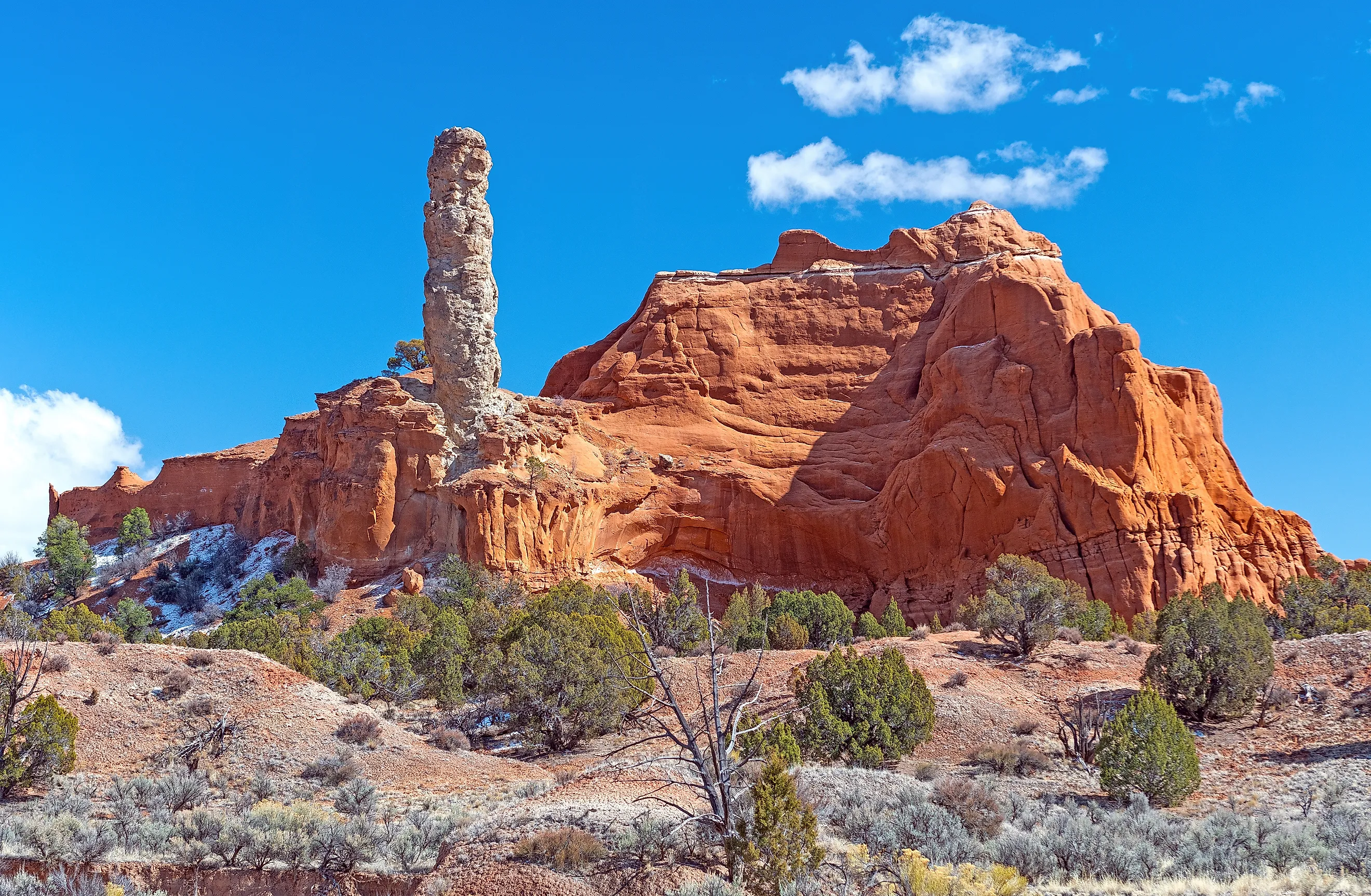
Colorful sandstone chimneys known as sedimentary pipes are the defining feature of Utah's Kodachrome Basin. Located on the Colorado Plateau, Kodachrome Basin State Park has 67 stone spires that stand 6 to 170 ft tall. Each formation's sandstone layers reveal geologic time, stretching 180 to 95 million years in the past. Despite these natural timestamps, geologists are unsure how the majestic pipes exactly came to be. One theory links their existence to cemented sediment from ancient springs, but the exact origin remains uncertain.
Throughout the day, these multi-colored spires appear to shift in color, with direct light and deep shadows altering the layers of red, pink, and white. Hikers can see these hues shifts on the Panorama Trail, a 3- to 6-mile loop passing some of the park's best sedimentary pipes. For hikers completing the full 6-mile loop, other remarkable geological features can also be spotted. The Cool Cave is a tall box canyon explorers can wander through. An attached loop also leads to the Secret Passage, a less frequented area with quirky cone-shaped rock formations and a short slot canyon.
Slide Rock State Park, Arizona

Slide Rock State Park is named after a wide slab of sandstone that parkgoers ride as a natural waterslide. Set inside Arizona's Oak Creek Canyon, the park was previously Pendley Homestead, a historic apple farm. These days, rangers maintain the historic orchard with nearly 300 trees, and parkgoers can pick fruit starting in late August to early September. However, the slide rock remains the park's centerpiece, especially in the summer.
For an overhead view of the creek and slide rock, the 0.25-mile Clifftop Nature Trail begins near the park's apple barn. The "waterslide" sits beneath the orchard, bounded by the red walls of Oak Creek Canyon. Half a mile deep, the large canyon is amazingly new, carved by the Oak Creek fault less than 6 million years ago. The slide rock is an 80 ft stretch of sandstone used as a chute into Oak Creek. Water erosion and living algae keep the rock smooth and slippery, making it easy to slide into Oak Creek for swimming and wading.
Makoshika State Park, Montana

Montana's largest state park is famous for its dinosaur fossils and distinct rock formations. Makoshika State Park covers 11,538 acres of southeastern Montana's badlands. The area is part of the Cretaceous Hell Creek Formation, a geologic division known for its fossil preservation. More than 10 dinosaur species have been found in Makoshika, including the remains of a Tyrannosaurus rex. Makoshika's landscape is also more eroded and carved than other badlands, possibly due to an ancient grass fire. Geologists theorize the fire-exposed plain was weathered by water erosion, later forming many of the epic formations we see today.
Capped rocks are a popular find in Makoshika State Park. Differential erosion formed these unique towers, with harder limestone "capping" the softer claystone. This contrasting erosion can be seen on the half-mile Cap Rock loop, a trail that also leads past a natural sandstone bridge. A separate Twin Sisters trail showcases more differential erosion. The short hike leads to one of Makoshika's most photographed landforms, 2 capped hoodoo "sisters" standing side by side.
Stories In Stone
These state parks and their strange formations have stories to tell. In Valley of Fire State Park, petroglyphs reveal how early humans were drawn to its rocks much like we are today. Geology tells an even older story, stretching back to the dinosaur age with Makoshika's exposed fossil bed. The Kodachrome Basin's stone spires also expose their age through layers, revealing 180 to 95 million years of history. Ultimately, these eye-catching rock formations are more than just a view. They are ancient history in stone.