Montana's Largest State Park Is Wildly Underrated
Say Montana and most people picture the jagged peaks of Glacier National Park. The reality is flatter. The vast majority of the state is prairie and badlands, with the mountains squeezed into a thin sliver along the western border.
Montana is also enormous, covering more than 147,000 square miles as the fourth-largest state by landmass, yet it holds only about 1.13 million residents, ranking a sparse 43rd. All that empty space leaves room for a lot of excellent parks beyond Glacier. And the biggest of them is not a mountain park at all.
Makoshika State Park is little-talked-about, underrated, and overdue for some attention. Here is why it belongs on your list the next time you find yourself in eastern Montana.
The Geography of Makoshika State Park

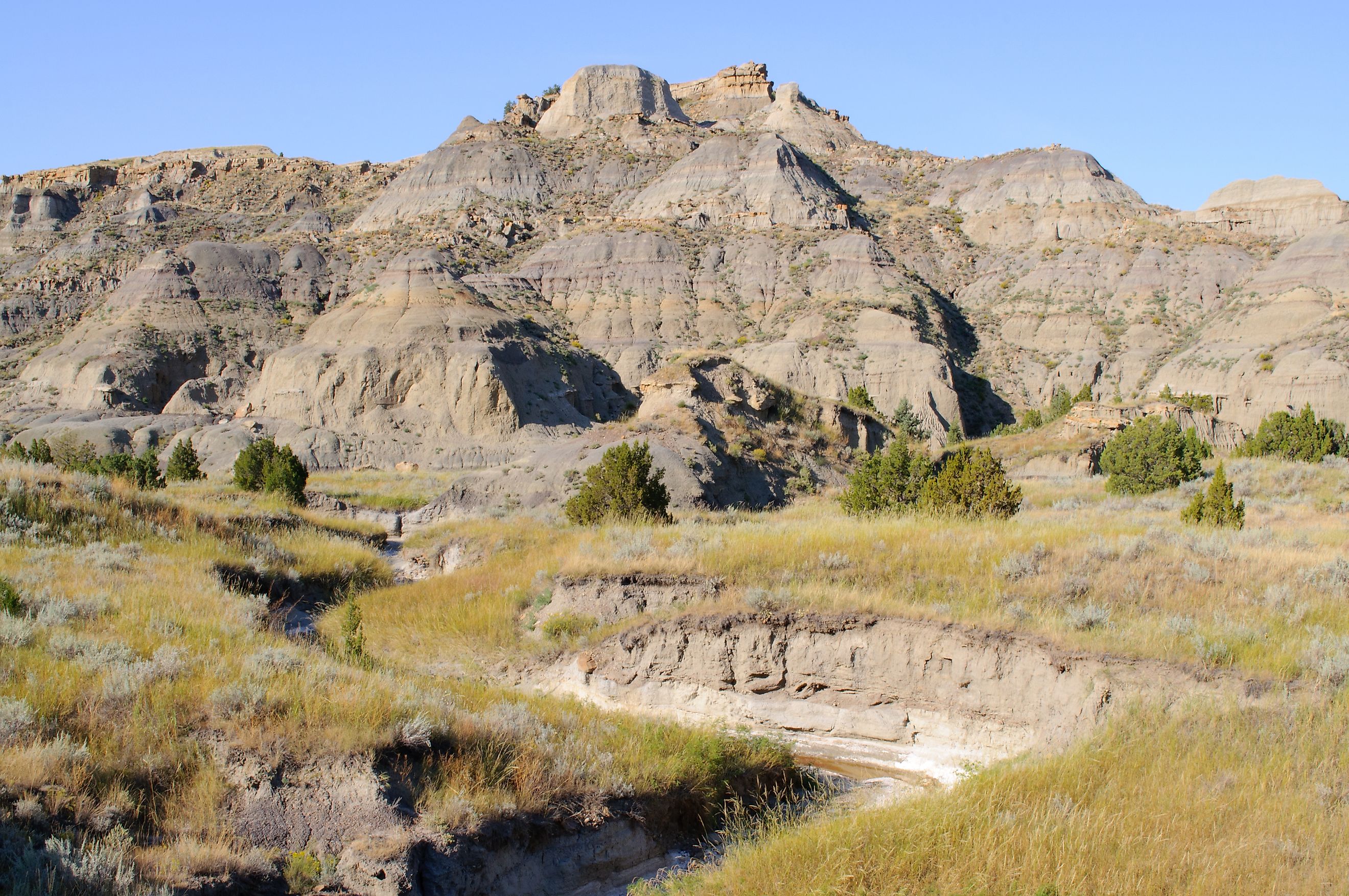
Pressed against the North Dakota border on Montana's far eastern edge, Makoshika sprawls across roughly 11,538 acres, making it comfortably the state's largest state park, with Fish Creek a distant second at around 5,600. The name comes from the Lakota Mako Sica, meaning "bad land" or "land of bad spirits," a nod to terrain that proved miserable for both hunting and farming. It sits in the rugged badlands of the Northern Great Plains, where the geology puts millions of years of Earth's history on open display.
Eroded sedimentary rock, sandstone, siltstone, and shale, carves the park into steep cliffs, spires, and natural arches. These layers date to the late Cretaceous and Paleogene, and they hold the bones to prove it: fossils of Triceratops and Tyrannosaurus rex have both turned up here, part of the famous Hell Creek Formation. Weathered by wind and water, the rock bands range from earthy reds and oranges to soft grays and tans, a running record of the minerals packed beneath your feet.
Deep ravines and plateaus break up the prairie grasslands, and the Yellowstone River runs nearby, shaping the landscape and feeding its wildlife. The climate is semi-arid, so vegetation is sparse, but junipers, cacti, sagebrush, and hardy wildflowers all hang on. Watch for the resident wildlife too: mule deer, bobcats, sage lizards, rattlesnakes, and birds ranging from mountain bluebirds to golden eagles and the turkey vultures the park all but celebrates.
What To Do in Makoshika State Park
Scenic landmarks, trails, campgrounds, and amenities cover the park, and the best part might be who is not there. Crowds are thin at Makoshika in a way you rarely find at Montana's marquee parks. Here is what to prioritize on a visit.
Go Fossil Hunting

Fossils are Makoshika's main event. Erosion keeps surfacing ancient dinosaur bones, and over the decades plenty have been spotted by ordinary visitors simply out for a hike. The state and generations of paleontologists have since marked the richest ground with educational signage, so you can learn what you are looking at. Just as worthwhile is the visitor center, where the collection includes T. rex and Triceratops fossils drawn from the surrounding badlands.
Hiking

The park runs 11 official trails, from short family strolls to tougher routes. The Cap Rock Trail delivers a parade of the park's strangest rock formations, while the Diane Gabriel Trail uses fossil replicas to walk you through the area's prehistoric life. The longest is the Hungry Joe Trail at about 4.6 miles.
Bring more water and sunscreen than you think you need, especially in summer, when rain vanishes and temperatures climb hard. And stay on the designated trails. The park's scientific value and fragile ecosystems mean a single step off-path can crush a priceless fossil or disturb the wildlife that lives here.
Visitor Center

Near the main entrance, the Makoshika State Park Visitor Center doubles as museum and rest stop. Its displays cover the park's natural history and, above all, its outsized place in paleontology. Do not skip the headline pieces: fossils from both a Triceratops and a T. rex. The center also has a gift shop, restrooms, a seating area, and a small parking lot, and it sits right beside the trailhead for several of the park's most popular routes.
Camping

The park holds about 28 campsites spread across several small campgrounds, none more scenic than Cains Coulee near the center of the park. Ringed by colorful cliffs and grassland and set up for tent camping with fire rings, it is the most immersive way to sleep under the stars here. If you need hookups, RV-friendly options wait just outside in Glendive, including Riverview RV Park and Blue Sky RV Park.
Disc Golf

Makoshika is a genuine disc golf destination, with two courses threaded through the badlands. The 9-hole Buccaneer Flats has been ranked the best course in the state by UDisc users, while the 18-hole Ponderosa Pines climbs into rougher terrain above the Cap Rock switchbacks. Both are PDGA-certified, and the views mid-round are hard to beat anywhere in the sport.
Visit Glendive

Glendive sits right on Makoshika's northern edge, the park's closest town and official gateway. The Yellowstone River runs through it, and the town of about 4,800 puts fishing, boating, and sightseeing within easy reach. Downtown is lined with restored early-20th-century buildings now filled with locally owned shops and restaurants.
Two museums are worth your time. The Frontier Gateway Museum traces the region's history from its pioneer days back to its prehistoric past, and the Glendive Dinosaur and Fossil Museum shows off exceptional fossils, many pulled from the ground nearby. Glendive also has those RV parks plus several hotels, most clustered at the north end of town, if you want to stay the night.
Makoshika, the Gem of Eastern Montana
Empty of crowds and full of striking country, Makoshika ranks among the most underrated parks in the United States. Getting to this remote corner takes some effort, and that is exactly the point. The things that go overlooked are often the ones most worth the drive, and eastern Montana is stacked with them, from the lesser-known parks scattered nearby to the small dinosaur-country towns that anchor them.