The Best State Parks For Fall Color
Fall calls for donning thick sweaters, sipping hot chocolate, and walking through forests full of bright leaves. Route 108 twists through Smugglers’ Notch while the Genesee River drops past Letchworth’s three major falls. Lake of the Clouds reflects the Porcupine Mountains, and Fall Creek Falls plunges 256 feet through the Cumberland Plateau. Yellow Rock overlooks the Boston Mountains while the Mississippi begins at Itasca. Across these US state parks, autumn comes with gorges, waterfalls, and overlooks worth framing.
Smugglers' Notch State Park, Vermont

Smugglers' Notch State Park lies in a steep mountain pass near Mount Mansfield, where elevation and local conditions can produce earlier color than in the lower surrounding valleys. The forest canopy is dominated by sugar maple, American beech, and yellow birch, species that produce the reds, oranges, and golds characteristic of New England.
The 3.5-mile scenic section of Route 108 winds through the notch, but it is extremely narrow and seasonal; oversized vehicles and long tractor-trailer combinations are prohibited, and visitors should park only in designated areas. While the road closes to vehicles in winter, it remains open during peak foliage season, typically late September to early October.
The park maintains several short hiking trails. The 1.1-mile Sterling Pond Trail climbs roughly 1,000 feet to a high-elevation pond surrounded largely by spruce and fir.
Letchworth State Park, New York

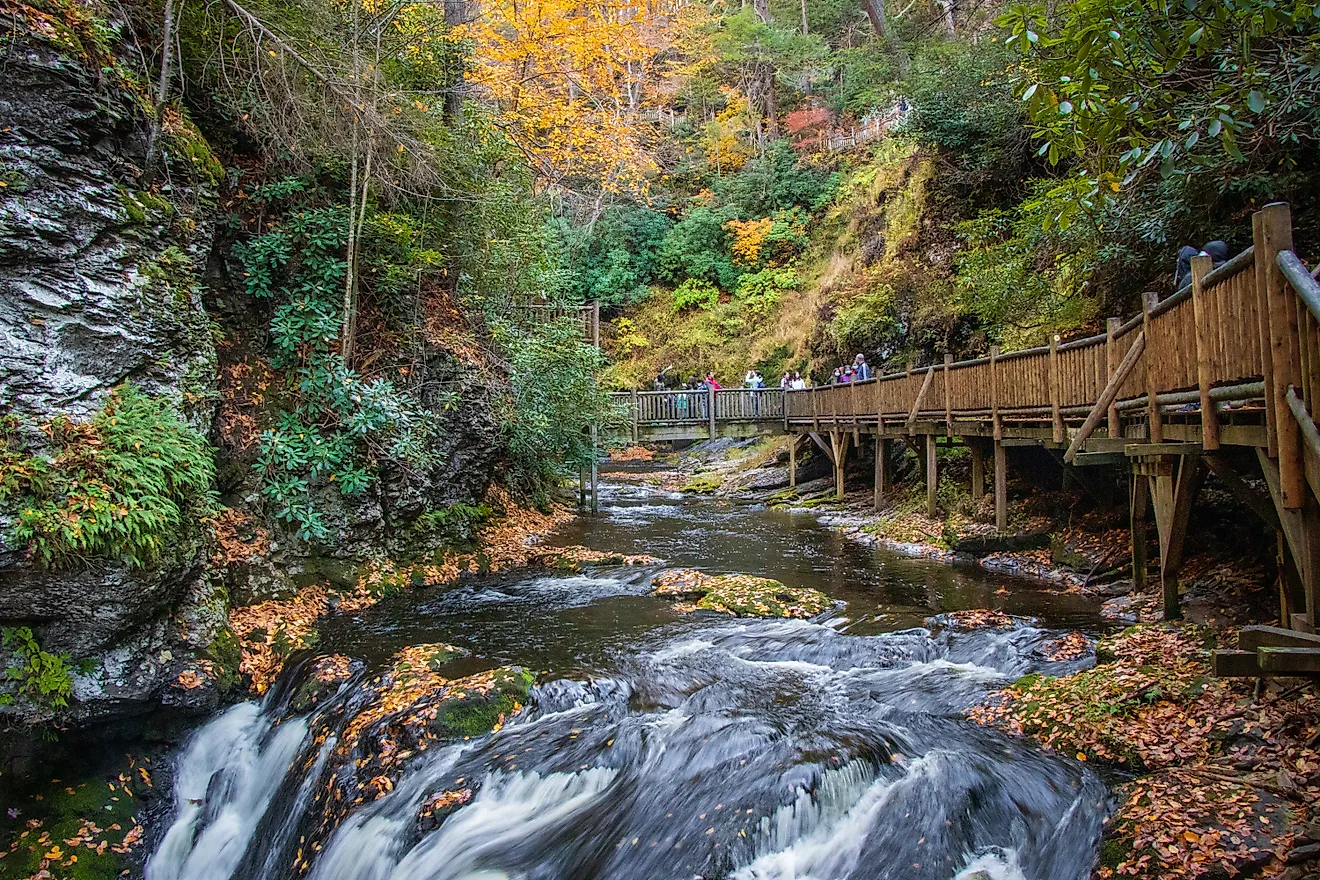
Known as the "Grand Canyon of the East," Letchworth State Park features the Genesee River carving a 17-mile gorge with cliffs rising up to 600 feet. The park encompasses over 14,000 acres of forested land where the mix of deciduous and coniferous trees creates a textured landscape of gold, red, and green. The dominant species include red oak, sugar maple, and black cherry, which turn brilliant shades of rust and scarlet by early to mid-October. The park's layout offers three distinct vantage points: the Upper, Middle, and Lower Falls overlooks, each providing a vertical perspective of the river winding through the colored canopy.
The seven-mile linear Gorge Trail follows the western side of the gorge, linking numerous overlooks and the major falls area, while several separate trails descend toward the river. The Highbanks Trail spans approximately five miles along the northern rim, allowing hikers to appreciate the forest canopy at eye level. The park's elevation ranges from 650 feet at the river to 1,200 feet on the rim, extending the viewing window, with lower elevations peaking later in the season. The presence of hemlock and white pine provides an evergreen contrast that accentuates the brightness of the deciduous foliage.
Shenandoah River State Park, Virginia

Located in the Shenandoah Valley along the South Fork of the Shenandoah River, the park offers views toward Massanutten Mountain and the Blue Ridge. The forest composition is typical of the Appalachian hardwood zone, featuring hickory, oak, and tulip poplar, which transition to gold and bronze hues in mid-to-late October.
Visitors can reach Cullers Overlook by road or via the half-mile Overlook Trail; the separate Cullers Trail can be combined with the River Trail and other paths to create longer loops.
Differences in slope exposure, moisture, and temperature can contribute to localized variation in the timing and intensity of fall color. Cullers Overlook provides a panoramic vantage point where the layered ridges of the Massanutten display a gradient of autumn tones.
Porcupine Mountains Wilderness State Park, Michigan

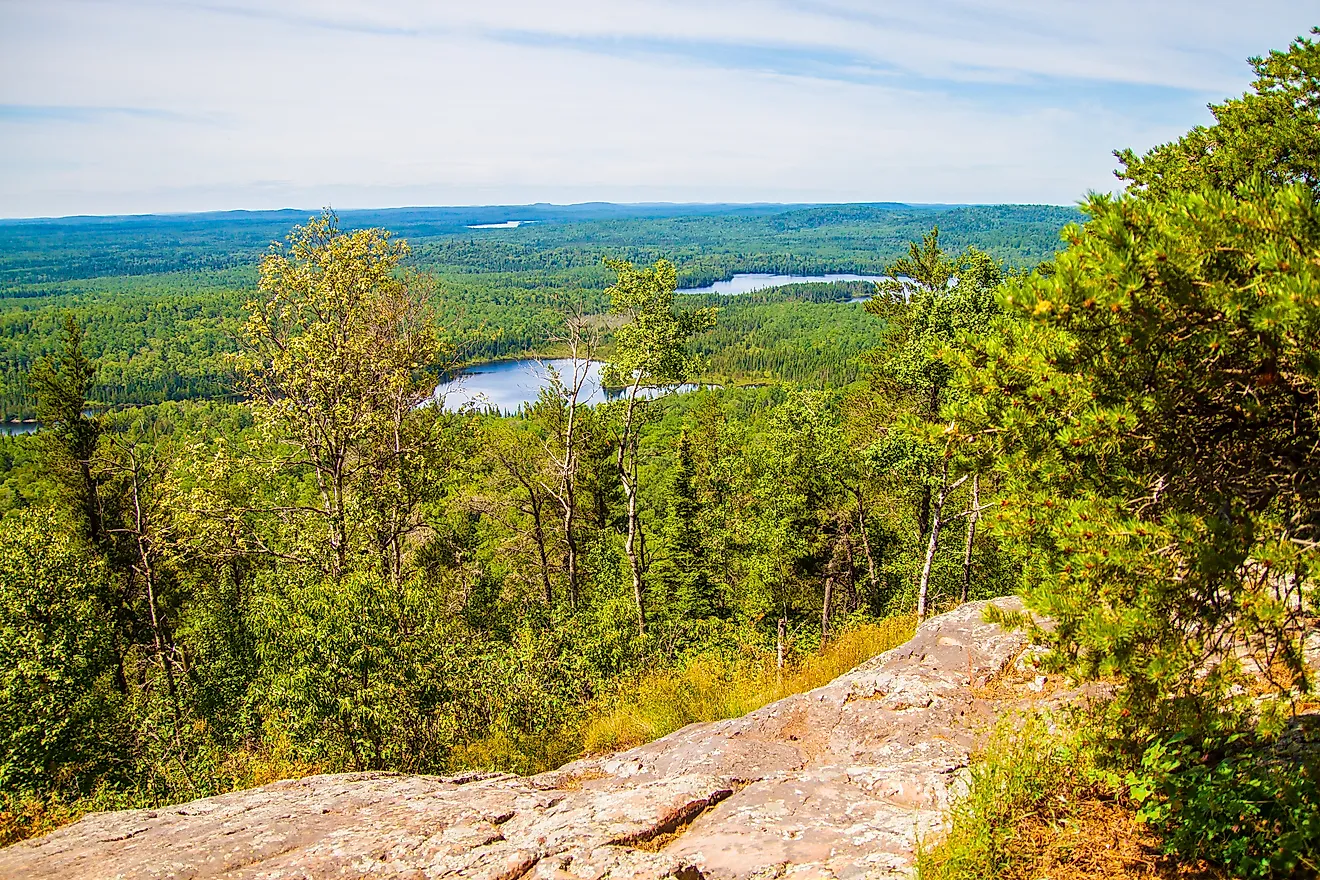
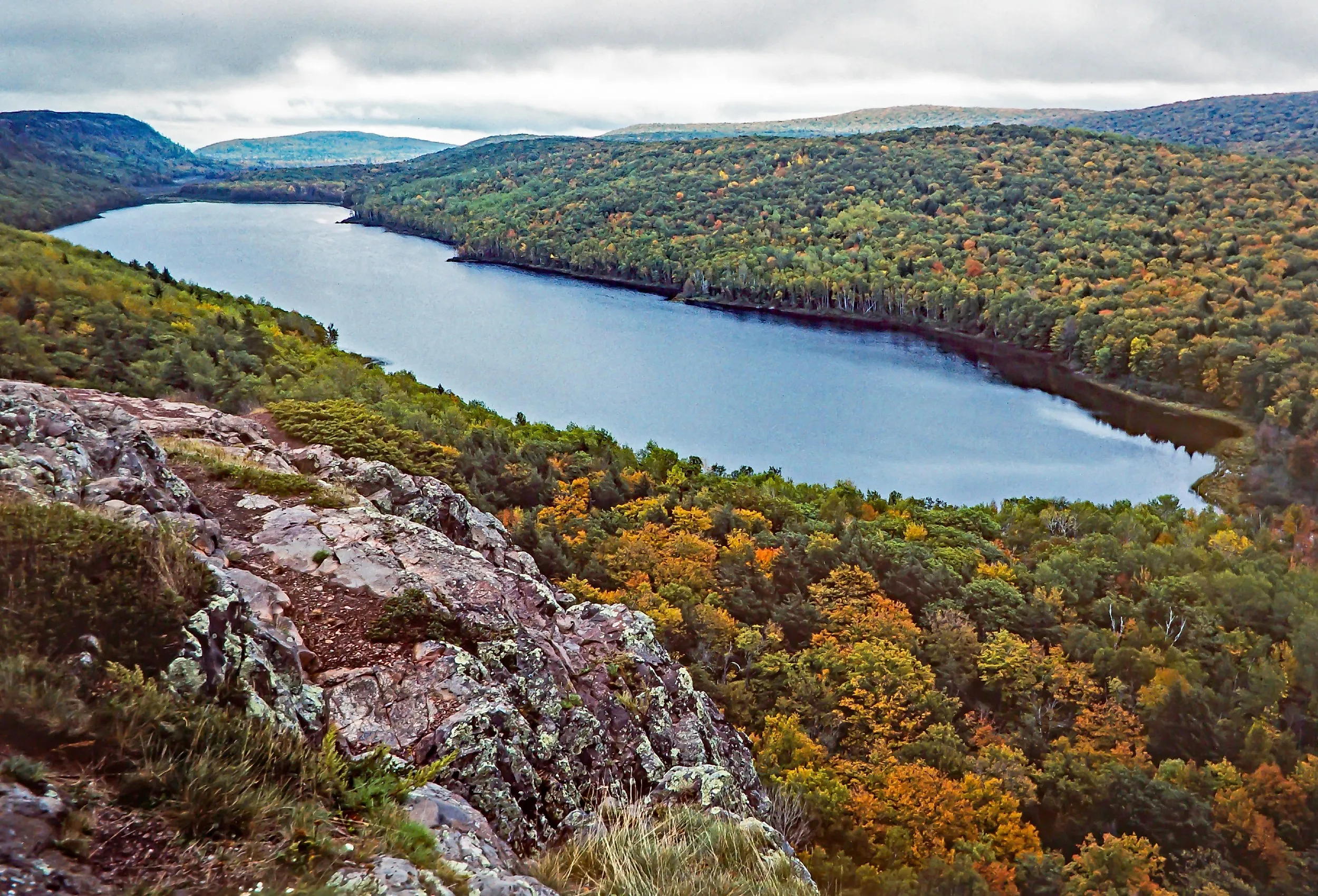
Porcupine Mountains Wilderness State Park, covering 60,000 acres in Michigan's Upper Peninsula, contains one of the largest remaining old-growth hardwood forests in the Midwest. The landscape is defined by the Presque Isle River and Lake Superior shoreline, with elevations reaching 1,958 feet at Summit Peak. The forest is a dense mix of sugar maple, yellow birch, and hemlock, where the maples turn a fiery orange-red, and the birches add a bright yellow contrast from late September to early October.
The park features the Lake of the Clouds overlook, a vista point where a two-mile stretch of water is framed by rolling hills of solid color. The 4.3-mile Escarpment Trail follows the ridge between Lake of the Clouds and the Government Peak trailhead.
Lake Superior moderates temperatures near the shoreline, so color timing can differ between lakeside areas and the park's inland ridges. Lake-effect snow can occasionally dust the colored leaves with white, creating a unique visual juxtaposition. The sheer density of the old-growth stand ensures an unbroken sea of color visible from multiple high-elevation vantage points.
Fall Creek Falls State Park, Tennessee

Fall Creek Falls State Park spans 29,800 acres on the Cumberland Plateau, featuring a landscape of deep gorges and waterfalls framed by deciduous forests. The elevation averages about 1,700 feet, placing the peak color window in late October to early November.
The forest composition includes northern red oak, hickory, and black gum, which produce deep burgundy and purple tones, mixed with the gold of hickory and tulip poplar. The park's namesake waterfall, dropping 256 feet, serves as a focal point where the colored canopy frames the white water.
The park has more than 56 miles of hiking trails and overlooks at Fall Creek Falls, Cane Creek Falls, and Piney Falls, but visitors should check current closures: the Piney Falls Trail segment and the Millikan's Overlook Trail remain closed, though the overlook itself is open. Differences in elevation, slope exposure, species, and local weather can create several stages of color within the park.
Devil's Den State Park, Arkansas

Devil's Den State Park protects about 2,200 acres in Lee Creek Valley, deep in the Boston Mountains of northwest Arkansas.
The Boston Mountains support mixed oak-hickory and oak-hickory-pine forests, producing varied reds, russets, and golds with patches of evergreen contrast. The park's signature view is from the Yellow Rock Trail, a three-mile loop that ascends to a sandstone bluff overlook, where the contrast between the orange foliage and the green pine understory is stark. The Lee Creek trails, including the Fossil Flats Trail, wind through the forest floor and along the creek, allowing hikers to walk beneath a tunnel of colored leaves.
The park's geology, featuring large boulder fields and caverns, adds texture to the landscape, with vines on the rocks turning deep red alongside the trees. The sheltered valley often delays the peak slightly compared with the surrounding ridgetops, extending the viewing window into the first week of November.
Itasca State Park, Minnesota

Itasca State Park, the headwaters of the Mississippi River, features more than 32,000 acres of mixed conifer and deciduous forest in north-central Minnesota. Its glacially shaped landscape contains rolling hills and more than 100 lakes.
The forest is a mix of paper birch, quaking aspen, sugar maple, and red oak, which turn brilliant yellow and orange by late September to early October. A popular viewing point is the Headwaters area, where the narrow Mississippi is framed by stands of golden birch. The Wilderness Drive, a 10-mile one-way scenic road, loops through the park's most dense color zones, offering multiple pull-offs for photography.
The 100-foot Aiton Heights Fire Tower provides a 360-degree view of the lake-dotted landscape, revealing the patchwork of colored forests and dark green pine stands. Birch and aspen supply broad areas of yellow, while maple, oak, spruce, and pine create a varied patchwork of orange, red, and green.
Fall Colors at US State Parks
These state parks collectively protect over 150,000 acres of diverse ecosystems, each offering unique displays of fall foliage framed by the parks' respective landscapes. From the sugar maple gorges of Vermont to the golden birch lakes of Minnesota and the crimson Ozark ridges of Arkansas, the visual experience is defined by the interplay of tree species, elevation, and light.
The parks provide scenic drives, trails, and overlooks, although visitors should verify seasonal road and trail conditions before traveling. These dates are only typical windows: day length provides the seasonal cue, while temperature, moisture, drought, and storms can shift peak color and leaf drop from year to year. By preserving these distinct forest types, state parks offer accessible spaces for witnessing the beauty of fall foliage.