How Long Have Humans Been On Earth?
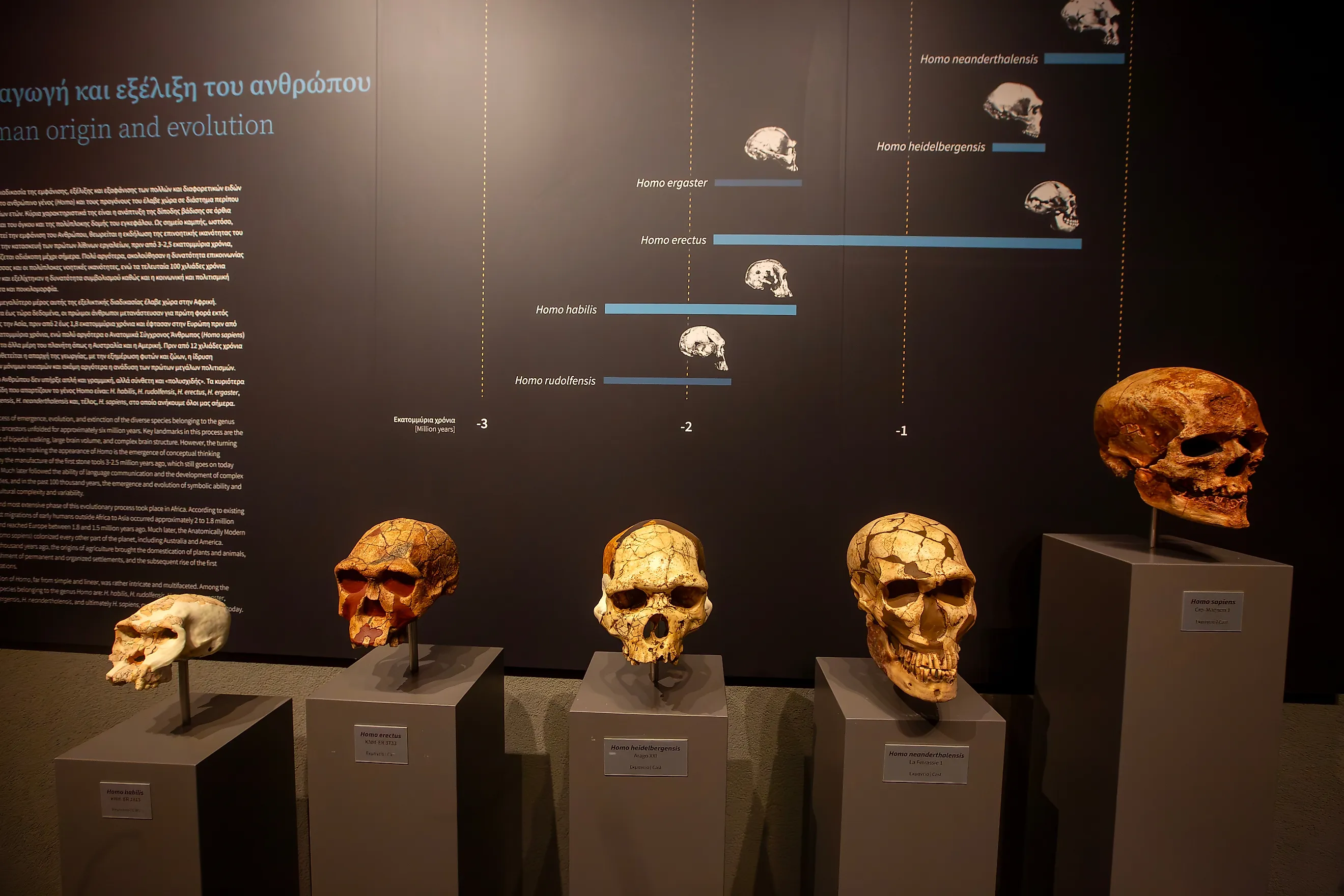
The answer depends on what counts as "human." If the question means our own species, Homo sapiens, the oldest securely dated fossils come from Jebel Irhoud in Morocco at about 315,000 years ago. If it means the genus Homo, which includes our extinct cousins like the Neanderthals and several earlier species, the earliest fossils are about 2.8 million years old. If it means the hominin lineage broadly (the branch of the primate family tree that split from chimpanzees), the oldest candidate fossils are roughly 7 million years old. The narrative below works through each of those layers in order, summarizing what is known and noting where the evidence is contested. The genus and species that walks the planet today, Homo sapiens, is the only surviving lineage of what was once a far more crowded family of upright-walking hominins; about 8.2 billion of us are alive at the time of writing.
The Earliest Hominins (7 To 4 Million Years Ago)
The oldest known candidate hominin is Sahelanthropus tchadensis, identified from a nearly complete cranium (catalog number TM 266-01-060-1, nicknamed "Toumaï") discovered in 2001 at Toros-Menalla in Chad by a team led by French paleoanthropologist Michel Brunet, and dated by cosmogenic nuclide methods to between 7.2 and 6.8 million years ago. The skull combines ape-like features (small braincase, prominent brow ridges) with hints of bipedalism in the position of the foramen magnum (the hole at the base of the skull where the spinal cord enters), though postcranial fossils published in 2022 keep the question of habitual upright walking partly open. Orrorin tugenensis, dated to about 6 million years ago and known from fragmentary remains found in Kenya in 2000, also shows possible bipedal adaptations in its femur.
Ardipithecus is younger and better documented: Ardipithecus kadabba from Ethiopia (about 5.8 to 5.2 million years ago) and the much better-studied Ardipithecus ramidus (4.4 million years ago, also Ethiopia) provide the most detailed picture of an early hominin. The partial skeleton "Ardi" (ARA-VP-6/500), published in 2009 after 15 years of analysis, showed a creature that walked upright on the ground but retained an opposable big toe for climbing. Contrary to a common misconception, Ardipithecus does not appear to have manufactured stone tools; the earliest securely dated stone tools, the Lomekwian assemblage from West Turkana in Kenya, date to 3.3 million years ago and predate the genus Homo.
Australopithecus And Lucy (4.2 To 1.9 Million Years Ago)

The genus Australopithecus ("southern ape") is the best-attested group of early hominins, with at least seven recognized species spanning 4.2 to about 1.9 million years ago across eastern and southern Africa. The most famous specimen is "Lucy" (catalog number AL 288-1, known in Amharic as Dinkʼinesh, "you are marvelous"), a 40-percent-complete skeleton of an adult female Australopithecus afarensis, discovered on November 24, 1974, by paleoanthropologist Donald Johanson at Hadar in the Afar Triangle of Ethiopia. Lucy is dated to about 3.2 million years ago and showed conclusively that bipedalism evolved before brain enlargement: she had a chimp-sized brain (about 375 to 500 cubic centimeters of cranial capacity) but walked upright on humanlike legs. A. afarensis survived for about 900,000 years, roughly three times as long as Homo sapiens has existed so far. Whether Lucy's species was the direct ancestor of the genus Homo is a question that the field has been actively reopening: a December 2025 reanalysis of the so-called Burtele foot, now tied to the contemporary species Australopithecus deyiremeda, suggests at least two australopith lineages walked the same Ethiopian landscape simultaneously, and the line leading to Homo may have come from a different one.
Other members of the genus include Australopithecus anamensis (4.2 to 3.9 million years ago, ancestral to A. afarensis), Australopithecus africanus (3.3 to 2.1 million years ago, southern Africa, including the famous "Taung Child" found by Raymond Dart in 1924), and Australopithecus sediba (about 1.98 million years ago, Malapa Cave in South Africa).
Paranthropus: The Robust Side Branch (2.7 To 1.2 Million Years Ago)
The genus Paranthropus ("beside man") split from the australopith lineage about 2.7 million years ago and represents an evolutionary experiment in extreme dietary specialization rather than the broad, generalized diet sometimes attributed to it. Paranthropus species, especially P. boisei (East Africa) and P. robustus (South Africa), had massive mandibles, premolars and molars covered in thick enamel, and prominent sagittal crests on top of the skull for the attachment of huge chewing muscles, all adaptations for grinding tough plant matter such as nuts, seeds, tubers, and underground storage organs. The 1959 discovery of P. boisei at Olduvai Gorge by Mary Leakey (originally named Zinjanthropus boisei and nicknamed "Nutcracker Man") is the textbook example. The narrow specialization that made these adaptations so dramatic is also the leading hypothesis for the genus's extinction by about 1.2 million years ago: when the East African climate shifted, the food supply Paranthropus had specialized on shrank, while the more generalized Homo lineage adapted by changing diet and using tools.
The First Members Of Genus Homo: Homo Habilis
The genus Homo first appears in the fossil record between roughly 2.8 and 2.3 million years ago. Homo habilis ("handy man") was identified by Louis and Mary Leakey and South African anatomist Phillip Tobias at Olduvai Gorge in Tanzania in 1960, and named in 1964 from fossils dated to about 1.9 to 1.5 million years ago. The species had a slightly larger brain (about 600 to 750 cubic centimeters) than the australopiths, smaller teeth, and a less projecting face. Whether H. habilis truly belongs in genus Homo or should be reclassified as a late australopith is debated by paleoanthropologists; the species sits at the awkward boundary where genus designations break down. H. habilis is most strongly associated with the Oldowan stone tool industry (named for Olduvai Gorge), a technology of simple chipped pebbles and flakes that first appears in the fossil record about 2.6 million years ago, though the relationship is not exclusive: stone tools are also associated with contemporary Paranthropus and possibly late Australopithecus.
Homo Erectus: The Global Colonizers (2 Million To 117,000 Years Ago)

Homo erectus emerged in Africa about 2 million years ago and was the first hominin species to disperse out of Africa, reaching Georgia (the Dmanisi fossils, dated to 1.8 million years ago), China (the Zhoukoudian "Peking Man" fossils), and Java in Indonesia, where the youngest known specimens, the Solo River or Ngandong fossils, were redated in a 2020 Nature paper to approximately 117,000 to 108,000 years ago. (The species therefore survived in Southeast Asia long after Homo sapiens had emerged in Africa.) The species had essentially modern human body proportions: longer legs, shorter arms, and a more efficient bipedal gait than earlier hominins. The most complete H. erectus skeleton, the "Turkana Boy" (catalog number KNM-WT 15000), was discovered in 1984 on the western shore of Lake Turkana in Kenya by Kamoya Kimeu, a member of Richard Leakey's research team, and dates to about 1.6 million years ago. Homo erectus is associated with the Acheulean stone tool industry (the symmetrical teardrop-shaped hand axes that succeeded the Oldowan around 1.76 million years ago) and the earliest secure evidence of habitual fire use, dated to at least 790,000 years ago at the site of Gesher Benot Ya'aqov in Israel.
Other Homo Species
Between Homo erectus and modern Homo sapiens, the hominin family tree was crowded. Homo heidelbergensis (roughly 700,000 to 200,000 years ago, present in Africa and Europe) is the most widely accepted candidate for the common ancestor of both modern humans and Neanderthals. Homo neanderthalensis, the Neanderthals, evolved in Europe and western Asia from about 400,000 years ago and went extinct as a distinct population around 40,000 years ago; they had larger brains on average than modern humans (about 1,500 cubic centimeters versus 1,350 for modern H. sapiens), and modern humans of non-African ancestry carry about 1 to 4 percent Neanderthal DNA from interbreeding events approximately 50,000 to 60,000 years ago.
Denisovans, a sister population to the Neanderthals, were identified in 2010 from a finger bone and tooth found in Denisova Cave in the Altai Mountains of Siberia. Almost everything known about them comes from ancient DNA rather than fossils (only a few teeth, a finger bone, a partial skull, and a jaw from Tibet have been confidently assigned to the group), but Denisovan DNA persists in modern populations of Melanesia, Australia, and the Philippines, with the Ayta Magbukon of the Philippines carrying the highest fraction (about 5 percent of their genome). Homo naledi was discovered in 2013 in the Rising Star Cave system in South Africa, with at least 1,500 fossil fragments recovered from a single chamber; the species has a mosaic of primitive and modern features and was dated in 2017 to between roughly 335,000 and 236,000 years ago, meaning it overlapped in time with early Homo sapiens. Homo floresiensis, nicknamed "the Hobbit," lived on the Indonesian island of Flores until about 50,000 years ago (per the 2016 dating revision), stood about 1.1 meters tall, and may have evolved from an isolated H. erectus population through insular dwarfism.
Homo Sapiens (315,000 Years Ago To The Present)
The oldest securely dated fossils of Homo sapiens were redated in 2017 by a team led by Jean-Jacques Hublin of the Max Planck Institute for Evolutionary Anthropology, working at the Jebel Irhoud site in Morocco. The fossils, originally found by miners in 1961 and long thought to be late Neanderthals around 40,000 years old, were redated using thermoluminescence to 315,000 years ago (plus or minus 34,000 years). The discovery pushed the appearance of our species back by 100,000 years and shifted the geographic center of H. sapiens origins away from East Africa (long assumed to be the cradle on the basis of the Omo Kibish fossils from Ethiopia, 195,000 years old) toward a pan-African evolutionary process. The 2017 paper's interpretation is that H. sapiens evolved across the African continent simultaneously from multiple regional populations of a more archaic ancestor (most likely H. heidelbergensis or a closely related species), rather than from a single eastern source.
The major dispersal of Homo sapiens out of Africa is dated by genetic and fossil evidence to roughly 60,000 to 70,000 years ago, though there is evidence of earlier waves that did not contribute substantially to the modern non-African gene pool (the Misliya Cave maxilla in Israel is dated to about 177,000 years ago; the Apidima Cave fossil in Greece may be as old as 210,000 years). Modern humans reached Australia about 65,000 years ago (the Madjedbebe site in northern Australia), Europe by about 45,000 years ago (replacing or absorbing the resident Neanderthals), the Americas by at least 16,000 years ago (the White Sands footprints in New Mexico push the date possibly as far back as 23,000 years ago), and Polynesia in the final wave between roughly 1,000 BCE and 1,300 CE.
What All Of This Adds Up To
The hominin family tree is not a ladder leading inevitably to modern humans. It is a bush of dozens of species, most of which went extinct, and the current uniqueness of Homo sapiens as the only surviving hominin lineage is historically anomalous: for most of the last 6 million years, at least two and often three or four hominin species lived simultaneously somewhere on the planet. The last hominin species other than ours to go extinct, the Neanderthals (40,000 years ago) and the Denisovans (probably around the same time), did so within a window that overlaps with the emergence of cave painting, behaviorally modern symbolic culture, and the spread of Homo sapiens across Eurasia. Whether modern humans actively replaced the other hominin populations, absorbed them through interbreeding, or some combination of both, remains an open question. The current global population of Homo sapiens is approximately 8.2 billion (2025 estimate), about 2 million times the number of Neanderthals at the species' peak.