Famous Dance Forms From Around The World
In April 1603, a Shinto priestess named Izumo no Okuni led an all-female troupe in a new kind of stylised dance-drama on the dry bed of the Kamo River in Kyoto. Within a year the form had a name: kabuki. Four centuries later, kabuki is recognised by UNESCO as a Masterpiece of the Oral and Intangible Heritage of Humanity, and the troupes performing it have travelled the world. The same kind of trajectory (invented in one place, refined over generations, exported globally) has produced most of the dance forms below. The ten styles covered here all started in specific local traditions and now have national companies, dedicated festivals, training schools, and devoted communities outside their countries of origin. They are listed alphabetically; the order does not imply ranking.
Ballet

Ballet originated in the courts of Renaissance Italy in the 15th century and was formalised in France under Louis XIV, who founded the Académie Royale de Danse in Paris in 1661 and codified the five basic positions of the feet through his ballet master Pierre Beauchamp. Catherine de' Medici, an Italian noblewoman married to Henry II of France, is often credited with bringing the form to the French court from Italy in the mid-16th century. The form moved to Russia under Peter the Great's modernisation programme in the early 18th century, where it acquired the technical and dramatic refinement now associated with the "Russian ballet."
The defining Russian period ran from 1862 to 1903 under the French-born choreographer Marius Petipa at the Mariinsky Theatre in St Petersburg, who created the choreography for Swan Lake (with Lev Ivanov), The Sleeping Beauty, and The Nutcracker. Sergei Diaghilev's Ballets Russes, based in Paris from 1909 to 1929, brought Russian ballet to Western European audiences and commissioned scores from Igor Stravinsky, Claude Debussy, and Maurice Ravel. Today the Mariinsky, Bolshoi (Moscow), Royal Ballet (London), American Ballet Theatre, and Paris Opera Ballet are among the leading classical companies in the world.
Belly Dance

Belly dance, known in Arabic as raqs sharqi (literally "eastern dance"), developed in North Africa and the eastern Mediterranean as a folk form, with regional traditions in Egypt, Lebanon, Turkey, and the Maghreb. The dance emphasises isolated movements of the torso, hips, and abdomen, with arms and footwork generally serving as supporting elements. Egyptian belly dance (raqs sharqi as performed in Cairo) was professionalised through cabaret performance in the early 20th century, with dancers such as Tahia Carioca and Samia Gamal becoming national celebrities through Egyptian cinema in the 1940s and 1950s.
Western-developed offshoots include American Tribal Style (ATS), created by Carolena Nericcio-Bohlman in San Francisco in the 1980s, which uses group improvisation with a shared movement vocabulary. The form is now taught in dance studios worldwide, with substantial communities in the US, Western Europe, Russia, Japan, and Australia. Egyptian-government licensing requirements for professional belly dancers in Cairo, in place at various points in the 20th and early 21st centuries, have made foreign professional dancers a notable part of the modern Egyptian scene.
Bhangra

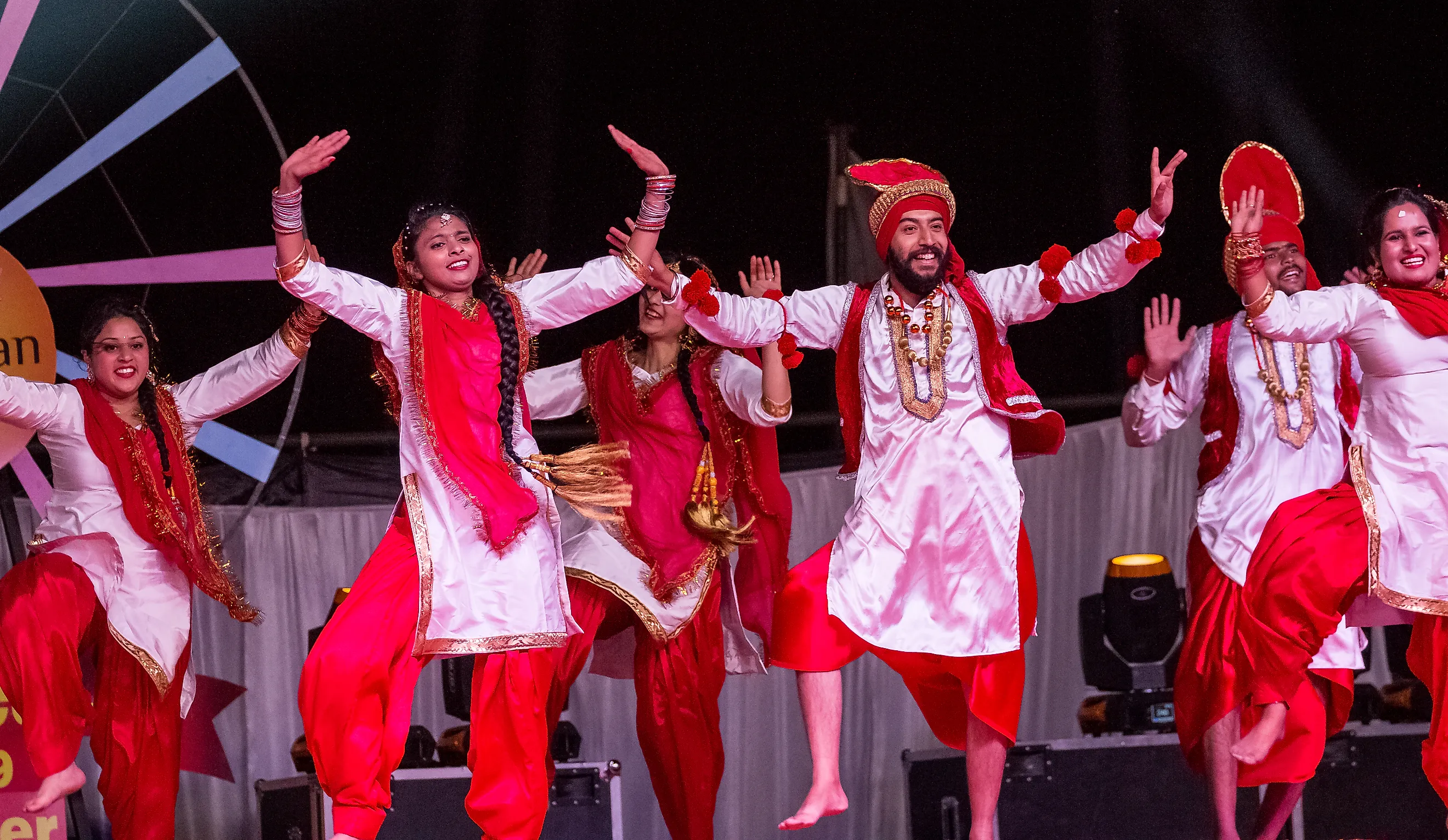
Bhangra originated in the Punjab region (now divided between India and Pakistan) as a folk dance tied to Vaisakhi, the spring harvest celebration. The traditional form is performed by male dancers in a circle around a dhol drummer, with characteristic energetic shoulder, arm, and leg movements. The form was a regional Punjabi tradition for centuries before gaining national visibility in India after Partition in 1947, when Punjabi cultural revival became a unifying cause for displaced communities.
The modern globalised form of bhangra dates to the 1970s, when first- and second-generation Punjabi immigrants in the United Kingdom began fusing the traditional drumming and dance with Western pop, hip-hop, and electronic music. Producers such as Channi Singh, Bally Sagoo, and the Birmingham-based group Apache Indian shaped the modern bhangra sound. The result became one of the most successful diaspora-driven dance music genres in the world, performed at weddings, festivals, and competitive bhangra events in London, Toronto, Vancouver, and other major diaspora cities. Indian films, including many produced in the Bollywood industry, regularly feature bhangra sequences.
Bollywood Dance

Bollywood dance is the choreographic tradition of the Hindi-language film industry based in Mumbai, which produces more than 1,500 feature films per year and is the largest single film industry by output in the world. Bollywood dance is not a single style but a continuously evolving fusion of Indian classical traditions (kathak, bharatanatyam, kuchipudi), Indian folk forms (bhangra, garba, lavani), and Western styles ranging from jazz and hip-hop to contemporary and salsa. Numbers are typically choreographed around the song-and-dance "item" sequences that punctuate most commercial Hindi films.
Defining choreographers include Saroj Khan (1948-2020), who worked on more than 2,000 song sequences across a five-decade career and won three National Film Awards; Farah Khan, who choreographed and later directed several major commercial films; and Prabhu Deva, whose dance training and choreography helped popularise more athletic Bollywood styles in the late 1990s and 2000s. Bollywood dance studios now operate in cities worldwide, particularly in the UK, Canada, Australia, the United States, and parts of the Middle East, where they teach a simplified accessible version of the cinematic form.
Breaking (Break Dance)

Breaking, also called b-boying or b-girling, originated in the South Bronx in the early 1970s among African American and Puerto Rican youth. The form is generally traced to DJ Kool Herc's August 1973 back-to-school party at 1520 Sedgwick Avenue, where Herc began extending the percussion "break" sections of funk and soul records by mixing between two copies of the same album; the extended breaks gave dancers room for floor-based improvisation. The Rock Steady Crew (founded in the Bronx in 1977) and the New York City Breakers helped codify the form in the late 1970s.
The four foundational movement categories are toprock (upright dancing), downrock (footwork on the floor), power moves (athletic spinning movements such as windmills and headspins), and freezes (held positions). Breaking made its Olympic debut at the Paris 2024 Summer Olympics under the name "Breaking," with separate b-boy and b-girl events. The Japanese b-girl Ami Yuasa (competing as B-Girl Ami) won the inaugural women's gold medal; the Canadian b-boy Phil Wizard won the men's. Breaking will not appear at the Los Angeles 2028 Olympics but is expected back in future Games.
Flamenco

Flamenco developed in the Andalusian region of southern Spain in the late 18th and 19th centuries, with roots in the music and dance traditions of the Andalusian Romani (Gitano) community, intermixed with Moorish, Sephardic Jewish, and broader Iberian folk influences. The form has three integrated pillars: el cante (the singing), el toque (the guitar playing), and el baile (the dance). Performances are typically accompanied by palmas (rhythmic handclapping) and pitos (finger-snapping), with jaleo (verbal encouragement and exclamations) from supporting performers.
Flamenco was inscribed on UNESCO's Representative List of the Intangible Cultural Heritage of Humanity in 2010. The Seville-based Bienal de Flamenco festival, held every two years since 1980, is the form's largest international event. Japan has the largest flamenco scene outside Spain. The country has more registered flamenco schools than Spain itself, a phenomenon dating to a 1929 tour by Spanish dancer La Argentinita that captivated Tokyo audiences and seeded a community that has grown across four generations.
Kabuki

Kabuki is a form of stylised classical Japanese dance-drama, traditionally combining song, mime, and elaborately costumed and made-up dance. The earliest documented performance was given in 1603 by Izumo no Okuni and her all-female troupe on the dry bed of the Kamo River in Kyoto. The Tokugawa shogunate banned female performers in 1629 to suppress the prostitution that had grown up around the early kabuki scene; the form became all-male, with male actors specialising as onnagata (female-role performers), a tradition that continues today.
Kabuki's defining visual element is kumadori, the bold red-and-white or red-and-black makeup applied to characters of high status, supernatural beings, or villains. The Kabuki-za theatre in Tokyo's Ginza district, opened in 1889 and rebuilt several times most recently in 2013, is the principal modern venue, with daily performances and afternoon-only matinee programmes for tourists. Kabuki was inscribed on UNESCO's Representative List of Intangible Cultural Heritage in 2008 (originally proclaimed as a Masterpiece in 2005).
Salsa

Salsa is a partner dance and music genre that developed in New York City in the 1960s and early 1970s through the fusion of Cuban son montuno, mambo, cha-cha-cha, and Puerto Rican plena and bomba, in the Latino communities of East Harlem and the Bronx. The label "salsa" emerged as a marketing term used by Fania Records, the New York-based label founded by Jerry Masucci and Johnny Pacheco in 1964, which became the dominant force in Latin music through the 1970s with artists including Hector Lavoe, Willie Colon, Ruben Blades, and Celia Cruz.
Several regional salsa dance styles have developed. "New York style" or "on2" dances on the second beat of the measure and emphasises smooth slot-based movement. "LA style" or "on1" dances on the first beat with showier turn patterns. "Cuban style" or casino dances in a circular pattern and forms the basis of the rueda de casino group format. The form is taught and performed worldwide, with major annual congresses and dance festivals in cities including New York, Los Angeles, Miami, Havana, Cali (Colombia), Tokyo, and London.
Samba

Samba developed in Brazil from West African dance and percussion traditions brought to the country by enslaved Africans, principally in the state of Bahia. The earliest form, samba de roda, is a circle dance accompanied by percussion and singing that originated in the Recôncavo region of Bahia in the 19th century. Urban samba, the style now most associated with Rio Carnival, developed in Rio de Janeiro in the first decades of the 20th century, particularly in the working-class neighbourhoods around the city centre and the Praça Onze district.
The first samba school (escola de samba), Deixa Falar, was founded in Rio in 1928. The school structure now anchors the city's Carnival: roughly 70 samba schools across Rio operate year-round and present elaborate themed parades along the Sambódromo (a purpose-built parade venue designed by Oscar Niemeyer and opened in 1984) during the Carnival period each February or March. Samba de Roda was inscribed on UNESCO's Intangible Cultural Heritage list in 2005. The form is taught and performed in many cities outside Brazil, particularly in Western Europe, Japan, and the Americas.
Tango

Tango originated in the working-class neighbourhoods of Buenos Aires and Montevideo along the Río de la Plata in the 1880s, drawing on European, African, and creole musical and dance traditions brought together by the wave of late-19th-century immigration to the region. The early form was associated with the port-side bars and brothels of both cities. By the 1910s it had crossed into respectable society in Paris and London, was being danced in upper-class salons, and was about to begin a sustained commercial period that runs roughly from the 1920s through the 1950s.
The defining figure of the music's "golden age" was Carlos Gardel (1890-1935), the French-born Argentine singer whose recordings and films through the 1920s and early 1930s defined the popular sound of tango. The dance's "golden age" (1935 to 1955) saw the great Buenos Aires orquesta típicas of Juan D'Arienzo, Carlos Di Sarli, Aníbal Troilo, and Osvaldo Pugliese. Astor Piazzolla's nuevo tango of the 1960s onwards extended the music into concert hall and jazz territory. Tango and the music of tango were inscribed jointly by Argentina and Uruguay on UNESCO's Intangible Cultural Heritage list in 2009.
What These Dances Have in Common
None of these ten forms is a single static tradition. Each has a recognised core technical vocabulary, a recognised place of origin, and a network of teachers, performers, and audiences that has carried the form outside that place of origin and updated it in successive generations. Six of the ten (kabuki, flamenco, samba, tango, and breaking) appear on UNESCO's Intangible Cultural Heritage list or its predecessor Masterpiece list. Several (ballet, breaking, bhangra, salsa) sustain elite competitive circuits with formal judging criteria. All ten continue to be taught, performed, and choreographed today by working professionals, and the global communities around each remain large enough to support specialised media, festival circuits, and full-time teaching careers.