The Oldest Cable Car Still Running In America
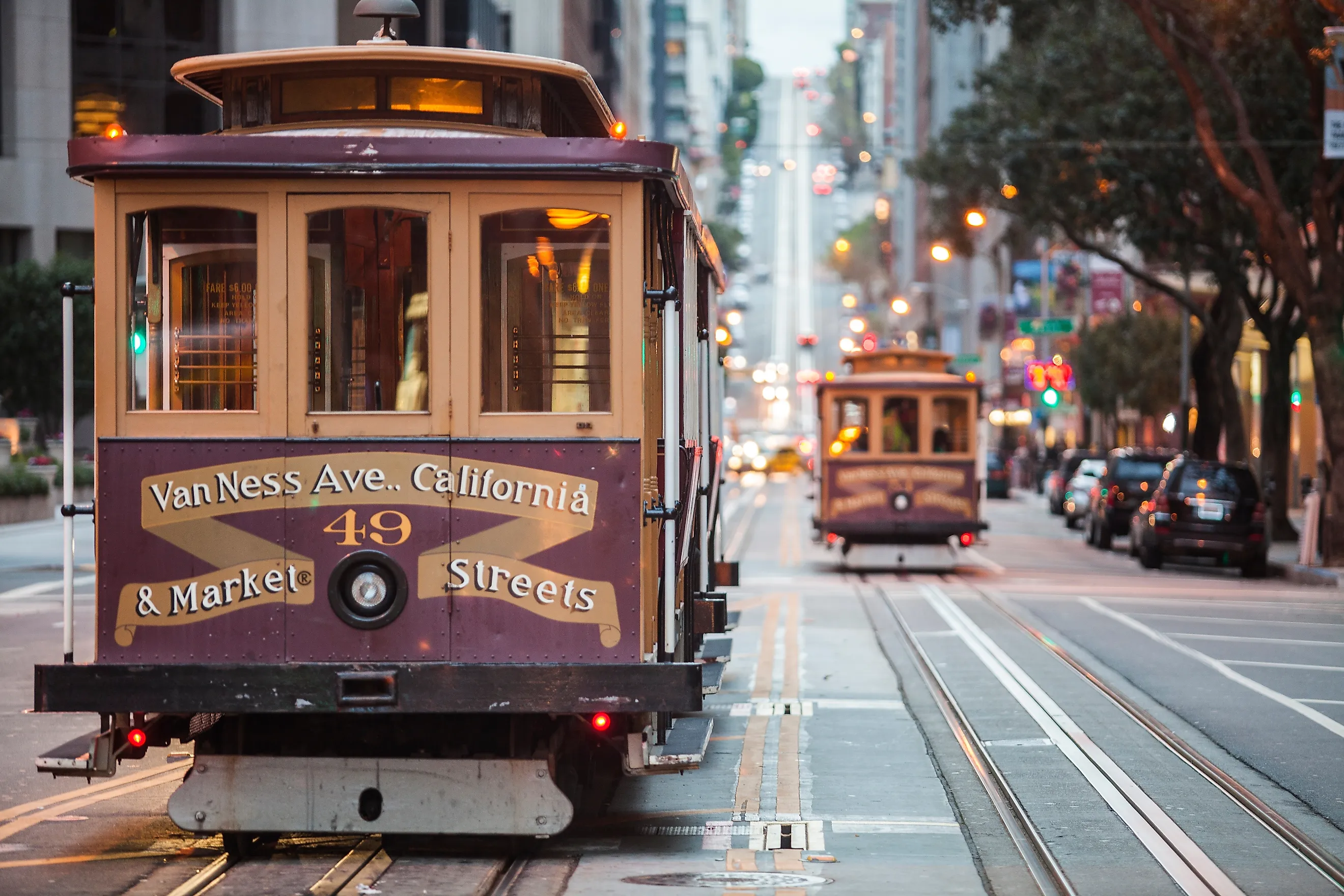
America’s oldest operating cable car is the California Street Line of the San Francisco cable car system. The cable car has been running along a city street corridor up and down Nob Hill since April 10, 1878. The historic transit route is a street-running segment of the city’s public transit system and carries thousands of people daily across 1.4 miles.
The California Line Cable Car Stands Out

A traditional street cable car grips a continuously moving steel cable running beneath the street and can release that cable as needed. Funiculars operate differently. Their cars remain attached to a haulage cable and generally travel on a dedicated inclined right-of-way. Pittsburgh’s Monongahela Incline is an example of a funicular. It opened on May 28, 1870, eight years before the California Street Line, and Pittsburgh Regional Transit identifies it as the oldest continuously operating funicular railway in the United States.
Andrew Hallidie’s Clay Street Hill Railroad opened in San Francisco in 1873. Unfortunately, the Sacramento-Clay Street route was altered and truncated several times. In 1906, the route was destroyed during the Great San Francisco Earthquake and subsequent fire. The open cable car was rebuilt after the earthquake into a double-end cable car setup and operated from 1907 to 1942. In 2019, the cable car resumed operations for San Francisco’s Muni Heritage Weekend after 77 years.
The History of the California Line

According to a story repeated by SFMTA, Andrew Hallidie conceived San Francisco’s cable railway after seeing horses struggle on the city’s wet, steep streets in 1869. Hallidie already had experience using wire rope for mining and other industrial applications. He tested his first cable car on Clay Street on August 2, 1873, and the Clay Street Hill Railroad began regular passenger service a month later. It remained San Francisco’s only cable-car company until the Sutter Street Railroad adopted cable technology in 1877.
The California Street Cable Railroad followed in 1878. Former California governor and railroad magnate Leland Stanford, along with Mark Hopkins and other investors, created the company, and service began between Kearny and Fillmore streets on April 10. The line was extended west to Presidio Avenue the following year and eventually east to Market Street. The California Street Line used side-grip technology developed by Asa Hovey and T. Day for Henry Casebolt’s Sutter Street Railroad. The design allowed the operator to control the grip from either direction, eliminating the need for a turntable on double-ended cars. The 1906 earthquake and fire destroyed California Street Cable Railroad cars and damaged the city’s transit infrastructure. The company rebuilt its cable operations, while many other cable routes elsewhere in San Francisco were converted to electric streetcars.
The California Street company remained privately owned longer than San Francisco’s other major transit operators. Financial problems eventually forced it to suspend service on July 31, 1951. The city purchased its assets in January 1952 and resumed service on the California Street Line shortly afterward. After further route changes during the 1950s, San Francisco settled on the three cable-car routes that operate today: California Street, Powell-Mason, and Powell-Hyde.
A Closer Look at Modern Cable Cars

The California Street Cable Line uses one of two types of cable cars found in regular San Francisco service today. The line has twelve larger maroon cars with open seating at both ends and an enclosed section in the middle. Because the cars are double-ended, operators can run them in either direction without turning the entire vehicle around. The two Powell Street lines use smaller, single-ended cars that must be turned around on turntables at the ends of their routes. SFMTA keeps 28 Powell cars on its roster.
Along with the Powell-Hyde and Powell-Mason lines, the California Street Line carries both residents and visitors. Its current route follows California Street between the Market Street area and Van Ness Avenue, passing through the Financial District and over Nob Hill. As of September 2026, the California line operates from 7:00 a.m. to 9:00 p.m. daily. A single cable-car ride costs $9, although SFMTA has approved an increase to $12 beginning in January 2027. Riders can board at marked stops along California Street, with Nob Hill, Chinatown, and the Polk Street area among the neighborhoods accessible along the route.
Why Other Cable Cars Deserve a Spot on the List

Getting back to the other contenders for oldest cable-powered systems, here is how some of the other cable lines compare to the California Street Line. As mentioned, the Monongahela Incline in Pittsburgh, Pennsylvania, opened in 1870 and is the oldest continuously operating cable-driven transit structure in America. John Endres built it to carry coal miners up and down Mount Washington (then known as Coal Hill), climbing 369 feet in elevation along a 635-foot track. But, unlike the California line, the incline relies on counterbalanced passenger cars fixed to opposite ends of a winding steel haulage cable. According to engineering standards, this cable line is classified as an inclined-plane funicular railway rather than a traditional street cable car.
The Powell-Mason Line was opened in 1888 by the Ferries and Cliff House Railway Company. It was designated as Muni Line 29 and is the second-oldest street cable car route still operating in San Francisco. It runs 1.6 miles from the intersection of Powell and Market Streets through Chinatown and North Beach to Taylor and Bay Streets near Fisherman’s Wharf. This line is one of the most famous transit corridors in the world.
Protecting America’s Oldest Cable Car Line

San Francisco nearly lost much of its cable-car system in the 20th century. In 1947, Mayor Roger Lapham supported replacing the city-owned Powell Street cable-car lines with buses. Friedel Klussmann helped organize the Citizens’ Committee to Save the Cable Cars, and voters approved a charter amendment requiring the city to maintain the Powell Street system. The California Street operation was still privately owned at the time and did not become part of Muni until 1952.
Another major interruption came in September 1982, when the entire cable-car system shut down for reconstruction. The larger project cost about $58 million and involved replacing track and cable infrastructure and rebuilding much of the Washington-Mason car barn and powerhouse. The California Street Line returned to service on June 3, 1984, after roughly 20 months without service. The system also stopped operating for 16 months during the COVID-19 pandemic before cable cars began returning to San Francisco streets in August 2021.
Why Cable Cars Are Still Popular
San Francisco’s cable cars survive as both public transportation and working pieces of 19th-century engineering. The cars carry no onboard propulsion motors. Instead, operators use a mechanical grip to attach the car to a moving underground cable powered from the central powerhouse. The California Street Line has changed ownership, lost portions of its original route, and survived several lengthy shutdowns since its first day of service in 1878. Nearly 150 years later, passengers still cross Nob Hill using the same basic cable-traction principle that made San Francisco’s earliest cable railways possible.