The Largest Zoos In the United States
Here is a fun problem: the largest zoo in America is not really a zoo in the way you are picturing. It is a reclaimed strip mine in rural Ohio the size of a small town, where rhinos roam pastures that used to be a coal operation. That is the thing about ranking zoos by size. Once you sort them by sheer acreage, the list stops being a tidy row of petting zoos and turns into a strange spectrum, from open-range safari parks you drive through to a Disney theme park with actual gorillas. These are the ten largest zoos in the United States by land area, biggest first, and they are far weirder than the word "zoo" suggests.
The Wilds, Cumberland, OH

At roughly 9,150 acres, The Wilds is not just the largest zoo in the country, it dwarfs the rest of this list combined. To put it in perspective, the second-place zoo would fit inside it three times over with room to spare. The land was a gift with a backstory: it is reclaimed strip-mine territory donated by a coal company in 1984, transformed into open range where rhinos, giraffes, Przewalski's wild horses, and cheetahs roam pastures rather than pace enclosures. You explore it by safari tour, zipline, or even an overnight stay, which is a sentence you cannot write about most zoos. It is run by the Columbus Zoo, sits two hours from anything, and is essentially the closest thing America has to dropping the African savanna onto Appalachian coal country.
North Carolina Zoo, Asheboro, NC

The North Carolina Zoo holds a title it loves to mention: at about 2,800 acres, it bills itself as the world's largest zoo measured by the land it actually develops for natural-habitat enclosures. That is the whole design philosophy here. Instead of cramming animals into a compact downtown footprint, it spreads them across huge, landscaped habitats meant to mimic the real thing, split into a sprawling Africa region and a North America region. It is also one of only two state-owned zoos in the country (the Minnesota Zoo, further down this list, is the other). Bring comfortable shoes, because seeing it properly means walking what is essentially a small wildlife park.
San Diego Zoo Safari Park, Escondido, CA

Do not confuse this with the famous San Diego Zoo in Balboa Park. That one is the urban 100-acre crowd-pleaser; this is its enormous country cousin about 30 miles northeast, sprawling across roughly 1,800 acres near Escondido. The Safari Park was purpose-built to give big herd animals room to behave like big herd animals, and you tour its open savanna habitats by tram, watching rhinos, giraffes, and antelope mingle across fields rather than stand in pens. It runs one of the most serious conservation operations on Earth, including the "frozen zoo," a cryogenic bank of cells from endangered species, which is exactly as science-fiction as it sounds.
Fossil Rim Wildlife Center, Glen Rose, TX

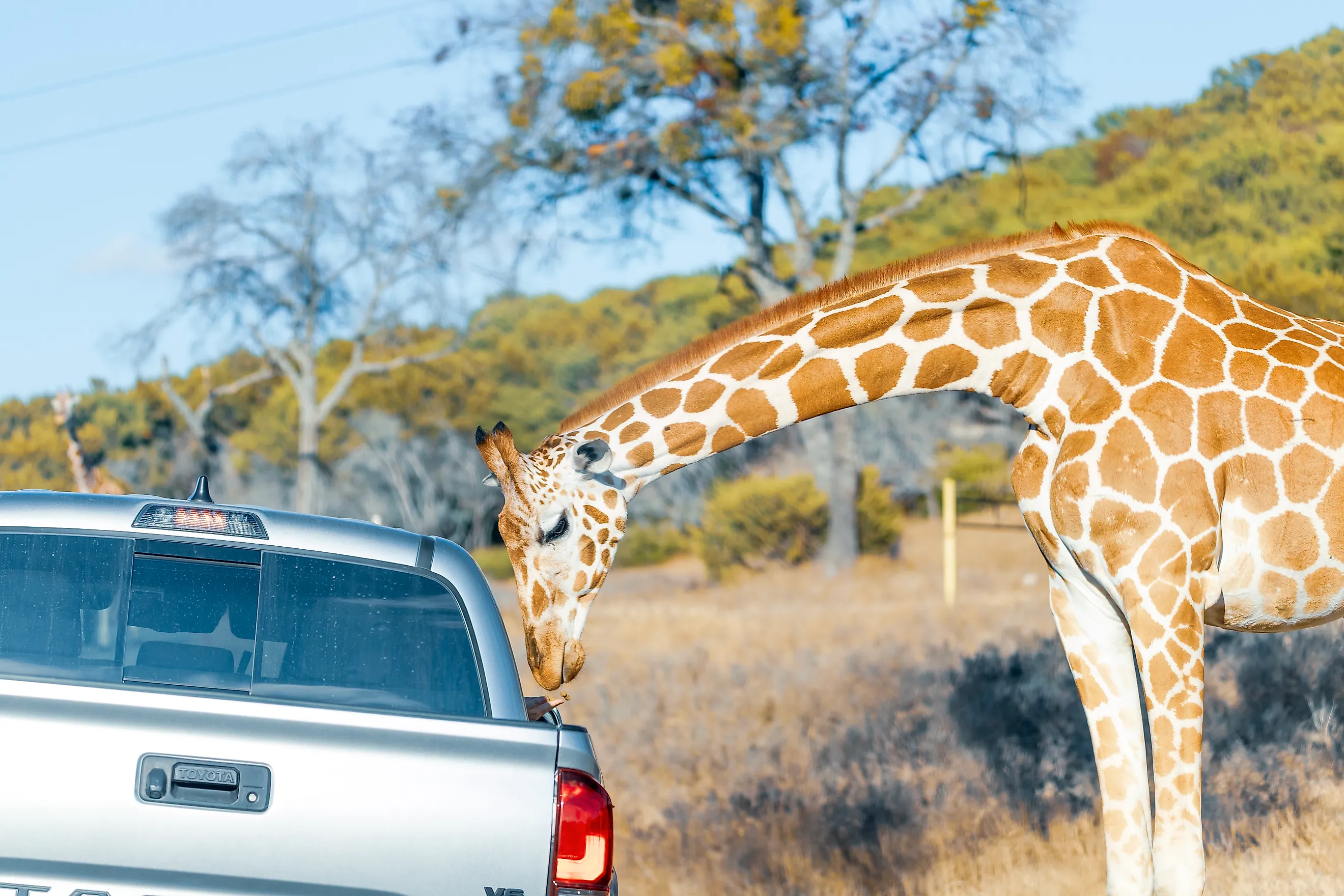
Fossil Rim is where the line between "zoo" and "you are now in the animals' house" basically vanishes. Across roughly 1,800 acres of Texas Hill Country, more than 1,000 animals from about 50 species roam free while you drive through in your own car on a 9-plus-mile route. Roll the window down and a giraffe may lean in to investigate your snacks, which is thrilling or alarming depending on your relationship with giraffes. It started as an exotic-animal ranch in the 1970s and pivoted to serious conservation, becoming an early player in endangered-species breeding programs for cheetahs and the scimitar-horned oryx. It is a zoo only in the sense that a safari is a zoo.
Zoo Miami, Miami, FL

At about 750 acres, Zoo Miami is the largest and oldest zoo in Florida, and it has one genuinely unusual advantage: the climate. Because South Florida is subtropical, the zoo can keep animals from Asia, Africa, and Australia outdoors year-round in conditions close to home, no heated indoor houses required. More than 2,000 animals across roughly 375 species spread along four miles of pathways, grouped by their part of the world. It is a hot, sprawling walk, so the wiser visitors rent a bike or hop the tram and save their energy for the animals rather than the parking lot.
Disney's Animal Kingdom, Lake Buena Vista, FL

Yes, it counts. Disney's Animal Kingdom is an accredited member of the Association of Zoos and Aquariums, which means it is held to the same standards as every other entry here, roller coasters and all. Spanning about 580 acres, it was the largest Disney theme park in the world when it opened in 1998, and it is home to roughly 2,000 animals. The centerpiece is Kilimanjaro Safaris, a genuine open-savanna ride where you bounce past free-roaming lions, elephants, and giraffes between, say, riding a thrill coaster themed to a fictional moon. Where else does conservation-grade animal care share a fence line with Avatar?
Minnesota Zoo, Apple Valley, MN

At roughly 485 acres, the Minnesota Zoo solved a problem most zoos ignore: what do the animals do all winter? Its answer was to lean into cold-climate species, so the Northern Trail features animals like Amur tigers, takin, and wild horses that are perfectly happy when it is well below freezing. It is the country's other state-owned zoo, and its standout feature is the Treetop Trail, a former elevated monorail track converted into the world's longest elevated pedestrian loop, letting you walk above the habitats. Home to thousands of animals across roughly 500 species, it is proof that a zoo in a place with brutal winters can turn the weather into the attraction.
Bronx Zoo, New York, NY

At about 265 acres, the Bronx Zoo is the largest metropolitan zoo in the United States, which is a small miracle given it is sitting inside New York City. Opened in 1899, it packs more than 6,000 animals across roughly 650 species into a footprint that somehow includes wooded river gorges and an Asian monorail. This is the flagship of the Wildlife Conservation Society, an organization whose conservation reach stretches to dozens of countries, so the zoo doubles as the public face of serious global fieldwork. Given the size and the crowds, it is the rare zoo where a map is not optional, and the monorail through Wild Asia is genuinely the smart way to see the far end.
Brookfield Zoo, Brookfield, IL

Brookfield Zoo, just west of Chicago and recently rebranded Brookfield Zoo Chicago, covers about 216 acres and earned its place in zoo history by being ahead of its time. When it opened in 1934, it was one of the first zoos in the country to ditch cages in favor of open, moated enclosures, the barless design that is now standard everywhere. It also built the first fully indoor dolphin exhibit in the U.S. and an early indoor rainforest. With more than 2,000 animals across around 500 species, it is the largest zoo in the Chicago area, and a pioneer that quietly changed what zoos look like.
Kansas City Zoo & Aquarium, Kansas City, MO

Rounding out the list at roughly 200 acres in Kansas City's historic Swope Park, the Kansas City Zoo packs a lot into its footprint, including a recently added aquarium that earned it the longer name. More than 1,700 animals live here, with strong African and Australian sections and a polar bear habitat called Polar Bear Passage. In the fall it transforms after dark for Glow Wild, a lantern festival that turns the grounds into a glowing menagerie of illuminated animal sculptures. It is the smallest zoo on this list and still 200 acres, which tells you everything about the scale of the giants above it.
Big Land, Bigger Mission
Line these ten up and the real takeaway is how little the word "zoo" actually tells you. The biggest is a former coal mine you tour by safari truck; another is a Disney park with a thrill ride next to the giraffes; a third is a Texas drive-through where the animals come to your window. What unites them is not a layout but a job: nearly all of them pour their acreage into conservation, breeding endangered species and giving animals room to act like themselves. The more land a zoo has, the more it can do that, which is why "largest" here is less about bragging rights and more about how much wild a place can actually hold.