The Largest Sinkholes In America
The US Geological Survey has an official answer and it comes with a caveat built into the wording. Alabama, the agency says, claims the largest recent collapse sinkhole in the country: the Golly Hole in Shelby County, which opened suddenly in December 1972 and measures about 325 feet long, 300 feet wide and 120 feet deep. Every qualifier in that sentence is doing work. It is the largest recent one, and it is the largest collapse, which leaves out both the ancient inactive sinkholes that are thousands of years old and the enormous holes opened by industry rather than by rain. Measured purely on area, the Golly Hole is roughly two acres, and a Louisiana sinkhole that appeared in 2012 grew to more than thirty.
Here are the biggest by each measure, and why the official record holder is a fraction of the size of the thing that swallowed a Louisiana bayou.
The Golly Hole, Alabama

The official record holder appeared on a December night in 1972 near Calera in Shelby County, and the account of its arrival has become local legend. Residents described a low rumble that built into something like approaching locomotives, the sound of trees cracking, then a single boom that shook the ground. Nothing looked wrong from the house. Over the treetops, roughly two acres of forest had simply gone.
The name comes from the reaction. When the couple who had heard it finally saw the hole, the wife said "Golly", and it stuck. Time magazine ran it in April 1973 under a better name, the December Giant, which never caught on locally.
Two caveats belong on the measurements. The Alabama Geological Survey gives 325 by 300 feet and 120 feet deep, while contemporary news accounts ran as high as 425 feet across and 200 feet deep, and published depths of 150 feet also circulate. Sources also split between December 2 and December 18 for the date. The site now sits on private land owned by Vulcan Materials and is closed to visitors.
Winter Park, Florida

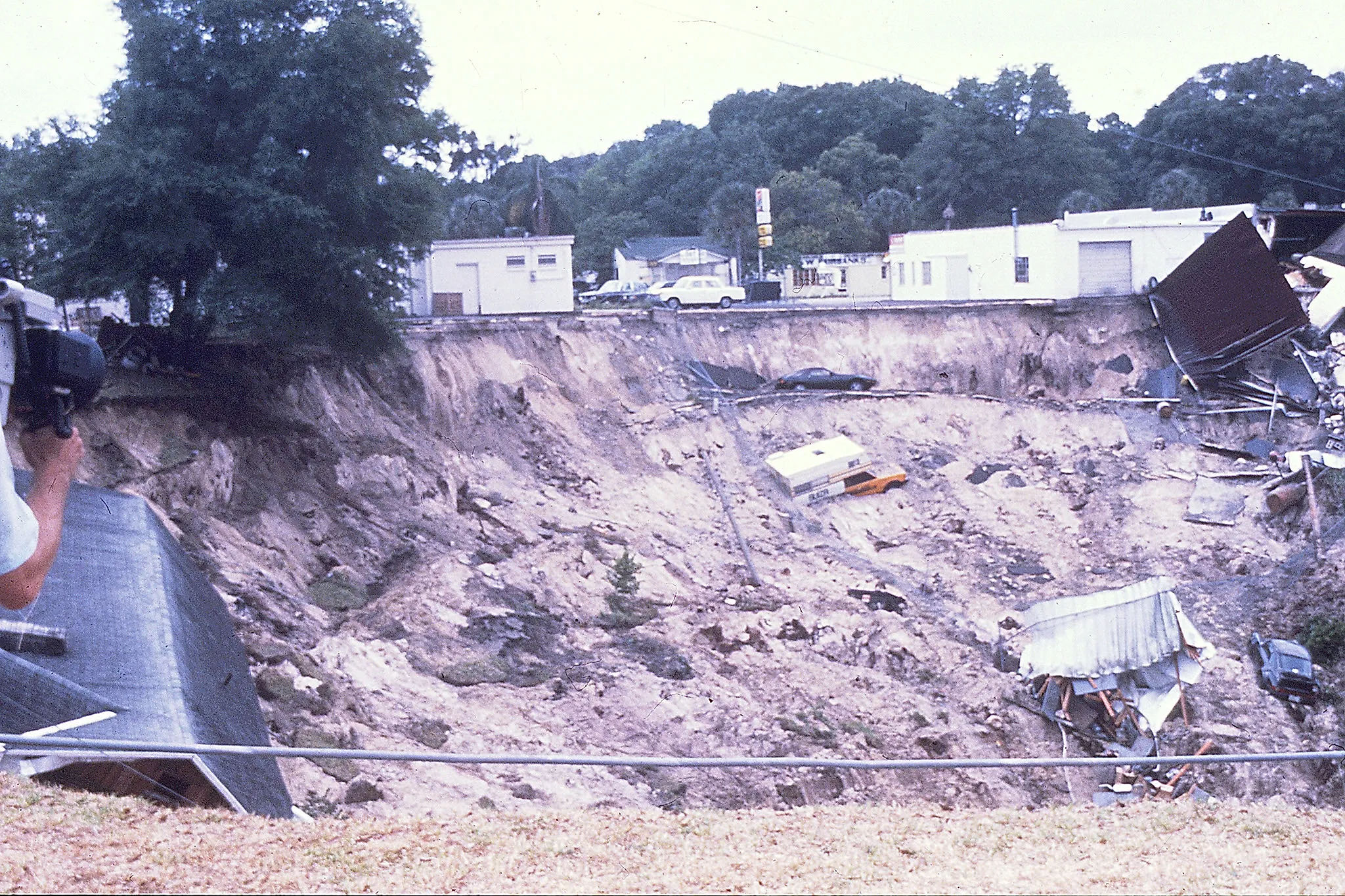
The most famous American sinkhole is not the largest, but it is the one with photographs. It opened on the evening of May 8, 1981, in a residential street in Winter Park, just north of Orlando, and USGS field notes recorded it the following morning at approximately 300 feet in diameter with a visible depth of about 80 feet.
It took a house, a good part of a car dealership including several vehicles, a camper van, two streets and the municipal swimming pool. The USGS observations from the scene describe slope movement as a series of small-scale slides occurring every few minutes, which is a very restrained way of describing a neighborhood falling into the ground while people watched.
The pool spilling into the hole briefly increased the collapse rate, which geologists attributed to lubrication helping material move down into the cavity. The site was later stabilized and turned into an urban lake.
Bayou Corne, Louisiana
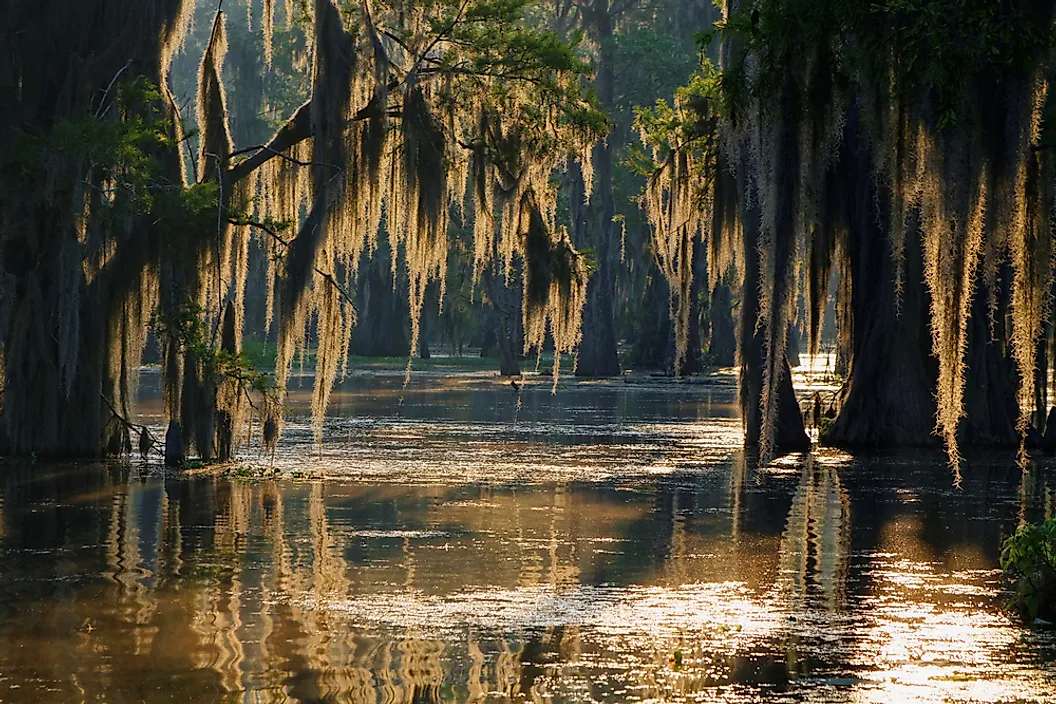
By area this is the largest sinkhole in modern American history, and it is more than fifteen times the size of the official record holder. In 2012 residents of a small community in Assumption Parish began noticing bubbling in the waterways, tremors, and the smell of crude oil. Then the ground opened. The hole grew to over 34 acres, swallowing trees and sections of swamp, and a mandatory evacuation was ordered.
The cause was not rain on limestone. A salt dome cavern operated by Texas Brine collapsed underground, and the surface followed it down. Most residents never came back, and the community is largely abandoned.
Daisetta, Texas

The same mechanism produced the other great modern example, in a small East Texas town built directly on top of a salt dome. The Daisetta sinkhole appeared overnight in 2008 and expanded rapidly, taking vehicles and oil field equipment and threatening houses before it stabilized. Locals named it Sinkhole de Mayo, which is the sort of thing a town does when the alternative is thinking about it seriously.
Salt domes are the reason the Gulf Coast produces sinkholes of a size the karst regions rarely match. Salt dissolves far faster than limestone, and when the dissolution is being helped along by brine extraction or storage caverns, the resulting void can be enormous.
The Corvette Museum, Kentucky

Small by the standards of this list and included because it is the one everybody has seen. In February 2014 a sinkhole roughly 40 feet across and 30 feet deep opened inside the National Corvette Museum in Bowling Green, taking eight cars down with it, on camera.
The location was not bad luck so much as bad geology. Bowling Green sits in some of the most intensely developed karst country in the United States, a short drive from Mammoth Cave, on ground riddled with solution cavities.
The museum eventually filled the hole, restored several cars and built an exhibit about the event, which is a rare example of a sinkhole improving a visitor attraction.
What The Official Record Leaves Out
The USGS wording is carefully hedged for good reason, and those hedges quietly exclude most of the largest holes in the ground in America. Ancient inactive sinkholes are excluded, and some of them are enormous. Kansas has natural basins formed by salt dissolution measuring a mile across. Florida's Devil's Millhopper is roughly 500 feet wide and 120 feet deep and took thousands of years to form rather than one night. New Mexico's Bottomless Lakes are water-filled sinkholes in a state park.
Human-caused collapses are also excluded from the collapse-sinkhole framing, which removes Bayou Corne, Daisetta and the Texas Wink Sinks, all of which are larger than the Golly Hole by area.
So the honest ranking depends on three separate decisions. Whether you measure area or depth, whether you count sudden collapses or slow dissolution, and whether a hole opened by a brine company counts at all.
Why Florida Has So Many

The most sinkhole-prone states are Florida, Texas, Alabama, Missouri, Kentucky, Tennessee and Pennsylvania, and Florida leads by a wide margin for reasons that are entirely structural.
The peninsula sits on thick limestone with a shallow water table and abundant rainfall, and rain is mildly acidic, which dissolves limestone into a network of voids. When the roof of one of those voids can no longer support the sand above it, the surface drops.
Groundwater pumping makes it worse by removing the water pressure that had been helping hold cavity roofs up. In January 2010 more than 110 sinkholes opened in the Dover area of Florida during a freeze event, when growers pumped heavily to protect crops from cold and groundwater levels hit record lows.
Nobody Is Counting
One fact belongs on any list of this kind, including this one. The USGS states plainly that there is no national database of sinkhole collapses in the United States, which means figures for how many open each year simply do not exist.
Some state geological surveys track reported collapses within their own borders and many do not. That means the record for largest American sinkhole is really the record for largest well-documented American sinkhole, which is a different thing in a country with this much limestone in it.
The Answer, By Measure

For the largest sudden natural collapse it is the Golly Hole in Alabama, at roughly 325 by 300 feet and 120 feet deep. That is the USGS answer, and it covers about two and a quarter acres.
For the largest by area, it is Bayou Corne in Louisiana at over 34 acres, caused by a collapsed salt cavern rather than by rain. For the most destructive in a populated area, it is Winter Park in 1981. And for the largest of all, it is whichever ancient dissolution basin you are prepared to call a sinkhole, some of which are measured in miles rather than feet.
The useful summary is that the biggest holes in America were mostly not made by water alone, and the most famous one is famous because it happened in front of a television crew.