The Largest Movie Theaters In The United States
In 1896, America's first dedicated cinema opened on Canal Street in New Orleans. Tickets were 10 cents, equal to around $4 today. The world would never be the same. Today, there are thousands of movie theaters and tens of thousands of movie screens in the United States, many of which are quite large. For this ranking, "largest" refers to the total permanent seating capacity of a single auditorium built to be, or currently functioning as, a movie theater. In other words, these are the theaters which can hold the most people.
Radio City Music Hall

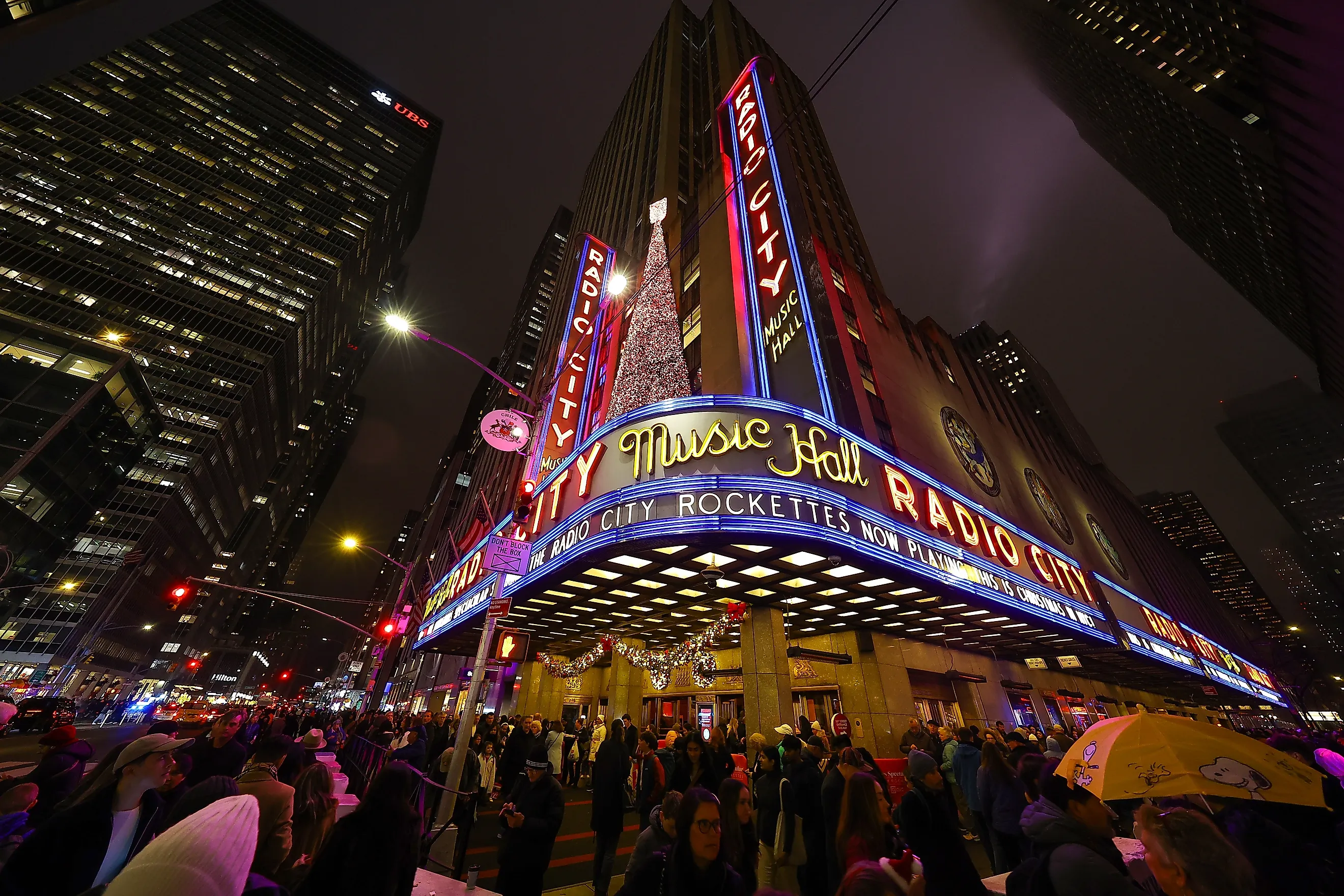
Radio City Music Hall in Midtown Manhattan is the largest single-screen movie theater in the country with 5,960 seats. For specific events, additional seating is added, bringing the seating capacity to more than 6,000. The idea for the theater came about in 1929, when John D. Rockefeller, Jr decided to build a complex of buildings on the 'speakeasy belt' to attract tenants after the stock market crash. Rockefeller teamed up with the Radio Corporation of America and S.L. 'Roxy' Rothafel to design and build Radio City Music Hall, which would open December 27, 1932.
The construction process included building more than thirty different spaces, including eight lounges, each with its own theme. Donald Deskey designed the carpets and furniture and had a hand in the design of the signage and balustrades. Over the years that followed, Radio City screened more than 700 movies, including the original King Kong, Mary Poppins, and The Lion King. Today, visitors can still experience the 160-foot auditorium and its 84-foot-high ceiling when booking a movie ticket. They can still see the choral staircases, the Great Stage with its proscenium arch, and the gold stage curtain. Those who see concerts instead of movies have their pick of seats across three levels, with the best views in the center-front Orchestra or First Mezzanine.
Fox Theatre (Detroit)

Detroit's famous Fox Theatre was designed and built by C.Howard Crane in 1928. It was designed as a mix of Far Eastern, Indian, and Egyptian design styles to create a movie 'palace.' The theater was built to replace the then-existing Fox Theater that stood near Grand Circus Park. The new building featured 5,048 seats, with the lobby stretching half a block and the entire structure rising six stories. It opened with the silent film Street Angel that same year. The Fox Theatre hosted several organ concerts over the years, thanks to its two onsite organs in the auditorium and lobby. It also hosted premieres and concerts, pivoting to horror movies and kung fu films as the city experienced a sharp decline during the 1960s and 1970s.
The theater went the way of the city too, before the Ilitch family intervened in 1987. They bought the theater and restored it over eighteen months. It cost $12 million to restore the theater to its original condition, including replacing the marquee. When the theater opened in 1988, it did so with a performance by Smokey Robinson, and seating of just over 5,100. It was named a National Historic Landmark the following year. In 2026, visitors can watch Broadway shows and musical events here, as well as special movie screenings mainly over the holidays or other celebrations.
Fox Theatre (Atlanta)

Atlanta's Fox Theatre boasts 4,665 seats, and visitors can look forward to more than 250 screenings, live shows, and Broadway performances every year. The theater opened on Christmas Day 1929, with a premiere of Steamboat Willie. Its design, which features gold leaf, domes, and minarets, made a massive impression on theatergoers, but unfortunately its success was short-lived. The Great Depression affected the theater to the point where it became bankrupt in 1932 and was auctioned off. After the auction, the theater continued to operate until it finally closed in 1974 due to neglect. There were plans to demolish the building, but the 'Save the Fox' campaign launched by residents saved the theater, and it was reopened in 1975 after extensive restorations. Today, it is operated by Fox Gives, which is heavily involved in restoring old and historic theaters. Some of the 2026 shows include Hamilton, the upcoming live concert version of Waiting to Exhale, and the anticipated Hip Hop Nut Cracker. Throughout the year, people can also book tickets for special movie screenings.
Fabulous Fox Theatre (St. Louis)

The Fabulous Fox Theatre in St. Louis is a 'replica' of the Detroit theater, built using the same plaster molds for the interior columns and ornaments. The theater features 4,500 seats and opened on January 31, 1929. At the time, people paid a mere 50 cents to see live entertainment and 'talkies.' The Fabulous Fox entertained visitors for almost 50 years before eventually closing down in 1978. It was bought by Fox Associates in 1981 and reopened with a performance of Barnum in 1982. In 2026, the theater continues to run at full capacity, hosting more than 200 performances and screenings every year. There are upcoming Neil Diamond tribute shows and the Mannheim Steamroller Christmas performance to look forward to in November and December, respectively. Visitors can also book a 90-minute walking tour of the theater on Saturday mornings, which includes a short organ performance.
The Wang Theatre

Boston's Wang Theatre boasts a current capacity of roughly 3,600 seats. The theater opened in 1925 as the Metropolitan Theatre. Developed by Max Shoolman and designed by Clarence Blackall, it was conceived as a grand movie palace where audiences could see motion pictures, vaudeville, and other live entertainment. Its marble columns and huge crystal chandeliers reflected the scale of the movie-palace era. Renamed the Music Hall in 1962, it later underwent extensive restoration and eventually became the Wang Theatre. The venue now focuses primarily on concerts and touring stage productions, although films still appear as part of special programming.
The Chicago Theatre

Illinois's Chicago Theatre is one of the flagship theaters of a bygone era. The staircase and ornately designed auditorium make it easy to see why it is considered 'the Wonder Theater of the World.' It opened on October 26, 1921, with a screening of The Sign on the Door featuring Norma Talmadge. Visitors also enjoyed a 50-piece orchestra and organ performance. The Chicago Theatre was built by Barney and Abe Balaban, and Sam and Morris Katz in the French Baroque Style. The exterior of the building features a smaller replica of the Arc de Triomphe, and the grand lobby was designed to resemble the Royal Chapel at Versailles. The auditorium boasts around 3,600 seats and is seven stories high. The chandeliers and bronze light fixtures were made by Victor Pearlman and Co and the tiles came from the Northwestern Terra Cotta Company. There are also ten ceiling murals across the auditorium painted by Louis Grell.
The theater excelled for 40 years, presenting many feature films, before closing down in 1985. The City of Chicago and the Chicago Theatre Restoration Associates worked together to buy and save the theater in 1986. It was restored and reopened on September 10, 1986, drawing visitors with a performance by Frank Sinatra. In the decades that followed, the stage hosted dozens of stars including Robin Williams, Dolly Parton, Diana Ross, and Aretha Franklin. It is not a daily movie theater anymore, but visitors can still catch the occasional film, combined with a special guest appearance.
The United Palace

The United Palace in Manhattan has nearly 3,400 seats. It opened in 1930 as Loew's 175th Street Theatre, the last of five lavish Loew's Wonder Theatres built in the New York City region. Architect Thomas W. Lamb designed the building as a deluxe movie and vaudeville house, while Harold Rambusch helped create its unusually elaborate interior.
The theater's decoration is difficult to place in any single architectural category. Its ornament draws on Byzantine, Romanesque, Moorish, and other traditions, creating one of the most unusual surviving movie-palace interiors in the country. A church organization purchased the building in 1969 as the movie-theater business declined. It now combines religious use with arts and entertainment programming. Unlike many surviving former movie palaces, the United Palace still regularly returns to its original purpose through movie screenings, premieres, and films accompanied by live music.
Preserving the Era of Single Movie Screens
The construction of 3,000-plus-seat single-auditorium movie theaters peaked between 1920 and 1935. Construction was driven by the increasing popularity of silent cinema and early 'talkies'. Unfortunately, operational costs led many of the theaters to close entirely before they were restored and reopened. The surviving venues on this list are among the best examples of grand cinema architecture today, even if some no longer screen films daily.
We may not build elaborate 3,000 to 5,000-seat theaters anymore, but these classic venues are finding ways to stay relevant. Some have installed digital laser projectors and larger sound systems to host Hollywood premieres, film festivals, and special screenings alongside live performances. The hope is that these theaters will remain for many decades to come, keeping the big-screen magic alive for new generations.