9 Ideal Tasmania Destinations for a 3-Day Weekend in 2026
Most trips to Tasmania begin the same way: the overnight ferry from Melbourne slides into Devonport a little after dawn, and you drive off the ramp with a whole island in front of you and no clear idea where to point the car. Here is the good news. You do not need Hobart or Launceston to have a great long weekend. Trace the coast instead, and within a few hours' drive of that ferry ramp you will find a copper-mining town that looks like the surface of Mars, a fishing village pinned beneath an extinct volcano, and the oldest bridge in the country still carrying traffic. Three days is enough to string a handful of these towns together into one loop. What follows is that loop, starting at the ramp and working its way around.
Devonport

You will already be in Devonport, because this is where the Spirit of Tasmania ties up, so you may as well spend the first morning here before the driving starts. Walk out to Mersey Bluff, the headland just north of the center, where a red-and-white-striped lighthouse has stood since 1889 above the mouth of the Mersey River. From the trails around it you can watch the ferry you arrived on turn around and head back across Bass Strait. Down at the Bass Strait Maritime Centre, staff tell the story of the shipwrecks, early explorers, and coastal traders who worked these waters, which is a useful bit of orientation before you head west along a coast that a lot of those ships never survived. If it is raining, the Devonport Regional Gallery is a dry hour well spent among contemporary Tasmanian work.
Burnie

Keep driving west and about 50 kilometres on you reach Burnie, a working port that has quietly turned much of its industrial past into something visitors actually want to see. The best hour of the day here comes at dusk, when little penguins ride the swell in and waddle up the rocks to their burrows. Volunteer guides at the Little Penguin Observation Centre keep the platforms open through the nesting season so you can watch from a few feet away without disturbing the birds. Earlier in the day, the Makers' Workshop is the place to catch glassblowers and papermakers at the bench, carrying on the craft trades Burnie was built on. The Burnie Regional Museum fills in the rest, from Aboriginal heritage through the mills and the port. It is an honest, unglamorous town, and better for it.
Stanley

An hour past Burnie, near the far northwest corner of the island, you come to the strangest skyline in Tasmania. Stanley sits at the foot of The Nut, a 143-metre volcanic plug with sheer sides and a flat green top, and the village of a few hundred people huddles at its base like something out of a picture book that happens to be real. You can climb the steep track to the summit in about fifteen minutes or ride the chairlift up, then walk the two-kilometre loop around the top for uninterrupted views over Bass Strait. Just outside town, Highfield Historic Site is the restored 1830s home of the Van Diemen's Land Company, the royal-charter outfit that ran wool operations across this whole corner of the colony, and it is open to walk through. Down at Godfrey's Beach, if you time it for evening, you may catch penguins coming ashore here too.
Strahan

From Stanley the drive turns south into wilder country, and by the time you reach Strahan you have swapped the settled north coast for the raw west. This little port on Macquarie Harbour is the way into the Tasmanian Wilderness World Heritage Area, and the classic outing is the Gordon River cruise, which carries you up glassy, tannin-dark water between walls of ancient rainforest to the ruins on Sarah Island, one of the harshest convict stations the colony ever ran. For something bracing and free, Ocean Beach runs unbroken for more than 30 kilometres, and standing on that windswept sand with nothing but the Southern Ocean ahead of you is the clearest sense you will get of just how far west you have come.
Queenstown

The road inland from Strahan climbs about 40 minutes to Queenstown, and honestly the drive is half the reason to come. The final descent switchbacks down through hills stripped bare and stained pink, grey, and rust by a century of copper smelting, a moonscape unlike anywhere else in the country. Copper is the whole story here. The Mount Lyell mines built the town, and in the 1890s crews cut a railway through the rainforest to haul the ore down to the port at Strahan. That line runs again today as the West Coast Wilderness Railway, its restored steam locomotives using an Abt rack-and-pinion system to grip the steep grades. Climb up to Spion Kop Lookout for the view over the rooftops, or drive out to the Iron Blow lookout above the original open-cut pit. The Galley Museum, in an old hotel, holds the photographs and the miners' stories.
Deloraine

Turning back toward the middle of the island, you leave the mining country behind and the landscape softens into farmland. Deloraine sits on the Meander River with the long wall of the Great Western Tiers rising behind it, and it has been one of Tasmania's leading arts-and-crafts towns for years. The riverside paths through the town's parks make for an easy stroll and good odds of spotting platypus at dawn or dusk. The Deloraine and Districts Folk Museum is worth an hour for its exhibits on pioneer and farming life, and if your weekend happens to fall in the right week, the town fills up for the Tasmanian Craft Fair, one of the largest in the country, when demonstrators and stallholders take over the streets. It is a natural place to break the drive and shift gears before the historic south.
Richmond

Drop down toward the southeast, just 25 kilometres short of Hobart, and you arrive in Richmond, where the convict era is not a museum exhibit so much as the town itself. Convicts finished the Richmond Bridge in 1825, and it is the oldest stone bridge in Australia still carrying traffic, its sandstone arches reflected in the Coal River below. A short walk away, the Richmond Gaol, also from 1825, is the oldest intact gaol in the country and predates the better-known penal station at Port Arthur by several years. Step inside the solitary cells and the flogging yard and the 1820s stop feeling abstract. For a gentler view of the same period, the Old Hobart Town model village recreates Hobart as it looked in the 1820s in miniature, right down to the wharves and the customs house.
Swansea

Now the loop turns up the east coast, and the mood changes again to sand, oysters, and wine. Swansea faces Great Oyster Bay across calm water, with the pink granite peaks of the Hazards on the Freycinet Peninsula filling the view on the far shore. This is the leg of the trip for slowing down: a swim, a plate of local oysters, a cellar door on the wine trail that runs south of town. A few minutes down the coast road, pull over for Spiky Bridge, which convicts built in 1843 out of fieldstone with no mortar at all, its parapets finished in jagged vertical rocks that give it the name. The Bark Mill Museum in town explains the odd local industry that once stripped wattle bark here for the tanning trade.
Bicheno

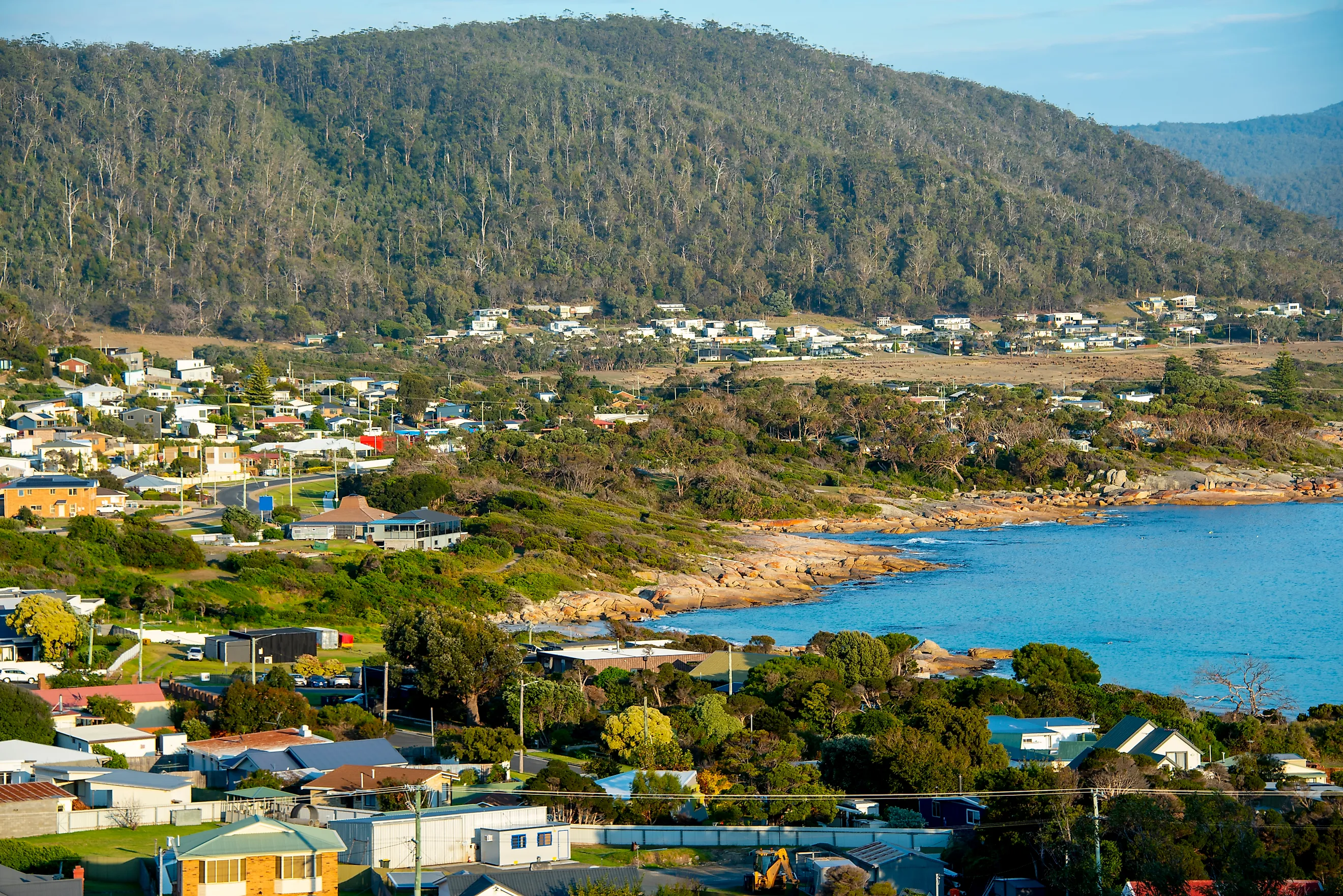
Half an hour further up the coast, Bicheno is the last stop before the loop runs out, a fishing town of just over a thousand people wrapped in orange lichen-stained granite. When a Tasman Sea swell is running, the Bicheno Blowhole forces seawater up through a gap in the rocks in sudden drenching bursts, and getting a little wet watching it is part of the fun. Just north of town, East Coast Natureworld is the easy way to meet Tasmanian devils, wombats, and kangaroos up close, and local guides run evening penguin walks to a protected rookery they have tended for decades. For a last look back over everything, make the short climb to Whalers Lookout, where the town, the coastline, and the Tasman Sea line up in one sweep, a fitting place to end before you turn back toward the ferry.
One Island, One Loop, Three Days
What ties these nine towns together is the drive itself. Point the car west out of Devonport and you can follow the coast from the penguins of Burnie to the copper hills of Queenstown, cut back across the farmland at Deloraine, and come down the historic southeast and up the east coast without ever doubling back. None of these places is large, and that is the point: a few hundred people at the foot of The Nut, a couple thousand mining families holding on at Queenstown, a thousand fishers and their neighbours at Bicheno. Small towns are easy to see well in a single afternoon, which is exactly what a three-day weekend allows. Pick up the loop wherever the ferry drops you, and let the road connect the rest.