8 Most Alligator Filled Places in Georgia
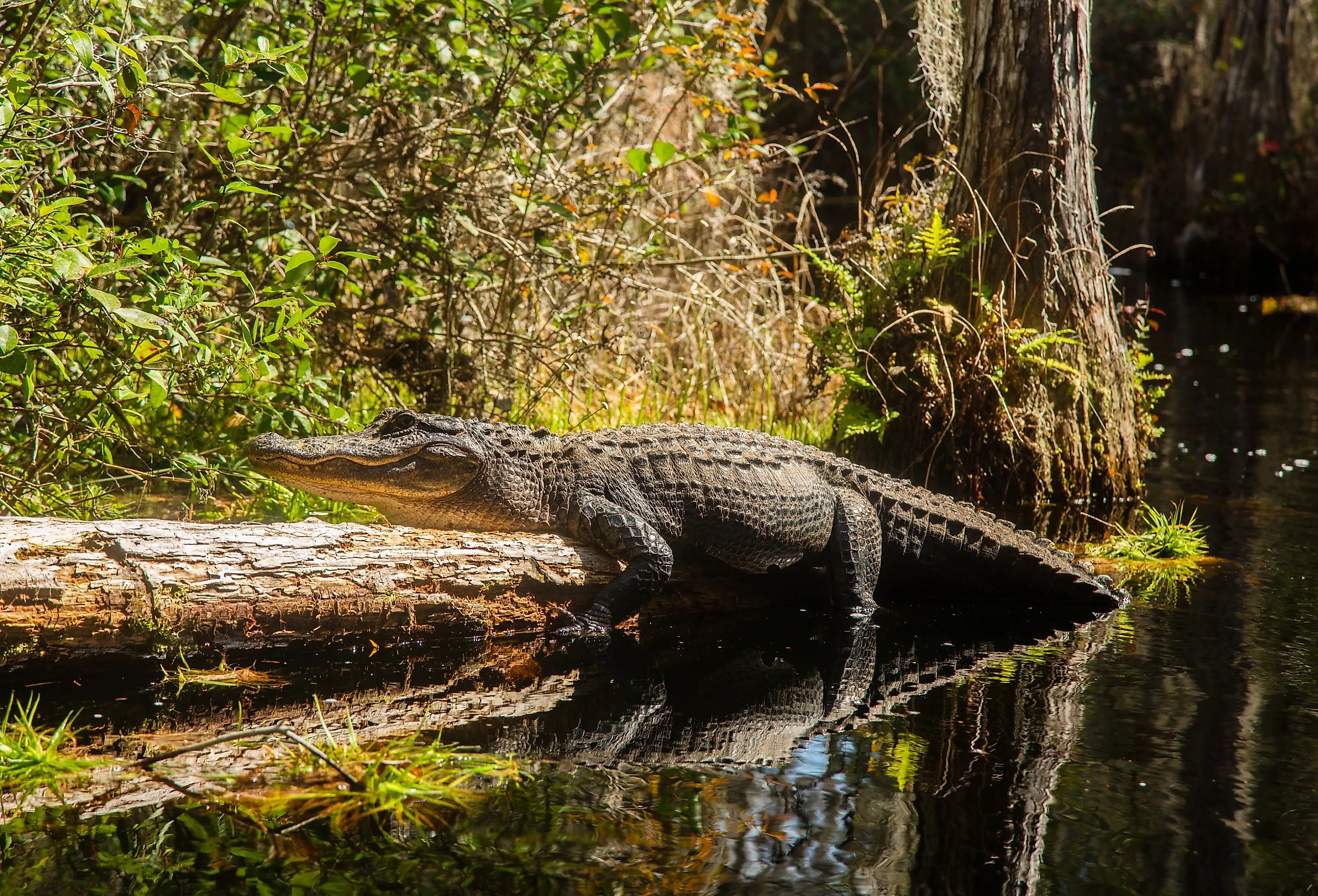
Found in places like the Okefenokee Swamp and Lake Seminole, alligators are abundant in Georgia. The American alligator (Alligator mississippiensis) is a conservation success story. Once an endangered species that benefited from decades of federal protection, this ancient, iconic reptile now numbers in the millions across the southeastern US. In Georgia alone, the gator population rose from ~30,000 in 1973 to ~250,000 in 2026. Helping determine gator abundance are professional scientists and just over 1,000 annually and sustainably selected hunters, who plod through backwater Georgia, quantifying the hottest gator hotspots. Behold eight such alligator filled places in Georgia.
Okefenokee Swamp

If gauging "gator-filled" by raw numbers, Okefenokee Swamp is likely the most gator-filled place in the state. Across its nearly half-million acres of southern Georgia wetlands live an estimated 15,000 alligators, which comprise a sizeable share of the statewide population. Most Okefenokee gators and their habitat are protected by the Okefenokee National Wildlife Refuge, where hunting is banned except for on a very small parcel. Naturally, visitors to the swamp can expect to see myriad gators, even over a short period. One travel blogger counted 127 alligators in a single day of kayaking. On a different day, a researcher observed about 300 gators congregating around a boat basin.
Jekyll Island

Hunting is prohibited on Jekyll Island, which is part vacation destination, part nature preserve, and millions of tourists annually vie for space with hundreds of alligators. That may seem like a small number until you realize that Jekyll Island spans only about nine square miles. As of 2024, the island was home to an estimated 115 alligators over four feet in length (the minimum size for a "nuisance" gator), a rate of nearly 13 potentially-problem gators per mile. Yet conflicts are rare. Gators are sometimes removed from residential yards, pools, and even the common areas at Great Dunes Beach Park. Problem gators are often caused by problem humans, who illegally feed them resort food like burgers and fries. But with all that said, the only known gator attack on Jekyll Island occurred in 1994 when a golfer tried to retrieve balls from a pond. His hand wound required 20 stitches.
Harris Neck National Wildlife Refuge

Hugging the Eastern Seaboard north of Jekyll Island, Harris Neck National Wildlife Refuge is a small preserve with some seriously big gators. Filling its 2,800ish acres are 10-plus-footers often seen sunning themselves on trails and banks or hunting with emersed eyes in murky ponds. The American alligator has one of the largest appetites in the animal kingdom, eating everything from fish to turtles to rodents to birds to berries to boars to bobcats. The larger the gator, the larger the potential prey. In 2004, a ~13-foot gator was photographed from a US Fish and Wildlife aircraft over the Harris Neck area. It had a full-grown deer in its jaws.
Lake Seminole

You cannot write about big Georgian gators without mentioning Lake Seminole, a massive reservoir on the Florida-Georgia line with some of the biggest gators from both states, and America as a whole. In 2010, a 13-foot-9, 692-pound behemoth was hunted at Lake Seminole and dubbed the longest alligator ever taken in Georgia. Three years later, that record was broken, again at Lake Seminole, by a near-14-footer weighing 620 pounds. Though a different reservoir now claims the all-time state record, Lake Seminole often yields the yearly state record. Georgia's largest hunted gator of 2024 was a 13-foot-8-incher pulled from Seminole.
Little St. Simons Island

Another gator-filled Georgian island, Little St. Simons Island, covers thousands of undeveloped acres and a comparable number of alligators. But none is bigger or cooler than Norm. The ruler of Norm’s Pond, a duckweed-covered oasis near the eastern beach, Norm is the largest gator on Little St. Simons. At roughly 13 feet in length, Norm could be around 50 years old, which is a ripe old age for an alligator. Besides striking fear and reverence in the hearts of human observers, Norm protects countless birds that, for many years, have reproduced in the rookery centering his pond. Though Norm is certainly unaware of this role, he and other sizeable gators deter egg-snatching predators like raccoons.
Phinizy Swamp

Located much farther north than other gator hubs, Phinizy Swamp lies in Augusta along the South Carolina border. Approximately 1,500 acres of the swamp are contained by the Phinizy Swamp Wildlife Management Area, while another 1,150 acres are protected by Phinizy Swamp Nature Park. The latter preserve has seen far more gator-human encounters, many of which have involved humans feeding and even petting alligators. This caused park officials to issue, in 2020, a public statement on the danger of such encounters, not just to people but to gators. "When wild animals are being fed they start to associate people with food and lose their fear . . . " the statement reads. "Once an alligator loses its fear and starts approaching humans, they have to be removed to prevent any injuries to people . . . When you decide to feed or pet an alligator at Phinizy, you are potentially causing that alligator to be put down." Hopefully, parkgoers listened.
Walter F. George Lake

Walter F. George Lake, AKA Lake Eufaula, is a reservoir along the Alabama-Georgia border that produced the longest hunter-harvested Georgia alligator on record. In 2019, a 14-foot, 1.75-inch gator was taken at Walter F. George, which beat the previous record-holder by .75 inches. The previous record-holder, a 14-foot-1-incher from 2015, was also taken at Walter F. George. This lake is so stuffed with supersized gators that it became a whole hunting zone unto itself, called 1A, which has the longest minimum legal catch length (eight feet) and the longest average catch length (roughly 10.5 feet). Trophy gators are still routinely pulled from Walter F. George, including the longest unofficial Georgian catch of 2025 (13-foot-5).
Skidaway Island

Per the Georgia Department of Natural Resources, just nine cases of alligator attacks on humans were reported in the state from 1980 to July 2023. Six were provoked. Three were predatory. Only one was fatal, and it happened on Skidaway Island. This Savannah-area barrier isle teems with gators, a fact that attained unprecedented gravity in 2007 when an 83-year-old woman was killed and partially consumed by an eight-foot Skidaway gator. The woman's family tried to sue the gated community where she was attacked, as they accused developers of building an unnatural and dangerous gator highway of interconnected lagoons, but the Georgia Supreme Court ruled in the developers' favor.
After nearing extinction and recovering thanks to state and federal protection, Georgia's gator population is large, stable, and concentrated in various hotspots. Among the most alligator-filled places in Georgia are Jekyll Island, Harris Neck National Wildlife Refuge, and Okefenokee Swamp. Visit these eight Georgian locales to see plentiful, prodigious gators sooner rather than later.