10 Best Places To Retire In California's Sierra Nevada
The Sierra Nevada draws hikers and skiers to its high country, but the lower foothills on the western slope have quietly become one of California's most appealing regions for retirees who want mountain scenery without a coastal price tag. Walkable historic downtowns, mild four-season weather, and home prices well below the statewide median define this string of old Gold Rush towns. Hospitals and specialists in nearby hubs are also close by. These towns pair affordability with the kind of low-key, senior-friendly activity that makes settling in easy. Short scenic walks, small museums that do not require a full day on your feet, wine and orchard tastings, and well-kept community parks. As of May 2026, California's statewide median home sale price was $782,221, according to Redfin. Each of these towns sits at or well below that number, making them among the best places for retirement.
Grass Valley

Grass Valley had a population of 14,016 at the 2020 census, and its median home sale price of $544,674 sits comfortably below California's statewide median. The extra size also means a full-size grocery store, a pharmacy, and a hospital within a short drive rather than a 45-minute trip over mountain roads. The town's centerpiece is Empire Mine State Historic Park, a former hard-rock gold mine turned state park with flat, paved paths through the historic mine yard and gardens. Downtown is walkable, and the historic Mill Street shopping district is lined with early-1900s brick buildings that now house cafes, bookshops, and antique stores. The Nevada County Fairgrounds hosts a low-key farmers' market and community events throughout the year. Grass Valley sits in the western foothills of the Sierra Nevada mountain range, which gives residents access to alpine scenery without living at higher, snowier elevations.
Sonora

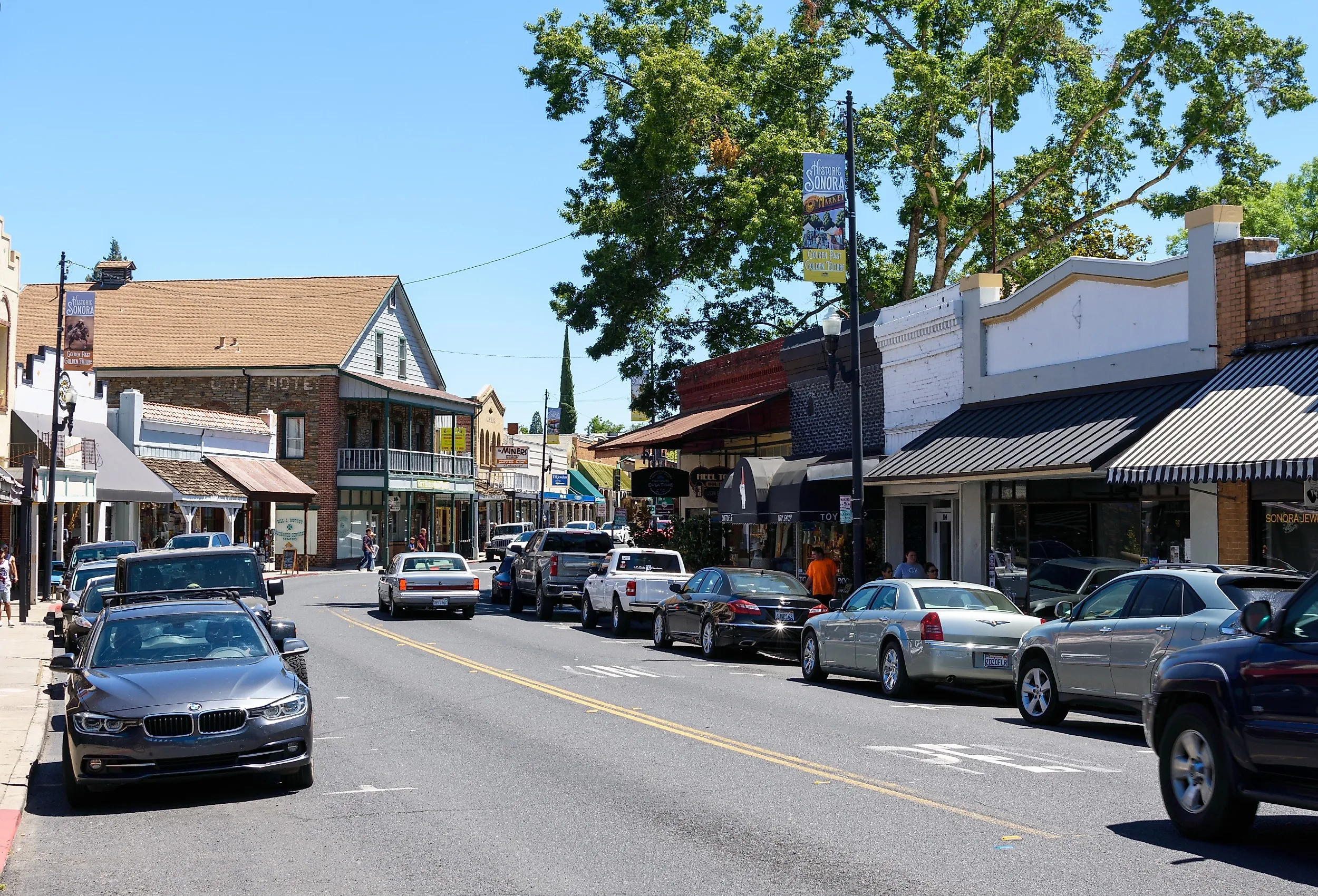
Sonora, the seat of Tuolumne County, had a 2020 census population of 5,003 and a median home sale price of $372,277, which makes it among the most affordable towns in the state. Founded during the Gold Rush by miners from the Mexican state of Sonora, the town's compact downtown along Washington Street is a National Register historic district, with balconied brick storefronts that make for level, shaded window-shopping. The Tuolumne County Museum and History Research Center occupies Sonora's former county jail, a structure rebuilt in 1866 after fire destroyed the original 1857 building, and presents exhibits on county history. The Dragoon Gulch Trail loops through oak woodland just above downtown, with a mix of flat and easy-grade sections. Sonora is also a basecamp for exploring Yosemite National Park, roughly an hour and a half east, for retirees who want day trips into the high Sierra Nevada without living at altitude year-round.
Placerville

Placerville, in El Dorado County, recorded a population of 10,747 in the 2020 census, and its median home sale price over the past three months was $508,000, according to Redfin. Known as "Hangtown" during the Gold Rush, the town centers on a Main Street marked by the Bell Tower, a 50-foot steel structure erected in 1898 to replace a 25-foot wooden tower built in 1878. Gold Bug Park, a city-owned park with a lit, walkable mine tunnel and gentle trails, is a favorite for anyone who wants a taste of Gold Rush history without a strenuous climb. The El Dorado County Historical Museum covers the county's mining, ranching, and railroad past in a single-story building that is easy to navigate. Just east of town, the Apple Hill growing region has dozens of farm stands, orchards, and wineries along a scenic drive, an unhurried afternoon of tastings. Placerville sits roughly midway between Sacramento and South Lake Tahoe, which keeps specialist medical care within reach.
Jackson

Jackson, the seat of Amador County, had a population of 5,019 at the 2020 census and a median home sale price of $585,000, per Redfin, still well under the statewide median. The town's Main Street includes the National Hotel, whose current building dates to 1862 and still operates as a hotel and restaurant. The Amador County Museum, set in an 1859 home on a hill above downtown, displays mining equipment and a scale model of the nearby Kennedy Mine's stamp mill. The Kennedy Gold Mine, just outside town, offers guided and self-guided surface tours, and two of the surviving wheels that once moved its waste rock stand at the separate Tailing Wheels Park in Jackson. For a quieter outing, Detert Park has shaded grassy picnic areas, a public pool, a tennis court, a playground, and a youth baseball field. Jackson's position on both State Route 49 and State Route 88 makes it a convenient hub for reaching Sacramento-area medical centers.
Sutter Creek

Nicknamed the "Jewel of the Gold Country," Sutter Creek is one of the smallest towns on this list, with a population of 2,646 at the 2020 census and a median home sale price of $495,000. Main Street, technically Old Highway 49, is a National Register historic district lined with balconied 19th-century storefronts, all on flat, easily walkable sidewalks. The Sutter Creek Theatre, a restored early-1920s house seating a little over 200, hosts live music, film, theater, and community events year-round. The Knight Foundry is the last water-powered foundry and machine shop in the United States, running for 123 years before it closed in 1996; it is now preserved as a historic site and opens for docent-led tours on the second and fourth Saturday of each month, when the forges are fired, and the belt-driven machinery runs. The Monteverde Store Museum, preserved as it looked when it closed in 1971, gives a picture of turn-of-the-century small-town commerce. Several wineries along the Shenandoah Valley wine trail sit a short drive north, a low-effort outing for retirees who prefer tasting rooms to hiking trails.
Angels Camp

Angels Camp, the only incorporated city in Calaveras County, had a 2020 census population of 3,667 and a median home sale price of $460,000, per Redfin. It is known as "Frogtown" for the Calaveras County Fair and Jumping Frog Jubilee, an event that grew out of the tale Mark Twain heard here in 1865 and turned into a short story; the town's compact Main Street historic district is easy to cover on foot in an afternoon. The Angels Camp Museum and Carriage House occupies three acres of the original Angels Mine claim, spreading across four buildings, with 29 restored horse-drawn carriages alongside mining and Gold Rush equipment. Downtown's Utica Park is a shaded gathering spot with picnic tables and a small amphitheater used for community events. A short drive brings residents to Murphys and Ironstone Vineyards, which pairs wine tasting with a small museum and gardens, and does not require much walking. New Melones Lake, also close by, suits calmer lakeside afternoons.
Oakhurst

Oakhurst, an unincorporated community in Madera County at the southern edge of California's Gold Country, had a population of 5,945 at the 2020 census. Its median home sale price is $522,500, per Redfin, well below the statewide median. Set at the junction of Highways 41 and 49, Oakhurst functions as the main gateway to Yosemite National Park's southern entrance, about 16 miles and a half-hour drive north. Fresno Flats Historic Park, named for the town's original name, preserves a cluster of 19th-century buildings connected by flat, shaded walking paths. Oakhurst Community Park has accessible picnic areas and a walking loop suited to a slower pace. A short drive brings residents to Bass Lake, with day-use sites, accessible recreation facilities, and waterfront dining that require no boat. Because Oakhurst sits along a well-traveled highway corridor, it also has better access to pharmacies, urgent care, and specialists than more remote Sierra Nevada communities.
Mariposa

Mariposa, another southern gateway to Yosemite National Park, had a population of 1,526 at the 2020 census. It is also the county seat of Mariposa County, one of only three California counties with no incorporated cities, so Mariposa itself remains an unincorporated community. Its median home sale price is $400,000, per Redfin, among the lowest in the Sierra Nevada foothills. The Mariposa County Courthouse, begun in 1854 and finished the following year, still hears cases and is listed on the National Register of Historic Places. The Mariposa Museum and History Center offers guided or self-paced tours of mining-era exhibits, including a working stamp mill, and the California State Mining and Mineral Museum, just south of town, displays a large collection of gold specimens and gems in an easily navigable gallery. Mariposa's small size means fewer services locally, so residents typically rely on Merced or Oakhurst for larger medical needs.
Ione

Ione, in Amador County, had a population of 5,141 at the 2020 census and a median home sale price of $560,000. The town's small Main Street historic district retains its 19th-century storefronts, but its most distinctive landmark is Preston Castle, a Romanesque Revival building completed in 1894 that once served as the administration building for one of California's oldest reform schools. The Preston Castle Foundation now runs docent-led and self-guided tours in the spring and summer months for anyone interested in its history and architecture. Howard Park, in the center of town, has shaded benches and picnic tables, making it a popular low-key gathering spot. Ione's position in the gently rolling hills west of the higher Gold Country towns gives it a milder, lower-elevation climate than some of its neighbors, with less snow in winter. It sits within a short drive of both Jackson and Sutter Creek, which puts a wider range of shops, medical offices, and dining within reach without leaving Amador County.
Copperopolis

Copperopolis, an unincorporated community in Calaveras County, had a population of 3,400 at the 2020 census and a median home sale price of $589,000, per Redfin. Unlike its gold-focused neighbors, the town's 1860s boom was built on copper, and the brick Copperopolis Congregational Church of 1866 survives from that decade. The modern Town Square at Copper Valley is a shopping and dining plaza designed to evoke an old-fashioned town center. The town's best-known recreation draw is The Golf Club at Copper Valley, formerly Saddle Creek Golf Resort, a course and clubhouse open to the public. Lake Tulloch, just outside town, has roughly 55 miles of shoreline and offers boating and fishing through approved public access points. Copperopolis sits along State Route 4, which connects it to both the Highway 49 corridor and the Central Valley, keeping grocery and medical trips manageable despite the town's small size.
Finding Your Place In The Foothills
The trade-off across these towns is mostly one of scale. Grass Valley and Placerville carry full-service downtowns, hospitals, and enough weekly activity to fill a calendar, while Mariposa and Sutter Creek ask residents to drive for specialists and big-box errands in exchange for quieter streets and lower prices. California exempts Social Security benefits from state income tax, but pensions and withdrawals from retirement accounts are taxed as ordinary income, which is worth modeling against a lower-tax state. Wildfire is another consideration: all of these towns sit in a high-fire-hazard part of the Sierra Nevada foothills, and the cost and availability of homeowners' insurance have become a real factor in the decision. What these towns share is Gold Rush history, a walkable historic core, and mountain access at prices well under the state median.