10 Best Hidden Gems In Europe
The destinations below sit outside the standard European tourist circuit by virtue of geography, scale, or sheer obscurity. Some are small (a Brittany hamlet of restored thatched cottages, a Portuguese village of three hundred people), some are large and historically significant but rarely on Anglophone itineraries (Bamberg, Leiden, Odessa), and two require honest acknowledgment of current circumstances (Odessa has been under repeated Russian missile and drone attack since February 2022; the Trans-Siberian Railway is currently inaccessible to most foreign tourists due to sanctions and travel advisories). The ten entries below cover what each place is and why it matters historically, not whether anyone can or should currently visit.
Bamberg, Bavaria, Germany

Bamberg is the seat of the bishopric founded by Henry II in 1007 (he became Holy Roman Emperor in 1014, and Bamberg was intended to be a "second Rome") and was inscribed on the UNESCO World Heritage list on December 11, 1993 for its largely intact medieval and Baroque urban form. The town sits across the Regnitz River about 60 kilometers north of Nuremberg and survived the Second World War with minimal damage because it had no strategic war industry. The cathedral (Bamberger Dom St. Peter und St. Georg), founded in 1002 and consecrated on May 6, 1012, is the burial place of Henry II and his wife Cunigunde of Luxembourg, the only canonized imperial couple. The building visible today is the Romanesque structure completed in the 13th century after two earlier cathedrals burned. Albrecht Pfister, working in Bamberg from about 1460, was the first European printer to combine text with woodcut illustrations (his edition of Ulrich Boner's Der Edelstein, dated 1461, is the earliest known printed book with woodcuts in any language); Bamberg was one of the earliest centers of printing in Germany after Gutenberg's Mainz workshop produced the 42-line Bible around 1455. The town passed to Bavaria in 1803 during the secularization of the German ecclesiastical states.
Ilha das Flores, Azores, Portugal

Flores Island sits at the western edge of the Azores archipelago, about 1,360 kilometers west of mainland Portugal, and is the westernmost point of geographic Europe (the small neighboring island of Corvo is at almost the same longitude). The island covers about 142 square kilometers, has a population of roughly 3,400, and is the volcanic remnant of a much larger structure now mostly eroded; the highest point, Morro Alto, rises 914 meters above sea level. The interior is a network of crater lakes (the seven lagoas including Funda, Comprida, Rasa, Branca, Lomba, Negra, and Seca), waterfalls (Poço do Bacalhau drops about 90 meters), and pasture used for the dairy industry that anchors the local economy. The whole island has been a UNESCO Biosphere Reserve since 2009. Flores and Corvo together form the Western Group of the Azores and are administratively part of the autonomous Portuguese region of the Azores (the other two groups are the Central and Eastern Groups).
Kazbek, Georgia

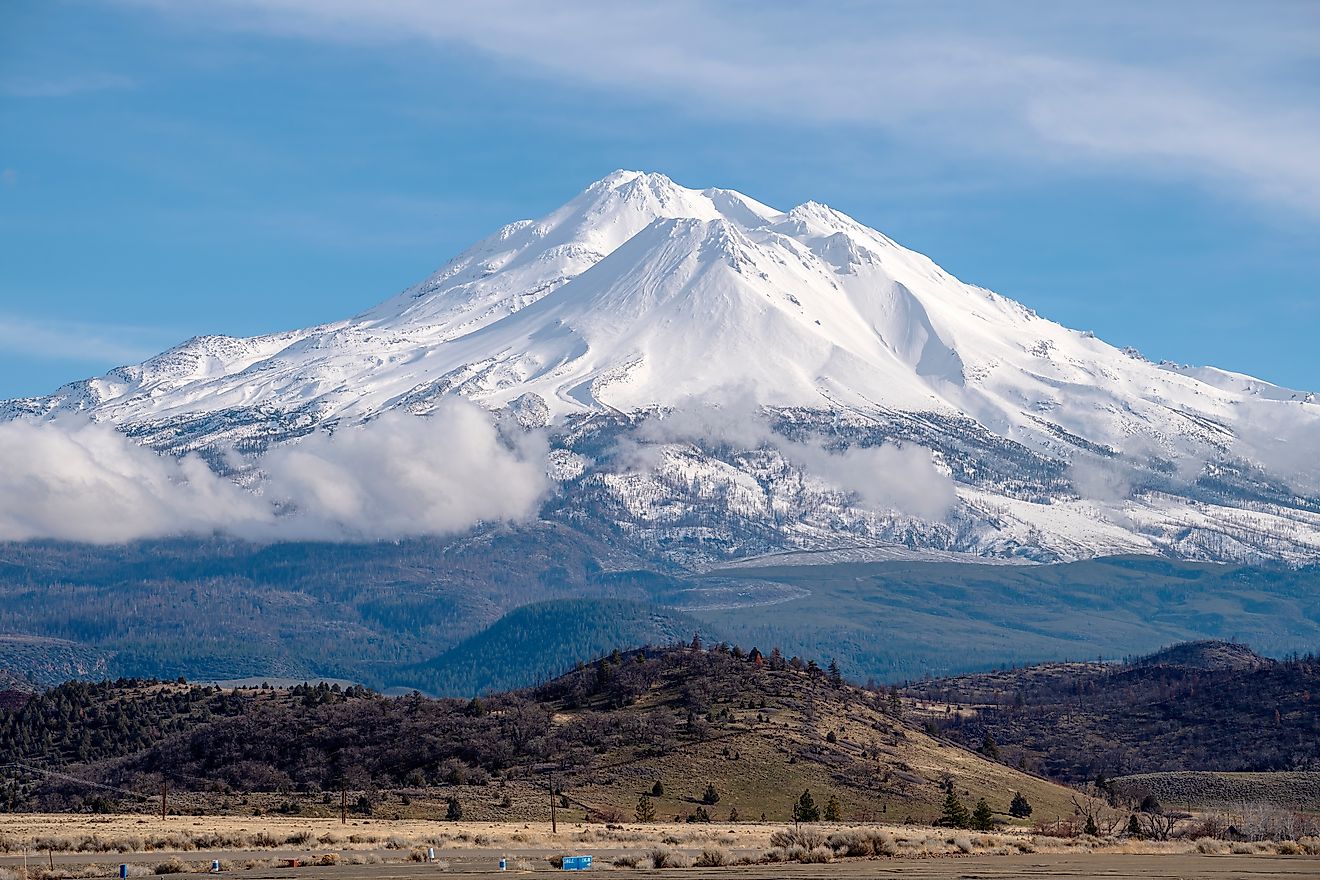
Mount Kazbek, called Mqinvartsveri ("glacier peak") in Georgian, rises to 5,054 meters (16,581 feet) in the eastern Greater Caucasus, on the boundary between Georgia and the Russian republic of North Ossetia. The mountain is a dormant stratovolcano of double-conical shape, formed by lava flows up to 300 meters thick; the lower slopes are alpine meadow. The Betlemi (Bethlehem) cave monastery, cut into a rock face at about 3,800 meters elevation, was accessed historically by monks using a long iron chain. The mountain is referenced in the work of the Russian poets Alexander Pushkin and Mikhail Lermontov (the latter set part of his 1840 novel A Hero of Our Time on its slopes). The standard climbing route up the southeastern flank is technically straightforward (mostly glacier walking with a short ice section of less than 40 degrees in the couloir below the summit), but the route is long enough that most ascents take three to five days from the base. The 14th-century Gergeti Trinity Church, on a ridge above the village of Stepantsminda (formerly Kazbegi) at 2,170 meters, is the standard staging point.
Leiden, Netherlands

Rembrandt was born in Leiden on July 15, 1606, and lived there until 1631 before moving to Amsterdam. The city also produced the painters Jan van Goyen, Gerrit Dou, Gabriel Metsu, and (a generation earlier) Lucas van Leyden, making it one of the major centers of the Dutch Golden Age. The University of Leiden was founded on February 8, 1575 by William the Silent, Prince of Orange, as a reward to the citizens for their resistance during the Spanish siege of 1574 (relieved on October 3, 1574, when the dikes were breached and the sea brought provisions and the Sea Beggars in by water; October 3 remains a major civic festival). Albert Einstein held a special professorship at Leiden between 1920 and 1946, traveling there to lecture annually while based primarily in Berlin and later Princeton; he was not a full-time member of the faculty. Leiden sits at the junction of the Oude Rijn and Nieuwe Rijn (Old and New Rhine) about 16 kilometers northeast of The Hague and 8 kilometers inland from the North Sea. The Pilgrims who would eventually sail on the Mayflower lived in Leiden between 1609 and 1620 (a memorial plaque marks the site of their meeting house on Pieterskerkhof) before departing for the New World.
Meneham, Brittany, France

Meneham is a hamlet in the commune of Kerlouan in the Finistère department on the north coast of Brittany, on the stretch of shoreline known as the Côte des Légendes. The defining feature is a small stone cottage with a heavy granite roof, built around 1756 under the orders of the Duc d'Aiguillon (commander-in-chief of Brittany 1753 to 1768) as one of a chain of coastguard posts along the Breton coast during the Seven Years' War. The cottage sits wedged between two enormous granite boulders, deliberately camouflaged among the surrounding rock chaos. The hamlet around it was occupied successively by militia, customs officers, and (from the 19th century) "paysans-pêcheurs" or peasant-fishermen who combined small-scale agriculture with coastal fishing and seaweed harvesting. The site was gradually abandoned from the 1950s and was the subject of a careful restoration program by the commune between 2004 and 2009, which rebuilt the thatched cottages using reeds from the Camargue. The Pontusval lighthouse, the Chapelle Pol, and the Neolithic standing stone Menhir Men Marz are all within walking distance, and the GR®34 long-distance coastal footpath passes through the village.
Giverny And Monet's Garden, France

Claude Monet moved to the village of Giverny in Normandy in April 1883, initially as a renter, and bought the house and property in 1890. He lived there until his death on December 5, 1926, and produced most of his late work on the property: the Japanese-style footbridge over the lily pond he built in 1893 by diverting a branch of the Epte River, the iris and willow borders, and the Nymphéas (Water Lilies) series of about 250 canvases on which he worked from 1895 until shortly before his death. The two main gardens are the Clos Normand (the flower garden in front of the pink-and-green house, with the central Grande Allée running from the entrance toward the studio) and the Jardin d'Eau (the water garden across the road, dug starting in 1893). The property was donated to the Académie des Beaux-Arts by Monet's son Michel in 1966 and opened to the public after restoration in 1980. About 500,000 to 600,000 visitors come annually; the gardens are about 80 kilometers northwest of Paris and accessible by train via Vernon-Giverny station.
Odessa, Ukraine

Odessa is the third-largest city in Ukraine by population, the country's main Black Sea port, and historically one of the most architecturally distinctive cities of the Russian Empire and the Soviet Union. The city was founded by decree of Catherine the Great on September 2, 1794, on the site of the Ottoman fortress of Hacıbey (taken by Russian forces under Suvorov in 1789 and ceded to Russia by the 1792 Treaty of Jassy that ended the Russo-Turkish War). The Potemkin Stairs (192 steps, constructed 1837 to 1841) and the Odessa National Academic Theatre of Opera and Ballet (built 1883 to 1887 in Neo-Baroque by the Viennese architects Fellner and Helmer) are the architectural anchors of the central waterfront. The stairs were made internationally famous by Sergei Eisenstein's 1925 film Battleship Potemkin, in which a runaway baby carriage tumbles down them in one of cinema's most-quoted sequences. The historic center of Odessa was inscribed on the UNESCO World Heritage List in danger on January 25, 2023, following extensive damage from Russian missile strikes during the war that began with Russia's full-scale invasion of Ukraine on February 24, 2022. The city has been targeted repeatedly throughout 2022 to 2026 (a March 15, 2024 missile strike killed 21 people in the Kyiv district of the city; a December 13, 2025 drone-and-missile attack on regional energy infrastructure damaged Odessa's electric transport network). Foreign-government travel advisories currently advise against all travel to Ukraine.
Rothenburg ob der Tauber, Bavaria, Germany

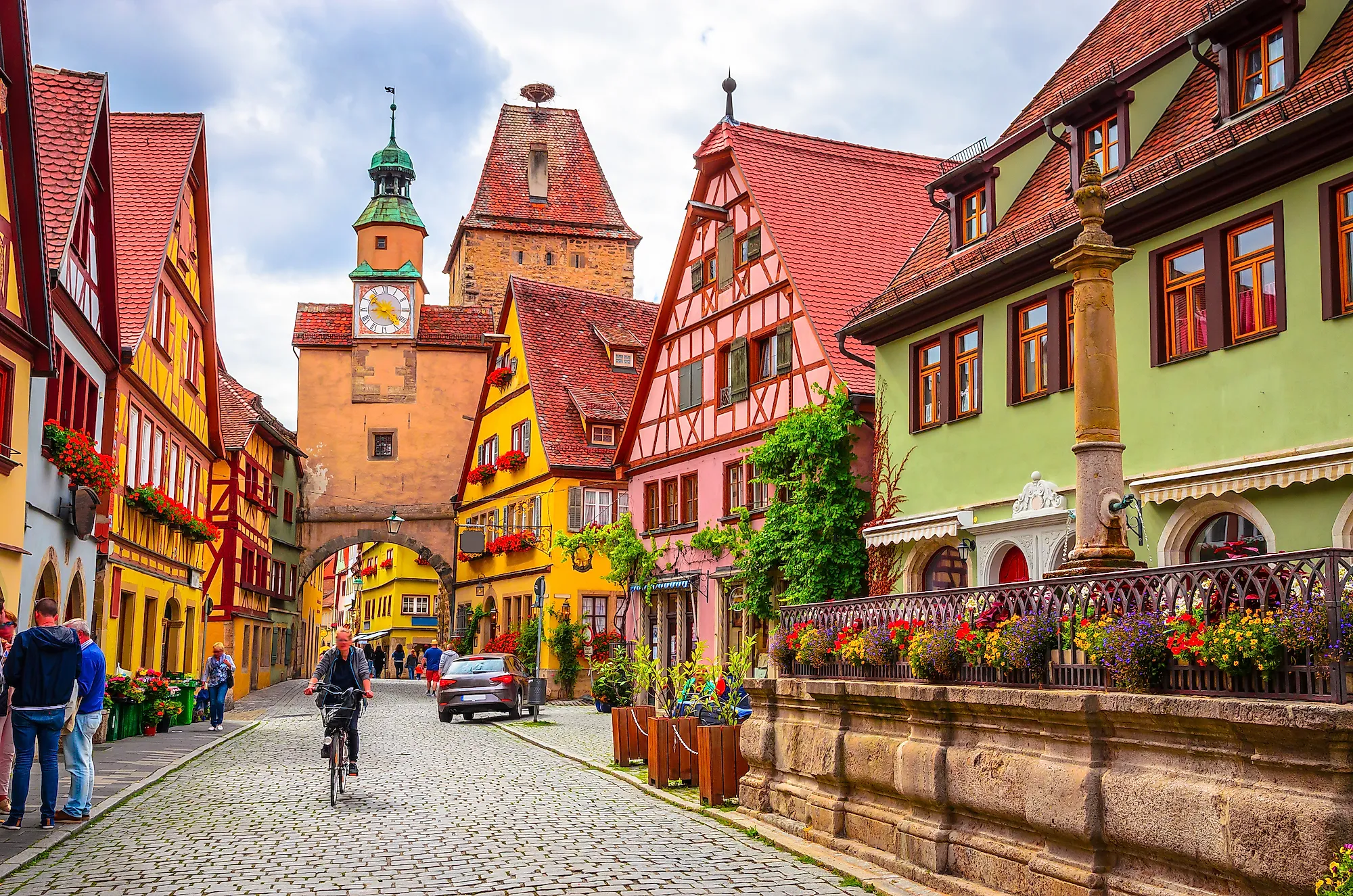
Rothenburg ob der Tauber is a walled town in the Franconian district of Middle Franconia in northern Bavaria, in the valley of the Tauber River, and is among the most completely preserved medieval city centers in Germany. The town was a free imperial city from 1274 (when Rudolf I of Habsburg granted its charter) to 1803, when it was mediatized into the Kingdom of Bavaria. Its political peak came under the burgomaster Heinrich Toppler (in office 1373 to 1408), when Rothenburg held territory and influence well beyond its walls. The town was besieged and captured by Catholic League forces under Johann Tserclaes, Count of Tilly, on October 31, 1631 during the Thirty Years' War; the local legend of the Meistertrunk ("master draught") holds that Tilly agreed to spare the town if a citizen could drink 3.25 liters of Franconian wine in a single attempt, and the former mayor Georg Nusch successfully did so. The story is almost certainly a 19th-century invention (it first appears in print in 1837), but the reenactment is performed weekly in the town hall during tourist season. Rothenburg sits on the Romantic Road (Romantische Straße), the postwar tourist route established in 1950 connecting Würzburg to Füssen, and is the central stop on the northern half.
Sistelo, Portugal

Sistelo is a parish (freguesia) in the municipality of Arcos de Valdevez in the Viana do Castelo district of northern Portugal, with a population of about 280 people in roughly 25 square kilometers. The defining feature is the system of stone-walled agricultural terraces (socalcos) cut into the steep slopes of the Vez River valley, which earned the area the local nickname "the little Portuguese Tibet" (Pequeno Tibete Português) and a place on the Seven Wonders of Portugal - Villages list in 2017. The terraces were built over centuries by successive generations of small farmers; the landscape was designated a National Monument and Cultural Landscape by the Portuguese government in 2018. The traditional economy is mixed agriculture (smallholder dairy, maize, and rye) and the corn is still stored in espigueiros, the stone-and-wood granaries on stilts that protect grain from rodents and damp. Sistelo is about a 90-minute drive northeast of Porto, mostly through the Peneda-Gerês mountains. The Brandas de Sistelo hiking trail (about 11 kilometers, marked) is the standard introduction to the landscape.
Trans-Siberian Railway, Russia

The Trans-Siberian Railway runs 9,289 kilometers (5,772 miles) from Yaroslavsky Station in Moscow to Vladivostok on the Pacific coast, making it the longest single railway line in the world. Construction began in 1891 under Tsar Alexander III, with Sergei Witte as the responsible minister, and the route was completed (with the Circum-Baikal section finished in 1904 and the Amur Railway in 1916) by the Russian Empire on the eve of its collapse. The main route crosses eight time zones, sixteen rivers, and passes through (or near) Yekaterinburg, Novosibirsk, Krasnoyarsk, Irkutsk, the southern shore of Lake Baikal (which holds about 22 to 23 percent of the world's unfrozen surface freshwater and is the deepest lake on Earth at 1,642 meters), Ulan-Ude, and Khabarovsk. Branch routes connect to Mongolia and China (the Trans-Mongolian and Trans-Manchurian lines). Following Russia's full-scale invasion of Ukraine in February 2022, most Western airlines suspended flights to Russia, the European Union and United States imposed extensive sanctions, and the United States, the United Kingdom, the European Union, Canada, and Australia all currently advise against any travel to Russia. The railway is a historical landmark and continues to operate domestically, but Western tourist access has been effectively impossible since 2022.
What These Places Have In Common
The ten entries split into three groups. Five are well-preserved historic centers that survived the 20th century with their pre-modern urban form intact (Bamberg, Leiden, Odessa, Rothenburg, and parts of central Giverny); each owes its preservation to some combination of lucky geography (off the main bombing routes of the Second World War) and active civic effort (the Sassi-style restoration of Meneham 2004 to 2009; the Sistelo terrace designation as cultural landscape in 2018; the post-1980 reopening of Monet's gardens). Three are landscape entries that depend on the natural setting rather than the built environment (Flores Island's volcanic crater lakes, Kazbek's glaciated cone, Sistelo's terraced valley). Two are honestly off-limits at the moment to most visitors (Odessa and the Trans-Siberian) for reasons that have nothing to do with their historical interest and everything to do with the war that began in February 2022. The historic significance of all ten survives the current accessibility of any of them.