5 Most Beautiful Gothic Churches In Oklahoma
Oklahoma boasts a diverse collection of churches that reflect the state’s architectural range and long-standing community traditions. St. Joseph Old Cathedral and Holy Family Cathedral feature Gothic Revival design, while St. Paul’s Episcopal Cathedral represents a Norman-style variation of Gothic architecture. Smaller communities, including Bristow and Lawton, are home to Bristow Presbyterian Church and First Christian Church, which incorporate stained-glass windows, wood trusses, and detailed architectural accents. Together, these churches reflect the faith communities that built them and the design traditions of their respective periods, appearing in both urban centers and rural towns across the state.
St. Joseph Old Cathedral

Located in downtown Oklahoma City, St. Joseph Old Cathedral is one of the state’s earliest examples of Gothic Revival ecclesiastical architecture. Construction began in 1901 and the church was completed and dedicated in 1904, serving as the first cathedral for the Roman Catholic Diocese of Oklahoma City. Its design incorporates pointed arches, steep gabled roofs, and a central spired tower flanked by shorter crenellated towers. The red brick exterior is accented with Gothic tracery and decorative stonework, creating a visually striking landmark in the heart of the city.
St. Joseph Old Cathedral sustained significant damage during the 1995 Oklahoma City bombing but was carefully restored, preserving its original Gothic features. Adjacent to the Oklahoma City National Memorial stands a statue carved from Italian marble, "And Jesus Wept," commemorating the tragic event. In 1978, the cathedral was added to the National Register of Historic Places for its architectural significance and central role in the community. Today, it continues to offer daily Mass, reconciliation, and Eucharistic adoration.
St. Paul's Episcopal Cathedral

Also located in downtown Oklahoma City, St. Paul’s Episcopal Cathedral, another notable Gothic church, was built in 1904 and designed by Arthur J. Williams. The cathedral uniquely reflects a Norman variant of Gothic Revival architecture, featuring a commanding Norman-style tower, Tiffany stained-glass windows behind the altar, and a Carrara marble altar. It was added to the National Register of Historic Places in 1977.
Like St. Joseph Old Cathedral, St. Paul's Episcopal Cathedral sustained structural damage during the 1995 bombing but was subsequently restored and expanded over the years. Today, it serves a congregation of around 1,100 parishioners, offering multiple worship services, programs, and support initiatives. The cathedral also houses a bookstore established by the Episcopal Church Women of St. Paul's, connecting the congregation to the wider Episcopal community.
Holy Family Cathedral

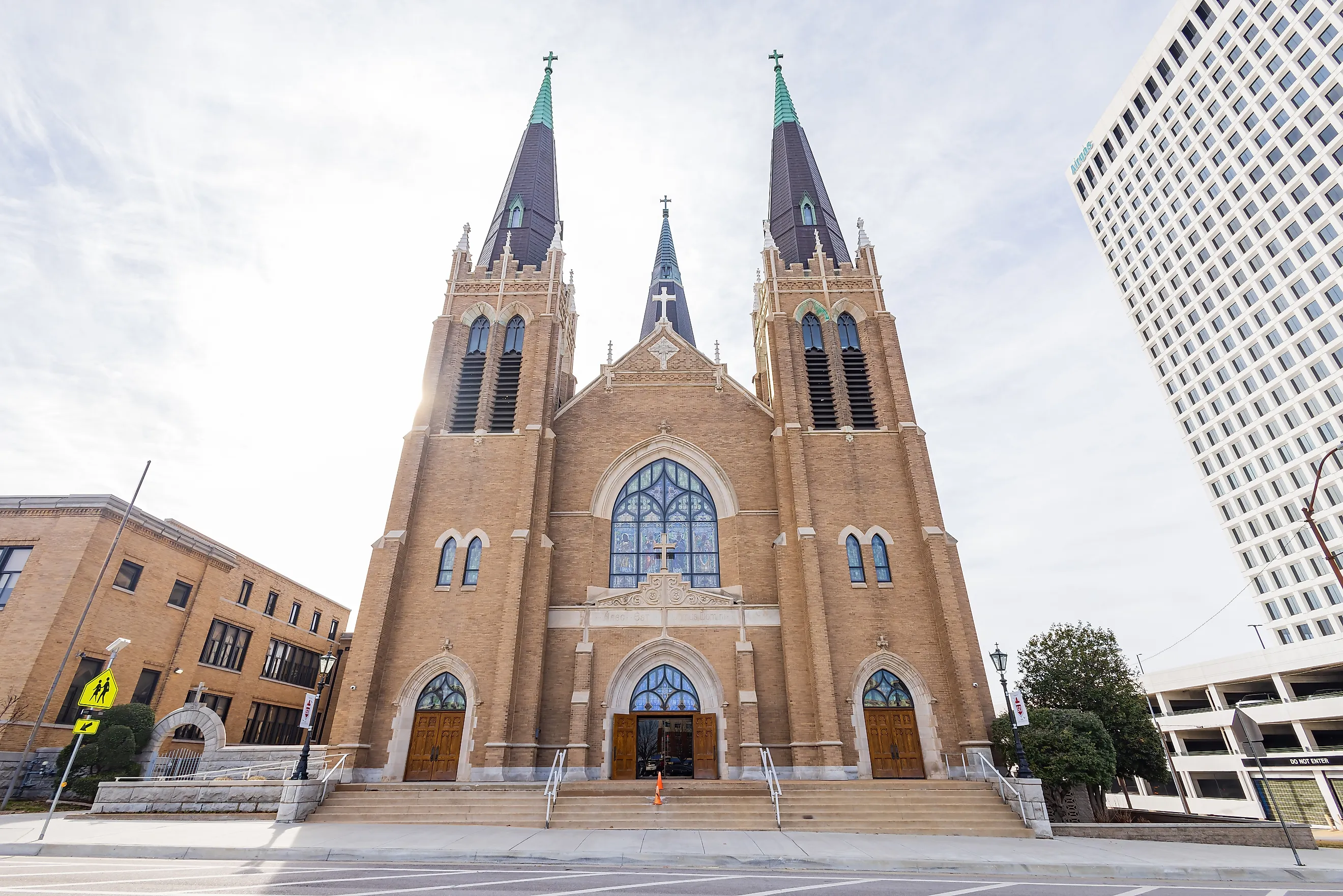
Holy Family Cathedral, originally known as Holy Family Church, serves Tulsa’s Catholic community. It is situated within the Holy Family Cathedral block, part of a larger “Cathedral Square” area noted for its concentration of ecclesiastical architecture in the city's Central Business District. Constructed between 1912 and 1914, the cathedral combines Gothic Revival verticality with classical Gothic proportions, giving it a prominent and elegant presence in the city skyline. Designed by J.P. Curtin and partners, its tall central spire was once the tallest building in Tulsa. The interior features stained-glass windows modeled after originals from the Royal Bavarian Institute of Art in Munich, Germany.
The cathedral block, which includes Tulsa’s first Catholic educational institution, Holy Family Classical School, was recognized for its architectural and historical significance and added to the National Register of Historic Places in 1982. Today, Holy Family Cathedral continues to offer daily Mass and sacraments such as baptisms, reconciliation, confirmation, and First Communion, as well as Bible study, ministries for women, men, and youth, and early learning programs, including Mother’s Day Out and Santa Casa Nursery.
Bristow Presbyterian Church

In smaller towns like Bristow, architectural gems such as Bristow Presbyterian Church demonstrate that Gothic design was not limited to urban cathedrals. Organized in 1917, the congregation has long been a cornerstone of the community, and its church building, completed in 1922 and added to the National Register of Historic Places in 1979, is an outstanding example of the style.
Funded by the local oil boom, Bristow Presbyterian Church was designed with the assistance of an outside architect, though much of the craftsmanship, including the tower, arched entryways, and red tile roof, was carried out by the pastor at the time, Reverend Thomas Murray. The exterior is constructed of Carthage marble, with Bedford stone lining the interior. Tiffany stained-glass windows and a finely crafted organ further distinguish it as one of Oklahoma’s most beautiful Gothic churches. Today, Bristow Presbyterian Church continues to serve the community with Sunday worship services and programs such as a midweek youth club.
First Christian Church

First Christian Church in Lawton was designed by Walter T. Vahlberg and rebuilt in 1929 after a fire. The three-story brick church, a notable example of Gothic Revival architecture in Southwest Oklahoma, sits on a concrete foundation with brick load-bearing walls and a full-length basement. Its pitched roof forms a cross shape, with brick gables, parapets, and a single brick chimney aligned with the wall buttresses. First Christian Church's exterior features a compound arch at the main entrance, a rose window, narrow arched windows, and decorative limestone accents.
Inside, the sanctuary has monumental wooden arches near the pulpit, a second arch around the organ pipes and baptistry, and large supporting trusses holding ornamental iron cathedral-style lanterns. In 1985, it was added to the National Register of Historic Places. First Christian Church remains an active place of worship with Sunday services, as well as community outreach programs that provide food, clothing, and other support to residents.
Oklahoma’s Gothic Church Legacy
These five Oklahoma Gothic churches, all listed on the National Register of Historic Places, reflect the architectural styles and faith communities that built them. From urban cathedrals such as St. Joseph Old Cathedral in Oklahoma City to smaller-town churches like Bristow Presbyterian Church in Bristow, they continue to function as vibrant centers of spiritual life, offering sacraments, educational programs, and community support to their members. Their preserved design elements, from stained-glass windows to spires and arches, maintain a tangible connection to the past while remaining integral to the life of their congregations and the wider communities they serve across the entire state of Oklahoma.