5 Most Beautiful Gothic Churches In Hawaii
The tropical islands of Hawaii aren’t the first place you’d expect to see towering cathedrals reminiscent of Notre Dame. When European missionaries arrived in the islands in the 1800s, they brought with them Gothic Revival architecture, an adaptation of medieval Gothic forms that had shaped European churches centuries earlier. Today, remnants of this style can still be seen throughout the Aloha State in its historic churches and chapels. These sacred spaces aren’t just beautiful examples of Gothic-inspired craftsmanship; they’re also key historic sites that provide a window into Hawaii’s past.
What is Gothic architecture?

Popular from the mid-12th century to the 16th century, Gothic architecture is known for its distinctive features, including dramatic pointed arches, colorful stained-glass windows, tall, jagged spires, and intricate tracery. In the 18th and 19th centuries, designers revived these ideas in the Gothic Revival movement, which is the form most often seen in Hawaii’s historic churches. Architects sought to create skyscraping buildings that encouraged worshippers to look heavenward and allowed plenty of natural light to seep into the space.
Despite the slur, Gothic architecture influenced church design for centuries. As it spread and evolved, it took many forms, among them High Gothic, English Gothic, Carpenter Gothic, and later Gothic Revival. In Hawaii, most surviving examples reflect Gothic Revival and related vernacular styles, from stone cathedrals to simple New England-style wooden churches. In many cases, the church architects have blended local features into the design to honour Hawaii’s rich heritage, blending old-world aesthetics with island culture.
St Andrews Cathedral, Honolulu, Oahu

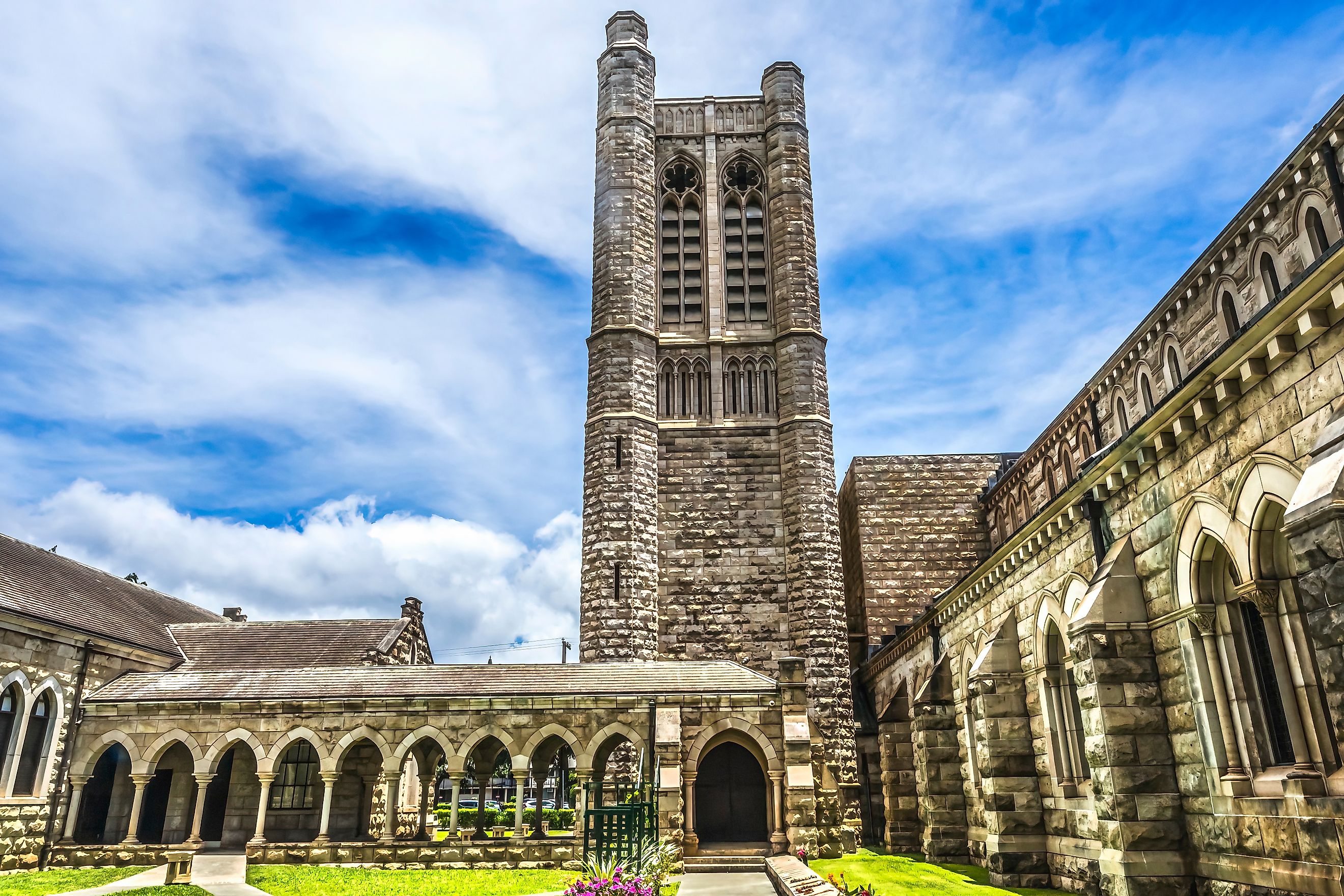
Inspired by the Gothic cathedrals of Europe, St Andrews Cathedral in Honolulu is a local landmark that’s seen over 150 years of history. The church was originally commissioned by King Kamehameha IV, but after his death in 1863, his wife, Queen Emma, took up the plans. Visiting England in 1865, she selected plans in a modified 12th-century French Gothic style and returned home determined to emulate it in the islands. The cornerstone of St Andrew’s was laid two years later, but Queen Emma died before the first phase of the cathedral was finished in 1886. Built in stages, the church was finally completed in 1958.

Today, the church is the seat of the Episcopal Diocese and an architectural treasure. It has many of the hallmarks of the Gothic Revival design, including huge columns, vaulting, intricate carvings, and striking stained glass panels. The cathedral is not a carbon copy of the European model, however. Elements of Hawaii have been carefully incorporated into the design to honour the islands' heritage. Carvings include island motifs such as tree fern, breadfruit, and papaya, and the walls are made of O'ahu beach stone. One of the cathedral’s eye-catching features is the Great West Window, whose lower right section tells the story of the Anglican and Episcopal Church in Hawaii.
St Benedict’s Catholic Church, Honaunau, Big Island

Also known as the Painted Church, St Benedict’s is a popular tourist attraction thanks to its unusual artwork. The church was built between 1899 and 1902 by Belgian priest Father John Velghe, who spent those years painstakingly building and beautifying the structure.
At the time, many Hawaiians could not read, so Father Velghe hit upon the idea of telling the story of the Gospels through Biblical murals. He painted frescoes depicting various biblical scenes, now often described as an example of American folk art. The paintings and the church’s design aim to evoke a miniature European Gothic cathedral. St Benedict’s attracts thousands of visitors a year and is listed in the Hawaii State Register of Historical Places and the National Register of Historical Places. There is a small museum at the back of the parish hall, and visitors are also encouraged to visit the two historic cemeteries on the far side of the property.
Kaahumanu Church, Wailuku, Maui

Built in 1876, the Kaahumanu Church was founded by American missionaries and named for Queen Ka'ahumanu, an early convert to Christianity who was so impressed by the Wailuku congregation that she asked the church to carry her name.
The church is now listed on the National Register of Historic Places and the Hawaii State Register of Historic Places due to its historical significance. Made of blue stone with thick walls, a high-pitched gable roof, and a clock tower, the church is a grand example of simple Gothic Revival in the New England style. It carries the signature tall arched windows of the Gothic style, as well as elaborate wood carvings and window tracery.
Immaculate Conception Church, Ewa, Oahu

The quaint blue-and-white building of the Immaculate Conception Church in Ewa, Oahu, is a striking example of how the Gothic style can be incorporated into a simple wooden structure. This Roman Catholic church can trace its history back to the late 1800s, when the community that later became Ewa sprang up around a sugar plantation. Attracting many Portuguese, Filipino, and Japanese immigrant workers, the plantation quickly became a village, and that village needed a church.
A simple building was constructed near the local sugar mill, but the congregation quickly outgrew the space and, in 1929, the present church opened its doors. The Gothic Revival building features white clapboard siding, a Gothic-arched portico, and a tracery-laden window. Additional features include a corner bell tower and an octagonal chapel. Inside, visitors are greeted with lancet windows and high wooden ceiling beams.
Makawao Union Church, Makawao, Maui

Founded by New England missionary Jonathan Smith Green, Makawao Union Church is a single-storey Gothic church with reinforced concrete walls, a lava-rock veneer, and a large square Norman tower. Constructed in 1917, the church is listed on both the Hawaii and National Registers of Historic Places and is recognized for its craftsmanship.
The tower dominating the facade contains a belfry, a clock, and the main entrance to the church. The roof is covered in slate from Vermont. Inside, notable features include wrought-iron chandeliers, delicate oak tracery, and four memorial stained-glass windows preserved from the church’s earlier building, which the congregation occupied in 1889.
Makawao Union Church was designed by prominent American architect C.W.Dickey, who was raised in Hawaii and had a profound influence on the archipelago’s architecture. Dickey led the move toward designs appropriate to the islands, adapting European designs to Hawaiian settings and creating some of the state’s most famous buildings.
Aloha Architecture
One of the reasons the Gothic Revival design has stood the test of time is its adaptability. Its unmistakable features have been reinterpreted across different eras and settings while preserving their original intent to evoke celestial beauty. In Hawaii, the Gothic style has helped preserve the state’s unique heritage, make use of local resources, and provide places of worship across generations.