These 6 South Carolina Towns Have The Best Historic Districts
South Carolina’s historic districts turn an ordinary walk into a trip across centuries. Beaufort’s colonial street grid leads past Tabby Manse and homes that served Union forces during the Civil War. In Georgetown, the Old Market Building and Prince George Winyah Church recall the rise of one of the Lowcountry’s oldest ports. Abbeville’s Court Square shifts the scene to Beaux-Arts grandeur with its courthouse and still-active Opera House. Across these towns, preserved streets and landmarks reveal how South Carolina rebuilt and expanded without erasing its past.
Beaufort

Beaufort's historic district is compelling because its streets preserve several distinct chapters of South Carolina history within the same small area. Beaufort was laid out in 1710, and its regular street grid, modified to fit the shoreline of the Beaufort River, remains a defining feature of the approximately 304-acre historic district. Much of the architecture seen along those streets dates from the town's growth during the antebellum period, when Beaufort became an important center of the Lowcountry plantation economy. The Civil War brought another major shift to the town. Union forces occupied the area, and many buildings in the district were converted into military offices, hospitals, and quarters.
This history is reflected in the district's buildings. The Tabby Manse, built around 1786, is among Beaufort's earliest surviving houses and illustrates the Lowcountry use of tabby, while the William Barnwell House, dating to 1816, represents the larger residences that appeared during the town's antebellum growth. For a closer look at the Civil War and Reconstruction chapter of the town's identity, the Reconstruction Era National Historical Park's visitor center occupies the Old Beaufort Firehouse on Craven Street. The National Park Service identifies the surrounding district as a place where the experiences of former enslaved residents became an important part of the town's postwar history.
Georgetown

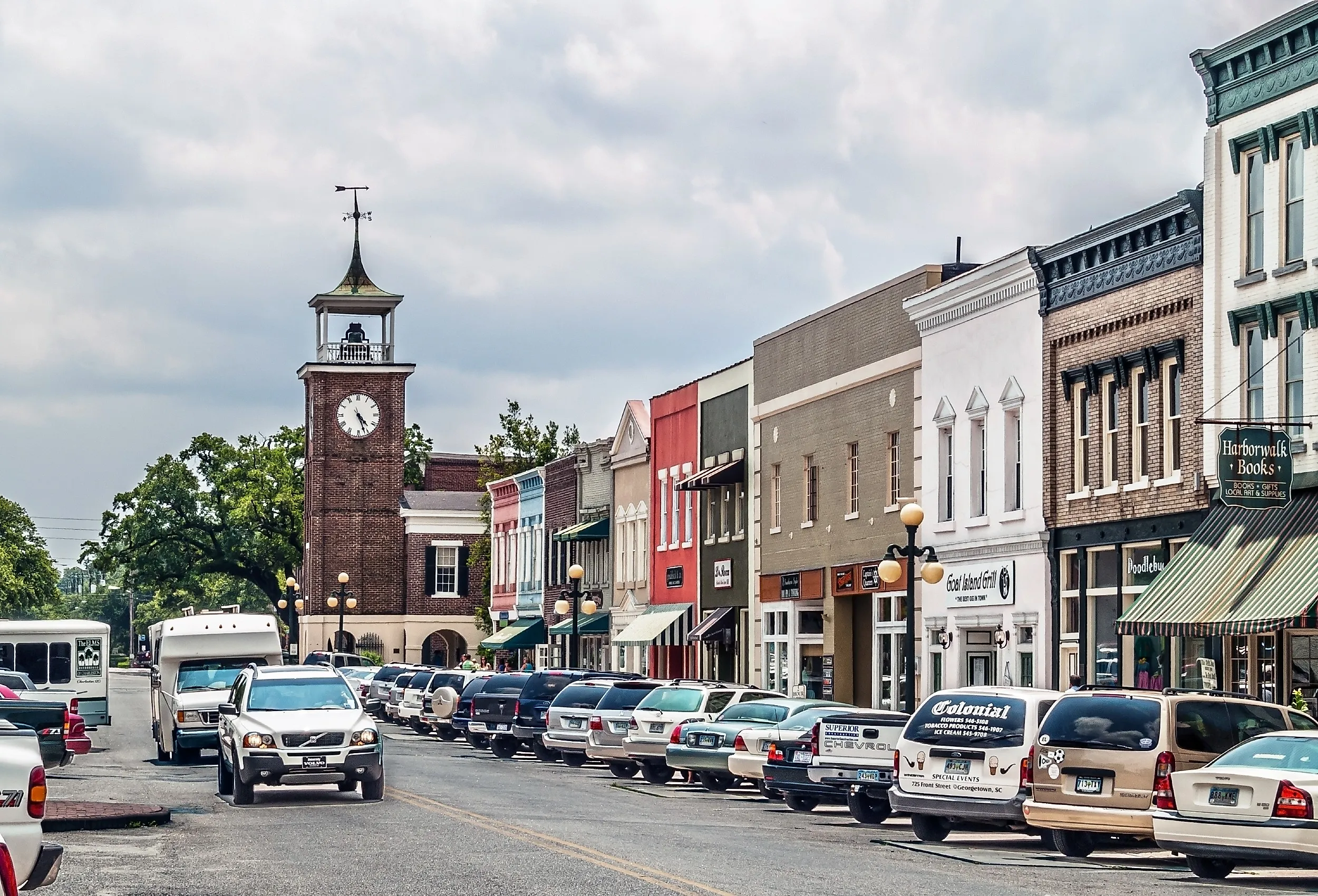
Georgetown was laid out in 1729, and a 1735 plan divided the settlement into blocks crossed by five streets running at right angles to the river. That early layout still shapes the district, where roughly 28 surviving structures date to the 18th century, alongside later buildings from the antebellum period and beyond. The architecture traces Georgetown's growth from an early colonial settlement into a major center of the Lowcountry rice economy, with Georgian houses, churches, public buildings, and more elaborate Classical Revival structures littering the area.
The Old Market Building, constructed around 1832, served as a market, town hall, and jail before becoming the Rice Museum. Its iconic clock and bell tower were added in the 1840s. Prince George Winyah Church, dating to about 1750, is another important survivor from Georgetown's colonial era and was occupied and damaged by British troops during the Revolutionary War. The district also preserves the Joseph H. Rainey House, associated with the first Black member of the U.S. House of Representatives, who began his political career in Georgetown.
Camden

Camden's historic district reflects a town that had to rebuild itself. A fire in 1813 destroyed much of the community, changing the course of its development as new construction spread into what became the Kirkwood neighborhoods. The area initially attracted summer residents, but by the 1840s, larger homes and permanent residences were reshaping it into a substantial residential section of Camden. That period of rebuilding left behind a collection of Federal, Georgian, Greek Revival, Classical Revival, and Charleston-influenced architecture that now forms much of the district's character.
The town highlights some of Camden's most significant civic and religious architecture. The Robert Mills Courthouse, completed in 1827, is one of the few surviving South Carolina courthouses designed by the building's namesake, while the Bethesda Presbyterian Church, completed in 1822, is another prominent example of his work. The Historic Camden Revolutionary War Site adds an earlier chapter to the story, interpreting Camden's role during the Southern Campaign of the American Revolution.
Abbeville

Abbeville's historic district is a public square that still serves as the town's architectural and civic center. The community formed in the late 18th century, but much of the district's surviving material dates from the 19th and early 20th centuries, when Abbeville developed into a commercial and governmental center for the surrounding county. Of the district's 528 properties, 319 contribute to its historic character, including residences, churches, schools, railroad buildings, and a concentration of late 19th-century commercial structures around Court Square.
The Abbeville County Courthouse dates to 1908, while the adjacent Abbeville Opera House dates to 1904; together, their Beaux-Arts Classical architecture gives the square an especially cohesive early 20th-century appearance. The Opera House operated as a cultural venue for theatrical productions, public speeches, and community events, and remains one of South Carolina's notable surviving theaters. Elsewhere in the district, architectural styles range from Second Empire and Gothic Revival to Queen Anne and Bungalow, emphasizing the area's rich history and growth. The Burt-Stark Mansion preserves the site of Jefferson Davis's final council of war in May 1865 and is a National Historic Landmark.
Edgefield

Edgefield's historic district stands out for the way architecture and South Carolina's history intersect. The town's village green, established near the present-day Courthouse Square by 1787, remains the center of the district, with more than 40 19th-century buildings surrounding or extending from it. Greek Revival residences, Victorian-era houses, churches, and commercial buildings reflect the town's growth, while the area's civic importance is tied to the remarkable number of state and national political figures associated with Edgefield. The South Carolina Department of Archives and History notes that the town produced ten governors, five lieutenant governors, and several members of Congress and the U.S. Senate.
For an in-depth historical look at the area, the Edgefield Town Square is the place to start. The D.A. Tompkins Library provides local historical context, while the Oakley Park Museum, an 1835 historic house museum, adds an architectural view of the period. The architecture of Edgefield is its center point, with Greek Revival houses lining the square. There are also numerous churches across the town, ranging in style from Georgian to Victorian Gothic.
Walterboro

Walterboro's historic district is largely made up of its houses and neighborhood institutions. Most of the area's properties date from about 1800 to 1945, reflecting Walterboro's development as a pineland settlement founded in the early 19th century by Lowcountry planters seeking a cooler climate. The result is a melting pot of styles that blend to create a highly distinctive appearance. The district was added to the National Register of Historic Places in 1980 and expanded in 1993.
Several buildings illustrate this unique atmosphere perfectly. The Walterborough Library Society Building, dating to about 1820 and commonly called the Little Library, is one of the district's earliest surviving structures and was built for a literary society established by local residents. The Bedon-Lucas House, also constructed around 1820, represents the early residential character of the community, while the Walterboro High School reflects the town's immense growth. Added to the historic district in 1993, the former Walterboro High School, designed by James B. Urquhart and J. T. Dabbs, is now part of USC Salkehatchie's East Campus at 807 Hampton Street.
History You Can Walk Through
These districts turn South Carolina history into something visitors can see at street level. Beaufort’s colonial grid, Georgetown’s Old Market Building, and Abbeville’s Court Square each preserve a different chapter of the state’s past. Houses, churches, and civic buildings gain greater meaning from the neighborhoods around them. In these towns, centuries of change remain visible in every block.