The Great Lakes Forts You Can Walk Through
For 150 years, the Great Lakes were a contested frontier where France, Britain, the United States, and powerful Indigenous nations fought over the fur trade, the water highways, and eventually the border itself, and the strongholds they built to hold it all have aged astonishingly well. A surprising number still stand with their gates open: forts where costumed garrisons fire the noon cannon, where archaeologists have been digging the same ground for 65 years straight, and where a visitor can climb the actual ramparts that watched empires trade places. These are the Great Lakes forts you can still walk through, each one carrying a story stranger than its stone.
Fort Mackinac, Mackinac Island, Michigan

Perched on a bluff 150 feet above Mackinac Island's harbor, Fort Mackinac is the Great Lakes fort experience at full production value: 14 original buildings, costumed soldiers, rifle and cannon demonstrations all day, and the best view in the straits from the gun platforms. The British built it in 1780 during the Revolution, and its Officers' Stone Quarters ranks among the oldest buildings in Michigan, still standing at the heart of the post.

Its claim on history is one of the war's best anecdotes: in July 1812, a British and Native force landed by night, hauled a cannon to the island's high ground, and invited the American garrison to surrender, which it did, in part because Washington had not yet told its own soldiers that the War of 1812 had started. The fort soldiered on until 1895, which is why it survives so completely, and the island around it still bans cars, so the approach remains horse, bike, or boots.
Colonial Michilimackinac, Mackinaw City, Michigan

At the foot of the Mackinac Bridge sits the straits' older fort, Michilimackinac, built by the French around 1715 as a fur-trade hub where voyageurs, Odawa and Ojibwe traders, and soldiers did business inside a wooden palisade. Today's fort is a meticulous reconstruction standing on the original footprint, and beneath it runs its greatest distinction: archaeologists have excavated here every summer since 1959, one of the longest continuously running digs in North America, and visitors in season can watch artifacts come out of the ground that will be in the exhibit cases a few years later.

The fort's darkest, most famous hour came in June 1763, during Pontiac's War, when Ojibwe men staged a game of baggataway, lacrosse's ancestor, outside the gate, lofted the ball over the wall as if by accident, and followed it in, seizing the fort from the British garrison in minutes. The story is told on the very ground where it happened, which is the whole appeal of the place: at Michilimackinac, the past is not behind glass, it is underfoot.
Old Fort Niagara, Youngstown, New York

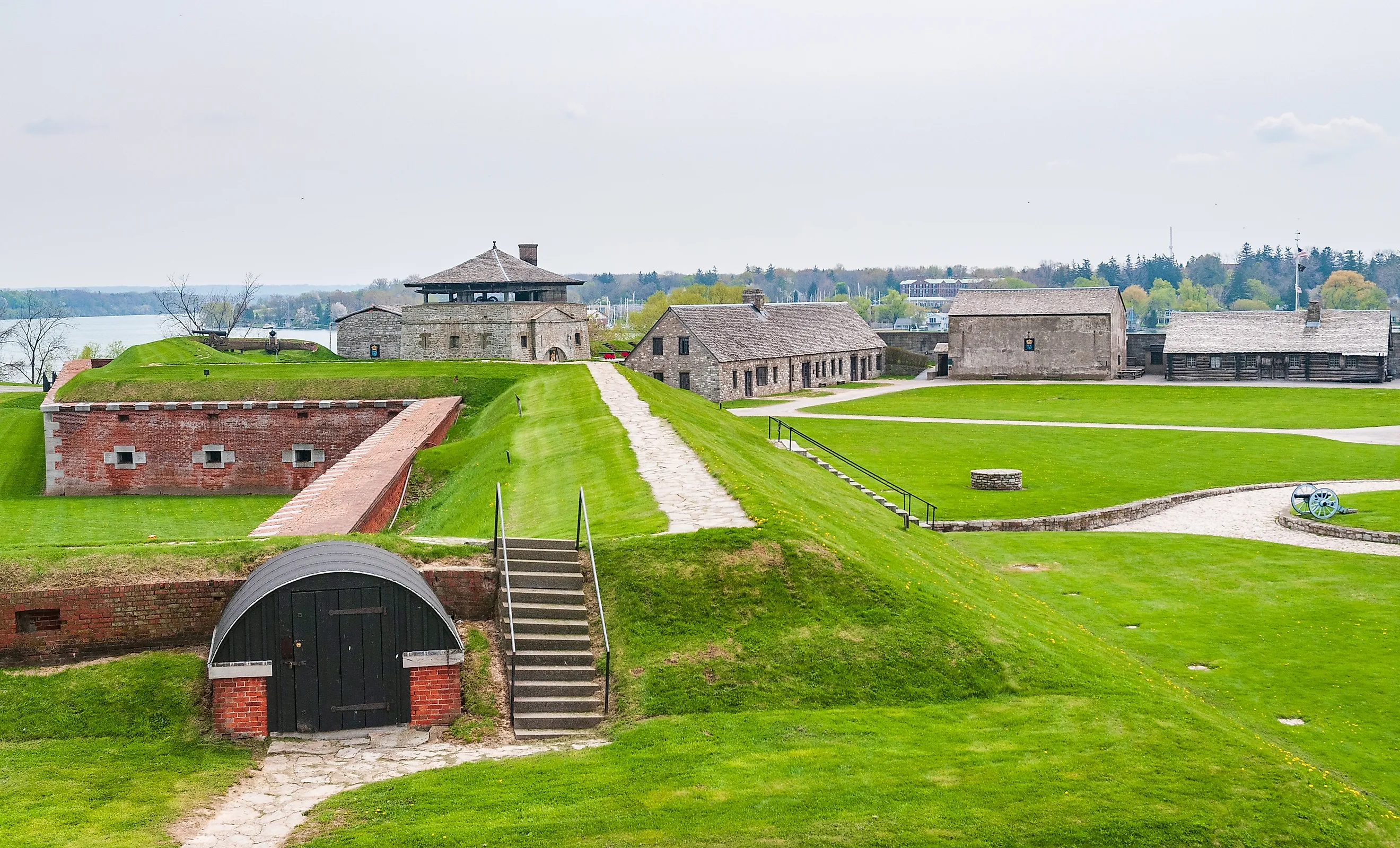
Where the Niagara River empties into Lake Ontario stands the patriarch of them all. Old Fort Niagara's centerpiece, the French Castle of 1726, is often called the oldest building on the Great Lakes, and the post it anchors was garrisoned continuously from the 1720s into the 1960s, a run that saw the flags of France, Britain, and the United States each fly over the same walls. All three still fly there today, which makes the parade ground a one-stop tour of who ran this frontier and when.

The Castle itself is a masterpiece of diplomatic architecture: France needed a fortress on Seneca land where the Seneca had permitted only a trading house, so the engineers built a fortress disguised as one, a great stone "House of Peace" with gun positions worked quietly into the design. Walking its halls, pocked with musket loopholes and period rooms, is the closest the region offers to stepping into the French and Indian War.
Fort George, Niagara-on-the-Lake, Ontario

Directly across the river mouth from Fort Niagara, close enough that the two forts shelled each other, stands its British rival. Fort George headquartered the British Army on the Niagara frontier in the War of 1812, fell to an American amphibious assault in May 1813 after a bombardment that flattened most of it, was retaken that winter, and today stands handsomely rebuilt inside its earthworks at the edge of Niagara-on-the-Lake's wine-and-theatre gentility, where musket demonstrations crackle a short walk away from tasting rooms.
The garrison experience leans immersive, with redcoat drills, fife and drum, and the blockhouses and officers' quarters furnished to the eve of the war. The pairing is the real attraction: stand on Fort George's ramparts and look across the river at the fort it fought, two enemies now holding a permanent truce 800 yards apart, with the war between them still argued about on both banks.
Fort Henry, Kingston, Ontario

Where Lake Ontario funnels into the St. Lawrence at Kingston, Britain built its insurance policy: Fort Henry, completed in the 1830s to guard the Rideau Canal's entrance and the naval dockyard against an American invasion that never came. It is the largest fortification on the list, a massive limestone citadel whose casemates, ditches, and ramparts now form part of the Rideau Canal UNESCO World Heritage Site, and its garrison lives on as the Fort Henry Guard, a trained interpretive unit whose drill, artillery salutes, and sunset ceremonies are a Kingston institution.
The fort's working life was almost entirely peaceful, which the interpretation embraces: this is the place to see how a Victorian garrison actually lived, from the schoolroom for soldiers' children to the officers' quarters, inside walls built for a war that stayed hypothetical. As military history goes, it is the happy ending, a superweapon that retired unfired into show business.
Fort Wilkins, Copper Harbor, Michigan

At the very tip of the Keweenaw Peninsula, about as far north as Michigan goes, Fort Wilkins is the oddball of the list: a fort built in 1844 not against a foreign empire but to keep order in America's first mineral rush, when copper fever flooded the wilderness with miners and the army arrived to referee. The feared trouble never materialized, the garrison spent its hitch battling isolation and winter instead, and the post was largely abandoned within two years, which froze it in time.
That abandonment is the visitor's gain. Preserved as a state park, Fort Wilkins keeps a dozen-plus buildings, many original 1840s structures, furnished to the copper-rush moment, with Lake Fanny Hooe behind and Superior's wild shore in front, and summer interpreters playing out garrison life at the end of the road. It is the only fort in America whose enemy was essentially boredom, and it lost honorably.
Historic Fort Wayne, Detroit, Michigan
Detroit's fort is the sleeper. Begun in the 1840s on the Detroit River, where the border bends closest, star-shaped Fort Wayne was engineered to duel British Canada across half a mile of water, mounting its original 1848 limestone barracks and massive earthen star walls, and then never fired a shot in anger in over a century of service, instead processing troops for every American war from the Civil War through Vietnam. The restored star fort and barracks open to visitors seasonally, with volunteer-led tours working through a restoration that is very much in progress.
What Fort Wayne offers is scale and strangeness: a genuine bastioned fortress inside a modern city, with Canada visible across the water it was built to bombard, now watching freighters pass instead. For anyone tracing how the world's longest peaceful border got that way, the fort that spent 100 years waiting for a war that never came is the whole story in masonry.
Walls That Outlived Their Wars
Seven forts, four nations' flags, and not one of them defending anything anymore, which is exactly what makes the Great Lakes fort trail worth driving. Together they bracket the whole arc: French traders behind a palisade, a castle disguised as a peace house, redcoats and bluecoats shelling each other across a river mouth, a citadel for an invasion that stayed on paper, and an army post that guarded a copper rush from itself. The lakes they watch are the same, the garrisons are actors and archaeologists now, and the noon gun still fires on schedule, aimed, these days, at nothing but applause.