7 Must-See Historic Forts In New Mexico
New Mexico is dotted with the ruins and remnants of 19th-century military forts. Most are still open to visit. Together, they tell a complicated story that touches on trade routes like the Santa Fe Trail and El Camino Real, the Civil War's reach into the Southwest, the forced removal of Native peoples, and the Buffalo Soldier regiments who served across the territory. These seven forts are worth the drive.
Fort Union National Monument

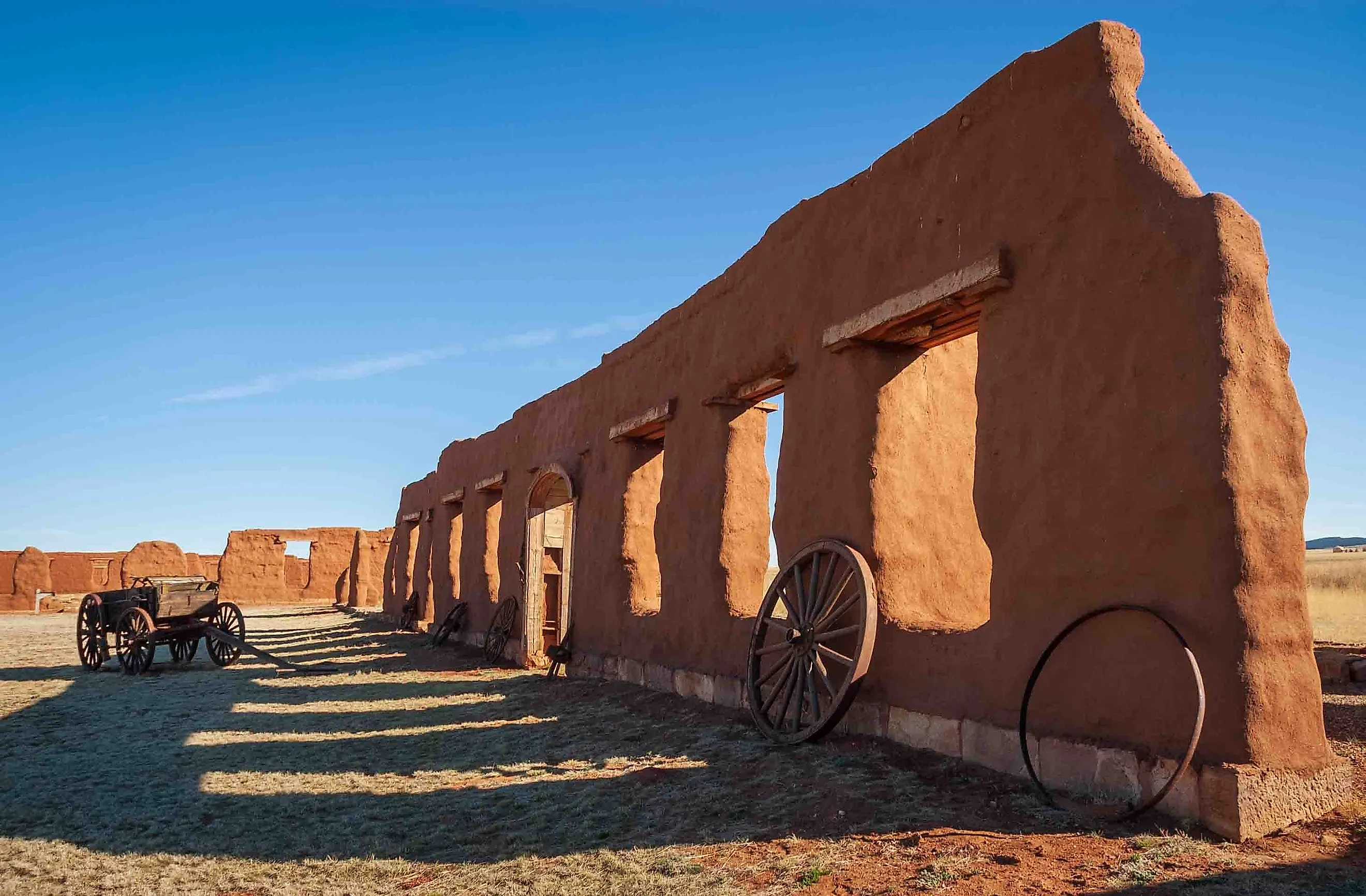
Fort Union National Monument preserves the adobe ruins of three forts built at the same site, along with remnants of the Santa Fe Trail. The first Fort Union, built in 1851 with pine logs, served as a supply depot and security post on the Santa Fe Trail; only its stone foundations remain today. The second, built in 1861, was an earthwork fort constructed during the Civil War to defend against a possible Confederate advance.
The third Fort Union was built in 1862 and remained in service until 1891. It was built in the territorial style, a blend of Spanish-Pueblo adobe construction with American Victorian and Greek Revival elements. The stone foundations supported adobe brick plastered with lime-fired plaster, and red bricks brought in from outside the territory added further ornament. A highlight at the site is the Santa Fe Trail Ruts, swales cut into the prairie by thousands of wagons traveling along the trail through the 19th century.
Fort Stanton Historic Site

Fort Stanton is one of the best-preserved military posts in the region. The site has 88 buildings, including a hospital, morgue, and officers' quarters, many of which are still intact. Built in 1855 amid conflicts with the Mescalero Apache, the fort also played a role in the Civil War and was a base for Buffalo Soldiers, the African American regiments in the post-Civil War U.S. Army.
The 9th and 10th Cavalry and the 24th and 25th Infantry regiments served across the western territories, where they protected settlers and later served in early national park patrol roles as parks were established in the late 19th century. The name Buffalo Soldiers is traditionally attributed to Native American tribes who encountered them, though the exact origin is debated. Fort Stanton's buildings were later used during World War II as an internment camp, mostly for German nationals.
Fort Selden Historic Site

The former U.S. Army post in Radium Springs is known for its adobe ruins and for its role in Buffalo Soldier history. Built in 1865, the fort was established to protect settlers and travelers along El Camino Real de Tierra Adentro, the 1,600-mile trade route established by the Spanish in 1598 between Mexico City and the territory that became New Mexico. The fort was a duty station for African American units at various times, including the 125th U.S. Colored Infantry in its first year and, later, elements of the 9th Cavalry.
The fort was built on the site of a prehistoric Mogollon village dating back to around 400 CE. In the 1880s, Douglas MacArthur lived at Fort Selden as a boy; his father, Arthur MacArthur Jr., was post commander at the time. The fort was decommissioned in 1891 as military conflicts in the region declined and the arrival of the railroad reduced its strategic value. Abandoned, it became a New Mexico State Monument in 1973.
Fort Craig Historic Site

Located in present-day Socorro County, Fort Craig preserves the ruins of a 19th-century U.S. Army outpost. The fort was one of the largest in the American West. By 1862, it had become central to the Battle of Valverde, the largest Civil War battle in the American Southwest. Fort Craig was important for stopping the advance of Confederate troops; Union forces even used "Quaker guns" (painted logs made to look like cannons) to discourage a direct assault.
When first established in 1854, the fort's primary function was protecting El Camino Real de Tierra Adentro and responding to raids by Apache and Navajo groups. Fort Craig also served as a base for the Buffalo Soldiers of the 9th Cavalry. Today, its adobe and stone ruins are preserved, including portions of the outer walls and building foundations.
Bosque Redondo Memorial at Fort Sumner Historic Site

Fort Sumner, established in 1862, is today best known as the site of the internment of Navajo and Mescalero Apache people at the Bosque Redondo Reservation between 1863 and 1868. The fort's stated function was to secure the region and support U.S. military operations. Following the Long Walk, a series of forced marches during which many Diné died or were taken captive by slave traders, the fort became the site of internment for more than 9,000 Navajo and around 500 Mescalero Apache.
The government intended to resettle the tribes as farmers, but the land was poor and dry, with little water. With the failure of this forced resettlement, the government closed the post in 1869 and signed a treaty allowing the Navajo to return to their homeland. The Bosque Redondo Memorial today is set among the ruins of the original fort and functions as a commemorative site and museum.
Fort Bayard National Historic Landmark

Located in southwestern New Mexico near Santa Clara, Fort Bayard was established in 1866. During the Apache Wars, several regiments of Buffalo Soldiers (the 9th and 10th Cavalry and the 24th and 25th Infantry) were stationed here to protect settlers and miners. A monument to the Buffalo Soldiers stands on the grounds, specifically honoring Medal of Honor recipient Corporal Clinton Greaves.
John J. "Black Jack" Pershing was stationed at Fort Bayard in 1886 as a young officer. The nickname "Black Jack" emerged later in his career, associated with his command of Buffalo Soldier units including the 10th Cavalry. In 1899, the fort was converted into a hospital facility and became the U.S. Army's first tuberculosis sanitarium; the dry air was well-suited for convalescence. It later operated as a Veterans Affairs hospital, and by 1943, it was being used to house German prisoners of war.
Fort Marcy

Little remains of what was once an irregularly shaped star fort, among the first U.S. military installations built in the New Mexico Territory and among the few surviving sites from the Mexican-American War era in the region. After the U.S. annexation of the New Mexico Territory, the fort was built as part of the Fort Marcy Military Reservation on a hilltop overlooking Santa Fe. Its 14 cannons were positioned to defend against a potential counterattack. Abandoned in 1894, what remains of the fort is a few earthen mounds from the adobe walls and the outlines of its foundation. The ruins are situated in Fort Marcy Park and have historical markers with information about the fort and its history. The ruins and the site are on the National Register of Historic Places.
Also part of the Fort Marcy Military Reservation is the Fort Marcy Officers' Residence, built in the 1870s. When the fort was abandoned, the residence was maintained as housing for local political families. It was remodeled in 1916 in the Pueblo Revival style and was transferred to the Museum of New Mexico. In 1975, the National Park Service listed the residence on the National Register of Historic Places.
What These Forts Reveal About New Mexico's Past
These preserved forts and historic sites are a direct link to the 19th-century American West. Beyond their role as tourist destinations, they document the difficult history of westward expansion and the relationship between the U.S. government, the army, and Native peoples in the territory. Their histories touch on military conflict, westward expansion, the Civil War, Native American communities, and the experiences of Buffalo Soldiers in New Mexico.