5 Must-See Historic Forts In Utah
Utah's military forts are like historical fingerprints, pointing back to the state's origins. Some were built to maintain order, while others functioned as leapfrogging survival and trading hubs for further territorial expansion. All have an interesting place within U.S. history thanks to their construction quirks. Old Fort Deseret came together over just 18 days in 1865 by 98 men during the Black Hawk War. Cove Fort was constructed using black volcanic rock for intense fire resistance. The five forts ahead earn their place as must-see attractions for history buffs visiting Utah.
Two major factors influenced fort construction within Utah. The Black Hawk War, fought between Mormon settlers and Ute, Southern Paiute, Navajo, and Apache groups between 1865 and 1872, was the longest and most destructive conflict between Indigenous peoples and pioneer settlers in Utah history. Meanwhile, the Mormon Corridor series of waystations between Salt Lake City and California served as rest stops, medical care, and resupplying stations for weary or beleaguered travelers.
Cove Fort

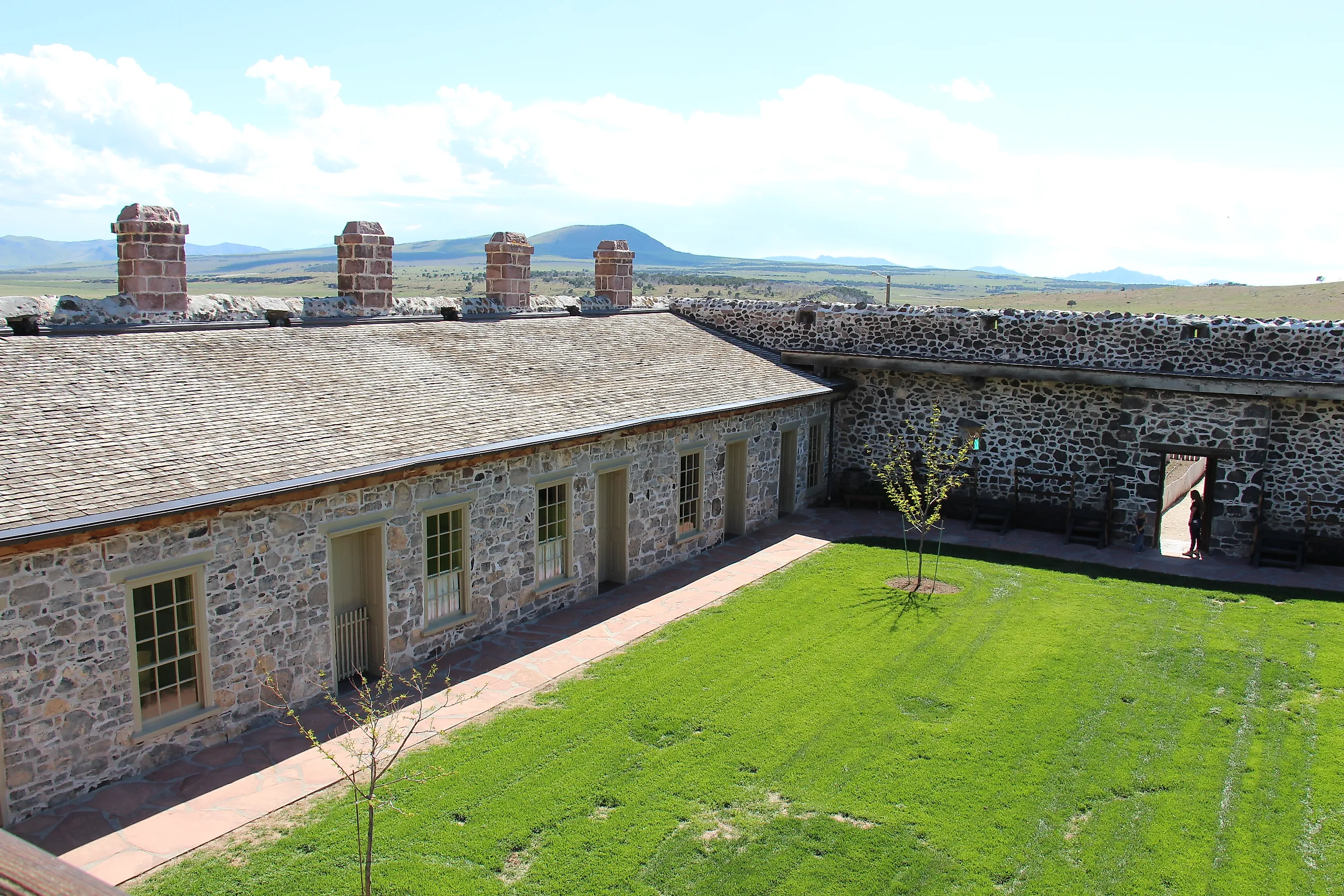
This Millard County fort served as a way station for travelers seeking refuge from the harsh wilderness. According to sources affiliated with the Church of Jesus Christ of Latter-day Saints, Cove Fort reportedly never suffered an attack and maintained positive relationships with the local Pahvant Ute and Navajo nations. It is unclear whether its construction and design ultimately contributed to increased safety, or if it was simply serendipitous geography that kept the area battle free. While it still stands, it used to serve as the Gilmer Salisbury Stagecoach line rest stop in addition to housing the area's telegraph office. Today, Cove Fort is classed as a restored historic fortification, uniquely constructed out of rare volcanic rock (under the request of Utah luminary Brigham Young himself). It primarily serves as a historic site, completed and dedicated in 1994 by former LDS President Gordon B. Hinckley, and tours are offered year-round. As far as must-see forts in Utah, this one tops the list.
Fort Pearce

Named after Captain John D. L. Pearce, a local military leader, Fort Pearce was originally envisioned to be a defensive garrison during the Black Hawk War (against raids by the Ute and Navajo tribes). This was not a federally mandated facility, however, but one constructed by local Mormons who saw the need arising for their own personal protection, specifically in dealing with raiding parties. According to the BLM, it was designed for around four to six men, who could signal nearby settlements in case of attack. Signals would have been carried out by armed riders who might be dispatched at the first sign of trouble. This is likely another reason why the fort itself had no roof, so that livestock could also be housed inside. While it is perhaps not the most magnificent attraction these days (it is largely in ruins), Fort Pearce could serve as part of a nice multi-stop day trip, and the general area is also wide in its natural beauty.
Fort Deseret Historical Site

These days, Fort Deseret is little more than a singular wall stretching the length of the original site, but it is still considered to be a worthy historical curiosity. In other words, definitely more of an archaeological interest as opposed to an architectural one. Built in 1865, it is the only remaining example of an adobe mud-and-straw fort in the entire state, and was said to have been constructed in just 18 days by 98 men (during the Black Hawk War). There is also a very interesting story associated with the origins of this fort, as it was Brigham Young who established a contest (designed to speed up production) wherein the losing team had to provide a dinner and dance for the winners. Disparate sources also seem to indicate that its presence successfully averted a major conflict in the spring of 1866. All of this makes Fort Deseret a very interesting stop on a larger itinerary of related sites.
Bluff Fort Historical Site

While not constructed for military purposes, Bluff Fort still served similar purposes for travelers and pioneers of the 1800s, acting again as a critical way station and haven from conflict. Its moniker apparently stems from the sandstone bluffs or cliffs surrounding the settlement, which in many ways serve as similar defensive walls (perhaps even better than those in a man-made fort). Bluff Fort's inception coincided with the Hole-in-the-Rock Trail expedition, which was built by chiseling and blasting a road through a steep crevice to create a shorter path through the Colorado River gorge. The area's pioneer history has been faithfully recreated through an entire period-appropriate village, allowing visitors to step into the past. A trip to Bluff Fort offers a chance to imagine what life might have been like during the pioneer days in a war-torn Utah.
Fort Douglas Museum

Fort Douglas' roots stretch back to the days of the Civil War, when it was first erected in October 1862, and was originally known as "Camp Douglas." The original purpose of this installation was to help protect mail lines and telegraph systems, alongside monitoring local Mormons. One particularly interesting factoid: between the years of 1872 and 1876, the Army began an extensive improvement program for the entire site. In short, soldiers were paid an extra 13 cents a day to build Gothic Revival-style structures out of locally quarried red sandstone. Today, a military museum remains among other preserved buildings and grounds. The museum spans several stone barracks, housing relics from the pioneer days.
Running The Gamut
Utah might not have quite as many historical fortifications to its name as many other states, but those it does possess retain a uniqueness that cannot be denied. Various regions of the state are rich in pioneer lore, and trips to its historical sites are a perfect complement to the beauty of its outdoor experiences. It is highly recommended that anyone planning a Utah history-related expedition string together several sites into one road trip, which should "fortify" the experience.