4 Must-See Historic Forts In Idaho
Idaho's forts do not all look like the stone-walled strongholds people sometimes imagine when they hear the word "fort." Some were fur-trade posts. Some were military installations. Others survive today as replicas, chapels, or preserved buildings that tell a larger story about migration and settlement across the Northwest. That is part of what makes them interesting. These four Idaho forts are open to the public in some form and have historic value beyond a quick roadside marker.
Fort Hall Replica

Fort Hall Replica in Pocatello is one of the most accessible fort-related stops in Idaho. The original Fort Hall was built in 1834 along the Snake River in southeastern Idaho and became a major trading post for fur traders, pioneers, gold seekers, Native Americans, and travelers on the Oregon and California Trails. The original fort was demolished in 1863, but the current replica gives visitors a way to step into that 19th-century setting rather than just read about it from a plaque.
The replica sits in Pocatello's Ross Park area near the Bannock County Historical Museum, making the stop feel more complete. Inside the reconstructed walls visitors can see a version of the trading-post world that shaped southeastern Idaho before statehood.
Old Fort Boise Replica And Museum

Old Fort Boise Replica And Museum in Parma brings visitors close to one of the most important early trading-post stories in southwestern Idaho. The original Fort Boise was built by the Hudson's Bay Company in 1834 as a competitor to Fort Hall to give fur traders and Oregon Trail travelers a supply point near the Snake River. The fort eventually became an important stop for emigrants moving west. However, the original site was abandoned in the 1850s after flooding and conflicts in the area made the location harder to maintain.
While the replica in Parma is not the original fort, it still gives visitors a physical sense of the fort's role along the Oregon Trail. The broader Old Fort Boise Park setting adds a picnic area, RV park and campground. What makes this fort a must-see is that it ties Idaho's fur trade history, overland migration, and the Snake River corridor in one place.
Fort Sherman Chapel

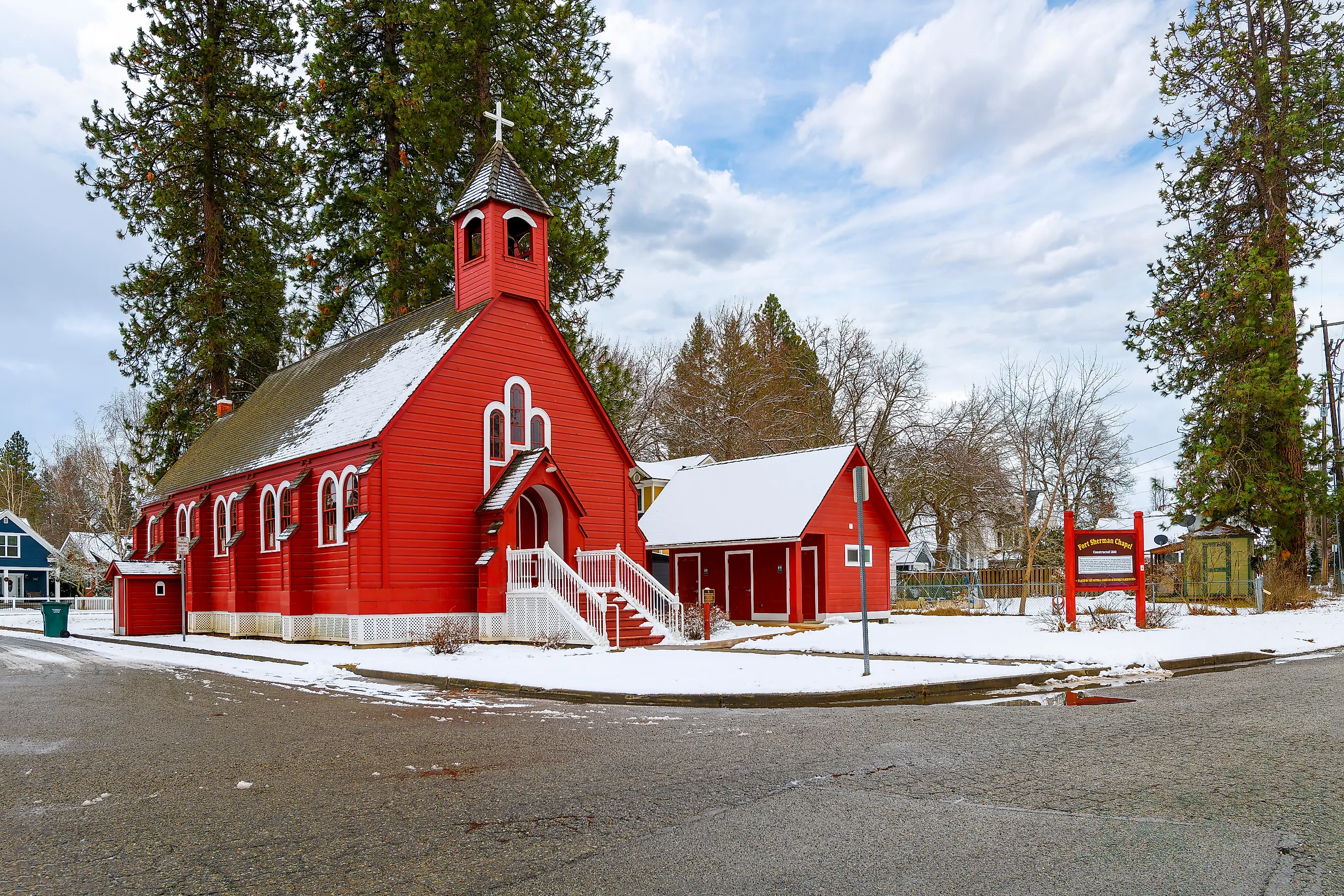
Fort Sherman Chapel in Coeur d'Alene is a smaller surviving piece of a much larger military post. Fort Sherman began as Fort Coeur d'Alene in 1879 near Lake Coeur d'Alene and the Spokane River, and was then renamed for General William T. Sherman. The post was abandoned in 1900 and most of the fort did not survive in a way visitors can tour today. What remains most clearly is the red chapel which was built by the U.S. Army in 1880.

The chapel is said to be Coeur d'Alene's oldest church, school, library, and meeting hall, which gives it a local importance beyond its military origin. The Museum of North Idaho also offers Fort Sherman-related walking tours. Its visitor information also notes seasonal chapel access. That makes the site more than a pretty old building near the lake. It is a reminder that Coeur d'Alene's growth did not happen separately from the fort. The city formed around the post and then kept pieces of that story after the Army left.
Fort Lapwai

Fort Lapwai in north-central Idaho is the most complicated stop on this list, but its history is too important to ignore. The fort was established in 1862, in what is now Lapwai on the Nez Perce Reservation, during a period of growing tension after gold discoveries brought miners and settlers into Nez Perce country. The surviving Officers' Quarters are one of the few remaining structures tied to the fort.
This is not a conventional museum. The National Park Service notes that the Officers' Quarters are owned by the Nez Perce Tribe and are not accessible to the public inside, although visitors can go to the site and read the interpretive sign in front of the building. Fort Lapwai is still a meaningful public-facing historic site. Its value is in the story it preserves, especially the relationship between federal power, Indigenous land, mining pressure, and the Nez Perce people.
Idaho's Forts Tell More Than One Story
The best historic forts in Idaho are not all preserved in the same way. Old Fort Boise and Fort Hall help explain the fur trade and the Oregon Trail. Fort Sherman shows how a military post helped shape one of northern Idaho's best-known lake cities. Fort Lapwai carries a more difficult story, tied to the Nez Perce Reservation and the pressure that followed gold discoveries in the region. Some are replicas, some are remnants, and some require a little extra context, but all four help explain how Idaho became the place people recognize today.