9 Prettiest Small Towns In Indiana
Indiana's small towns grew up around the state's rivers, canals, and religious communities of the 19th century, and most of them still show that history in their streets. New Harmony was founded on the Wabash in 1814 as a utopian religious community and preserves its original street grid. Metamora, along the 1846 Whitewater Canal, still works a stretch of the canal that includes the only covered wooden aqueduct left in the country. Madison, on the Ohio River, holds the largest historic district in the state, with blocks of steamboat-era mansions intact. Shipshewana anchors the third-largest Amish community in the country, with Amish farms and buggy routes stretching in every direction. Up north, Porter sits at the edge of Indiana Dunes National Park, where dunes rise more than 450 feet above Lake Michigan. These nine small towns are each worth a weekend.
Metamora

Founded in 1838 in Franklin County along the Whitewater Canal corridor near the Indiana-Ohio border, Metamora was a working canal stop in the 19th century. The 76-mile Whitewater Canal carried boats during its shipping years and later supplied hydraulic power to nearby mills. Today Metamora operates as a living village within the Whitewater Canal State Historic Site. The standout here is the Duck Creek Aqueduct, built in 1846 and the only covered wooden aqueduct still standing in the United States. The Metamora Grist Mill still grinds corn for demonstrations on site, and the town's biggest weekend of the year is Metamora Canal Days in early October, when Duck Creek Crossing fills with crafts, food, and period demonstrations.
Nashville

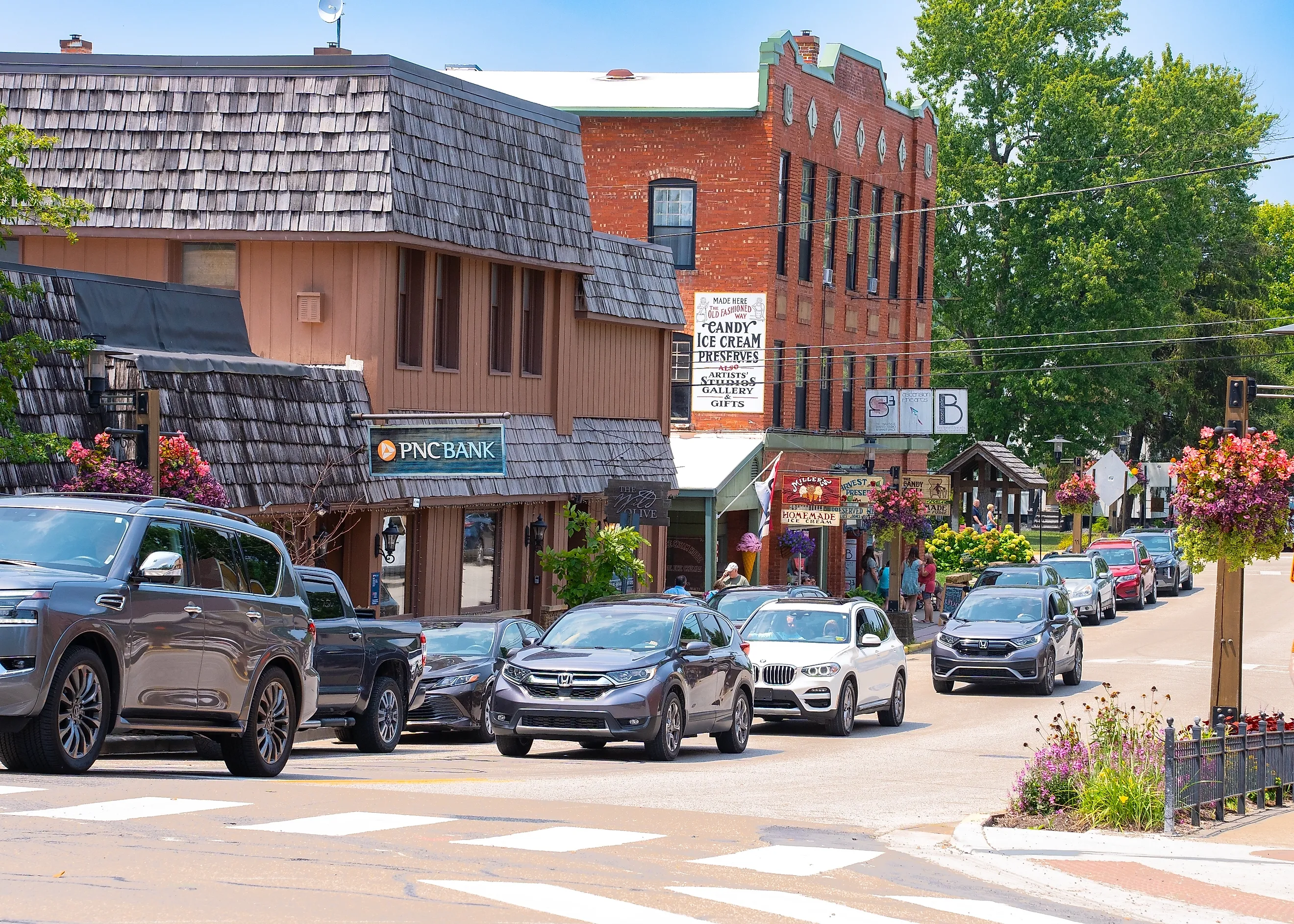
Nashville is the seat of Brown County, locally nicknamed the Hills O' Brown for its ridges and gullies, which are unusual for the Midwest. Much of that terrain is inside Brown County State Park, the largest state park in Indiana at about 16,000 acres, with a network of hiking and mountain-bike trails, fishing at Strahl Lake, and a restored 1930s fire tower. Trail 5 passes one of the state's champion yellowwood trees, an uncommon species at the northern edge of its range. Story Inn, just south of the park, sits in what's left of the former mining village of Story and offers dinner and rooms in restored 19th-century buildings. Nashville itself has the Brown County Art Gallery at its center, continuing a colony tradition that goes back to the early 1900s.
Shipshewana

Shipshewana sits in the middle of the third-largest Amish community in the United States, and much of the town's economy runs on Amish trade. Buggy Lane Tours offers narrated rides through the surrounding farms, passing fixtures like the Blue Gate Restaurant & Bakery and Menno-Hof, an interpretive center housed in a red barn-style building with a full Amish kitchen, a recreation of a 17th-century Anabaptist vessel, and exhibits on the community's European roots. The Shipshewana Flea Market, active Tuesdays and Wednesdays from May through September, is consistently described as one of the Midwest's largest. The 17-mile Pumpkinvine Nature Trail connects Shipshewana with Middlebury and Goshen through farmland and former rail corridor.
New Harmony

New Harmony, on the Wabash River in Posey County, has been home to two separate utopian experiments. The Harmonie Society, a millenarian Christian community from Württemberg, founded the town in 1814 and left a decade later when they moved to Pennsylvania. Robert Owen, the Welsh industrialist and reformer, bought the whole town in 1825 and attempted a secular socialist community of his own. The Harmonist Labyrinth, a formal hedge maze with a stone structure at its center, is a reconstruction of the Harmonies' original. The Roofless Church, designed by Philip Johnson and completed in 1960, is the town's architectural landmark, with a cast-bronze sculpture by Jacques Lipchitz at its center. Harmonie State Park, a short drive south, adds trails and fishing ponds along the river bluffs.
Winona Lake

Winona Lake grew up as a Chautauqua-style resort and religious retreat in the late 19th and early 20th centuries, and the imprint of that era still shapes the town. The lakeshore Village at Winona is a boardwalk shopping district with restaurants, galleries, and specialty stores facing the water. The Billy Sunday Home Museum preserves the house of the baseball player turned evangelist who drew some of the largest crowds in American revival history and made Winona Lake his base. The Heritage Trail, a walking path looping around the lake, passes a series of sculptures illustrating biblical scenes, and Limitless Park adds a sandy beach and splash pad for families on the south end.
Marshall

Marshall sits just outside Turkey Run State Park, one of the most distinctive landscapes in the state. The park's sandstone ravines, old-growth hemlock and beech stands, and Sugar Creek cliffs draw serious hikers, particularly for the 5 Mile Hiking Challenge, a route that crosses a suspension bridge, climbs a ladder out of a canyon, and scrambles over several creek beds. The Colonel Richard Lieber Cabin, named for the man considered the father of Indiana's state park system, sits inside the park. Parke County itself holds 31 surviving covered bridges, the most in the state, and a short drive to Rockville leads to the 1895 Billie Creek Covered Bridge inside Billie Creek Village.
Porter

Indiana's short Lake Michigan shoreline holds the state's only national park, Indiana Dunes, redesignated from national lakeshore to national park in 2019. Porter sits on the park's eastern edge. The dune system, built from centuries of wind-blown sand, supports a surprisingly diverse ecosystem that moves from beach through marsh and oak savanna to hardwood forest within a few hundred yards. Serious hikers can work toward the "3 Dune Challenge" pin by climbing Mounts Tom, Holden, and Jackson in sequence. The Century of Progress Historic District in nearby Beverly Shores preserves five houses originally built for the 1933 Chicago World's Fair and moved across the lake by barge, including the pink Art Deco Florida Tropical House and the log-clad Cypress Log House. Porter Beach gives direct access to the Lake Michigan shore.
Madison

Madison holds the largest historic district in Indiana, roughly 133 city blocks designated as a National Historic Landmark District. The 19th-century steamboat trade on the Ohio River brought enough money to Madison that by mid-century the town was filled with substantial mansions. The Lanier Mansion State Historic Site, finished in 1844 for financier James F. D. Lanier, is one of the best Greek Revival houses in the Midwest. The Shrewsbury-Windle House, built in 1849, is known for its unsupported three-story spiral staircase. Eleutherian College, founded in 1848 by abolitionist activists a few miles north in Lancaster, was one of the first U.S. colleges to admit Black and female students. Clifty Falls State Park, directly west of town, holds four waterfalls and dramatic sandstone cliffs.
New Albany

New Albany sits directly across the Ohio River from Louisville, Kentucky. The downtown holds one of the strongest runs of 19th-century architecture on the Indiana side of the river, concentrated along Main Street and the adjacent blocks known as Mansion Row. The 1869 Culbertson Mansion State Historic Site, built for local industrialist William S. Culbertson, is the centerpiece, with imported Scottish tin roofing, marble fireplaces, and painted ceiling frescoes. The Pepin Mansion B&B, also on Main Street, is one of several restored houses from the same era. The Ohio River Greenway connects New Albany with Jeffersonville along a paved riverside trail, and the Silver Hills Historical Nature Trail follows the right-of-way of an old interurban streetcar line on the town's north side.
Across The Hoosier State
These nine small towns cover most of the geography Indiana has to offer. The canals and covered bridges are in the southeast corner. The dunes and the national park are up north on Lake Michigan. The Amish economy runs through the northeast, the old utopian experiments sit out on the Wabash, and the steamboat-era mansions line the Ohio River at the state's southern edge. Pick a direction, point the car, and you'll find one of them.