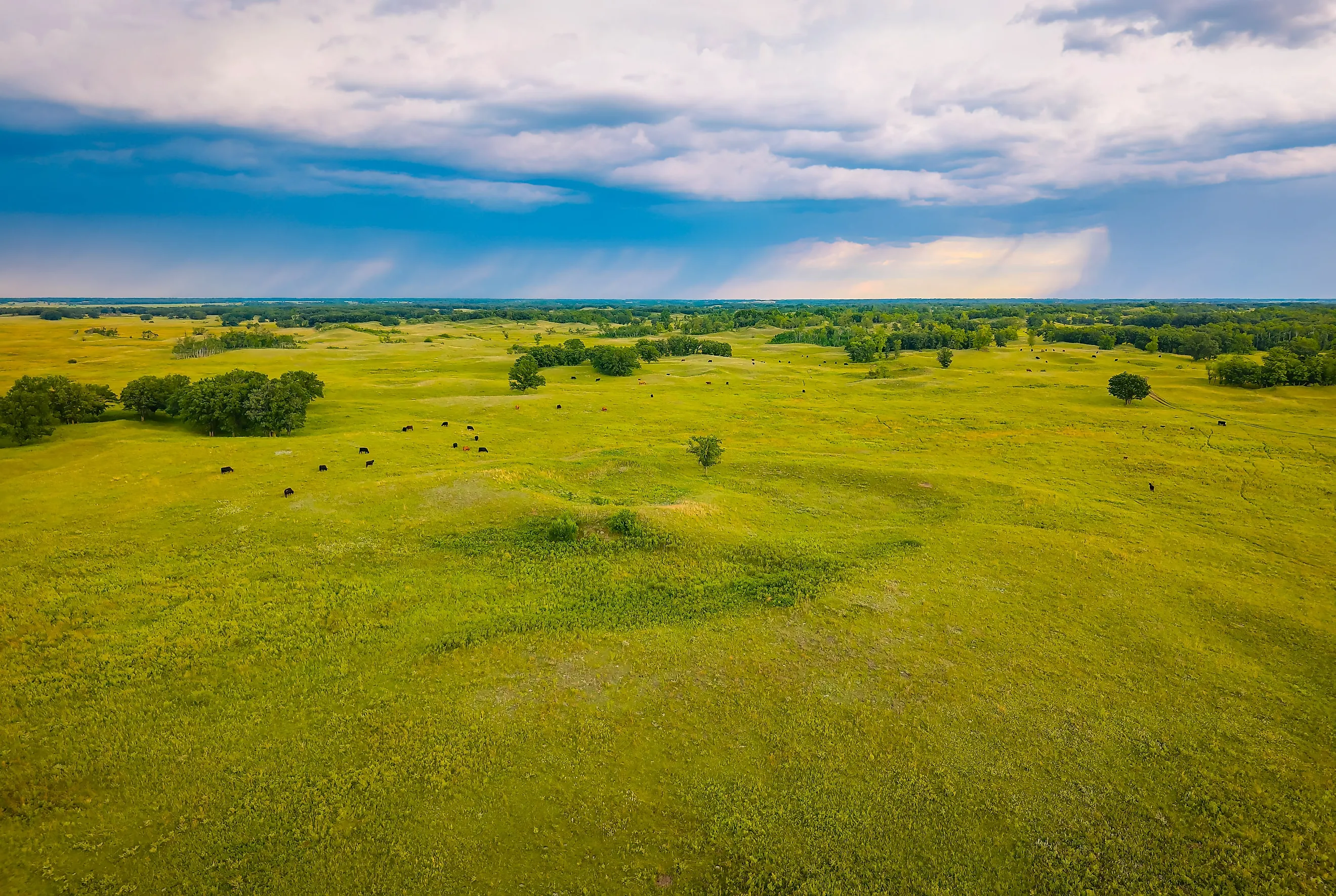
Why The Great Plains Has Almost No National Forest
Pull up a map of America's national forests and a pattern smacks you in the face. They pile up in the mountains, the Rockies, the Cascades, the Appalachians, and then there is one giant, conspicuous void running right through the belly of the country: the Great Plains. Hundreds of thousands of square miles, and barely a national forest in sight. So what happened here? Did someone forget? Not quite. The real answer is almost comically simple: you cannot protect a forest that was never there.
The Plains Were Never Forest

Let's clear up the biggest misconception right away. The Great Plains was not stripped of its trees; it never had many to begin with. It is a grassland, full stop. Most of the region is simply too dry for forests, scraping by on less than 20 inches of rain a year, which is why one 19th-century explorer took a single look at the land west of the 100th meridian and cheerfully wrote it off as "the Great American Desert." Trees try that climate once and quietly give up. Grass, on the other hand, positively thrives on a diet of drought, wind, fire, and being trampled by a few million bison. National forests exist to protect existing forests. Asking the prairie to supply one is a bit like asking the ocean to supply a mountain.
The Land Was Already Taken

Timing did the rest. When the government started setting aside national forests in the 1890s, it grabbed the scraps nobody else wanted: the steep, rocky, unfarmable mountains of the West, which happened to already be covered in trees. The Plains got no such treatment, for the simple reason that the Plains were being handed out like party favors. Under the Homestead Act, the feds were practically flinging free prairie at any settler willing to plow it, and plow it they did, fencing the whole region into farms and ranches. By the time the Forest Service clocked in for its first day in 1905, the Plains were already claimed, cropped, and closed for business.
The Plains Got Grasslands Instead

Now for the plot twist nobody sees coming. The Plains actually does have Forest Service land, it just does not have the decency to grow any forest on it. After the Dust Bowl, when the over-plowed prairie got so fed up that it physically blew away, the government sheepishly bought back around 11 million acres of the wreckage it had encouraged people to farm in the first place. Crews coaxed the native grasses back to life, and in 1960 roughly 3.8 million acres were rechristened National Grasslands, a brand-new type of public land run by, yes, the National Forest Service. Which means there is now a forest agency proudly in charge of millions of acres containing almost no forest at all. Seventeen of the twenty National Grasslands sit right on the Great Plains.
The Exceptions Prove the Rule

There are a couple of genuine national forests out here, and they only make the point stronger. The Black Hills National Forest is a cool, pine-covered island that erupts out of the flat Dakota prairie as if it wandered in from Colorado and forgot to leave. Real forest, so it got the badge. Then there is the Nebraska National Forest, which is the largest hand-planted forest in the entire country. That is not a typo. Back in 1902, a group of foresters stared at a treeless ocean of sand dunes and decided, essentially out of sheer stubborn optimism, to plant a forest there themselves, one seedling at a time. So the Plains earns a national forest exactly twice: once where nature bothered to build a mountain, and once where humans flatly refused to take "no trees" for an answer.
Why It Makes Sense

Here is the part that flips the whole thing on its head. That gaping hole in the forest map is not a failure at all, it is arguably a rare outbreak of common sense. Native prairie is one of the most endangered ecosystems in North America, with the vast majority of it long since plowed under, so protecting the survivors as grassland, instead of jamming trees into soil that has spent 10,000 years politely declining them, is exactly the right move. So the next time you notice the Great Plains sitting there looking empty on the national forest map, do not feel sorry for it. It is not missing a thing. It is absolutely stuffed with grass, much of it federally protected, and simply filed under a different name.