Where People Are Moving To In South Dakota In 2026
South Dakota added residents slowly overall between 2020 and 2025, but the gains were not spread evenly across South Dakota. Almost all the growth occurred in two corridors: the southern edge of Sioux Falls in Lincoln County and the Black Hills around Rapid City. The dominant in-state move ran out of Minnehaha County into Lincoln County, where Sioux Falls residents bought into newer subdivisions a few miles south. Rural counties told the opposite story: Jones and Ziebach Counties lost population, while older hubs like Aberdeen, Pierre, and Sturgis flattened or shrank. No state income tax, short metro commutes, and home values below the national average (about $319,894 versus $360,727 per Zillow) kept the metro edges growing. The six towns below sit where that population shift increased most.
Harrisburg

Harrisburg grew faster than any other South Dakota city by almost 5,000 residents. The Lincoln County community south of Sioux Falls grew from 6,845 residents in 2020 to 10,405 in 2025, a 52% increase, according to the US Census Bureau's Vintage 2025 estimates. Lincoln County posted the state's largest net in-state migration gain, drawing most of its new residents from neighboring Minnehaha County. The flow appears in the IRS Statistics of Income county-to-county data for recent filing years. The pull is plain: a buyer priced out of central Sioux Falls can find a newer house a few miles south for less. Growth shows up first in the schools. The Harrisburg School District enrolled about 6,195 students in 2024-2025. It now runs seven elementary schools, three middle schools, and a high school with a separate Freshman Academy. Roughly two-thirds of its students live inside Sioux Falls city limits, because the city expanded into district lines drawn generations ago. Liberty Elementary School reopened in a larger building after outgrowing its old one.
Tea

Tea sat just behind Harrisburg among the state's fastest-growing cities. The Lincoln County city on Interstate 29 climbed from 5,698 residents in 2020 to 8,019 in 2025, a gain of 40.7%, according to Census Vintage 2025 figures. Its growth stems from the same southward push that fuels Harrisburg. Most movers arrive from within Minnehaha and Lincoln Counties, per IRS migration data for recent filing years. The interstate access matters here. A Tea resident can reach downtown Sioux Falls or the Interstate 90 junction in minutes, which makes the city workable for commuters on both ends of the metro economy. The Tea Area School District has expanded to keep pace. It runs three elementary schools, a middle school, and Tea Area High School, home of the Titans. The district was organized in 2003, when Tea held a fraction of its current population. New residential plats continue to fill the farmland between Tea and the Sioux Falls line along the I-29 frontage.
Sioux Falls

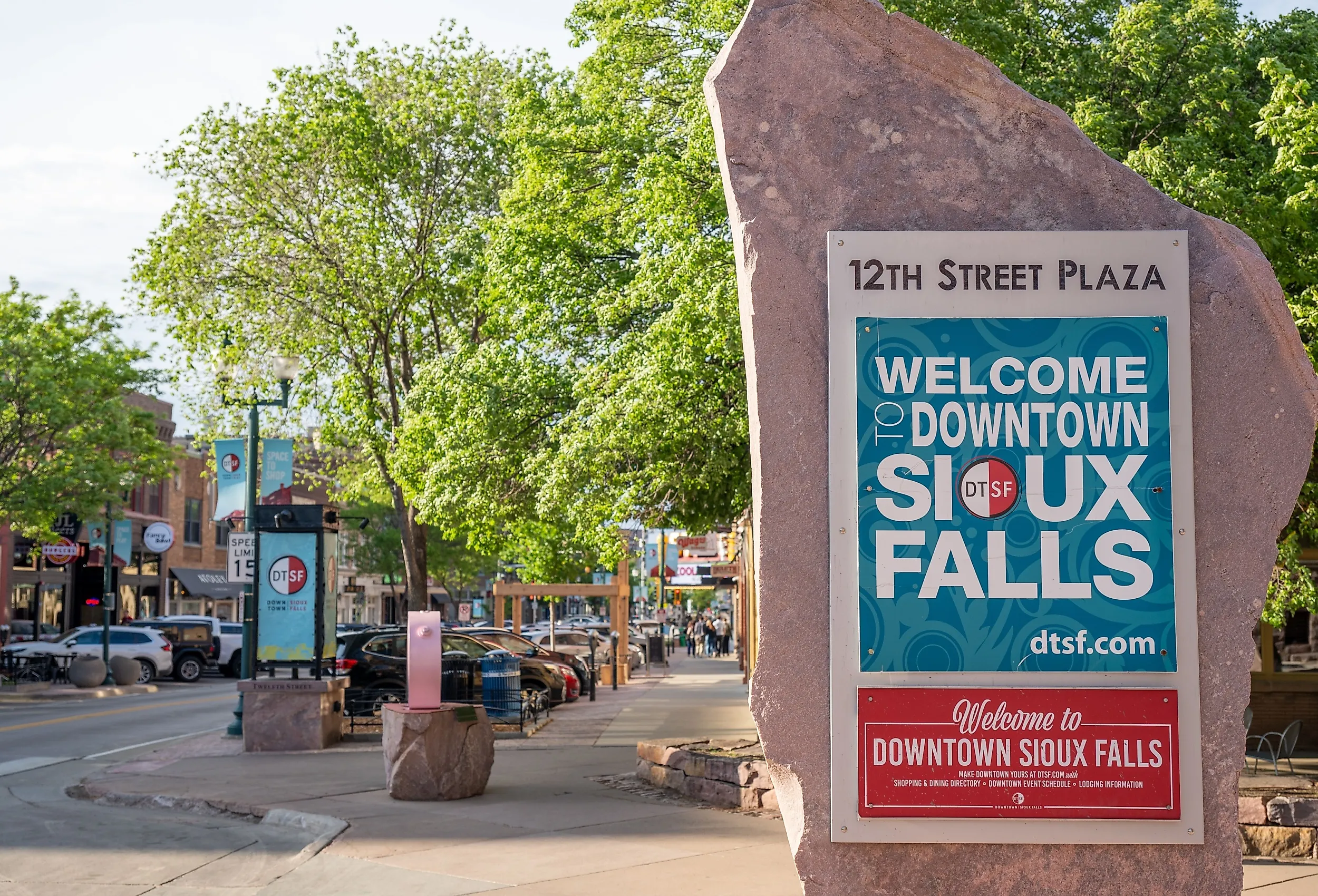
Sioux Falls remained the engine behind nearly all of this movement. The state's largest city grew from 193,453 residents in 2020 to 213,748 in 2025, an increase of 10.5%. That gain of roughly 20,000 people was the largest in raw terms among any city in Lincoln or Minnehaha Counties, per Census Vintage 2025. Much of it pushed outward into Lincoln County rather than staying in the old core. The economy rests on two large health systems. Sanford Health and Avera Health rank as the city's top employers, joined by Smithfield Foods, Wells Fargo, and an Amazon fulfillment operation. South Dakota levies no personal income tax, a structural draw that has anchored a sizable financial-services sector for decades. Construction has kept pace, with more than $1.2 billion in building permits issued in 2025. Falls Park on the Big Sioux River remains the city's signature landmark, and downtown, the Cherapa Place development added restaurants and a grocery.
Box Elder

Box Elder anchored the growth on the western side of the state. The city east of Rapid City rose from 11,948 residents in 2020 to 13,936 in 2025, a 16.6% increase, in the Vintage 2025 release. It sits on the plains at the edge of the Black Hills region, though its trajectory ties less to scenery than to Ellsworth Air Force Base. The Air Force selected the base in 2021 to host the new B-21 Raider stealth bomber, built by Northrop Grumman. The mission is projected to bring 3,000 to 4,000 additional airmen and roughly $2 billion in construction. Unlike the Sioux Falls suburbs, much of Box Elder's inflow arrives from out of state through military reassignment. The Douglas School District expects about 100 new students a year for the next 15 years. In March 2025, the state authorized a $15 million zero-interest loan toward the district's third elementary school. Housing has followed, with developments like Raider Pointe adding hundreds of new lots.
Spearfish

Spearfish carried the Black Hills growth north of the Ellsworth corridor. The Lawrence County city on the northern edge of the Black Hills grew from 12,239 residents in 2020 to 14,154 in 2025, a 15.6% rise, per Census Vintage 2025. Its growth reflects both regional movement from the Rapid City area and out-of-state arrivals to the Black Hills, the broad pattern visible in IRS migration data for western South Dakota. The appeal is partly economic and partly the setting at the mouth of Spearfish Canyon. Black Hills State University anchors the local economy and student population, while Monument Health runs the area hospital. Remote workers and retirees have added to housing demand near the Spearfish Canyon Scenic Byway and the trailheads of Black Hills National Forest. New subdivisions have climbed the benches above the older downtown grid. The D.C. Booth Historic National Fish Hatchery and a walkable Main Street keep longtime residents close to the center even as the edges expand.
Brookings

Brookings stood apart from the suburban pattern, growing on the strength of its university and factory base rather than metro spillover. The Brookings County city rose from 23,370 residents in 2020 to 25,355 in 2025, an 8.5% increase, per Census Vintage 2025. South Dakota State University, the state's largest university, drives enrollment and employment, pulling students and workers from rural counties across eastern South Dakota and nearby Minnesota. Daktronics keeps its headquarters here, the LED-display maker founded by two university professors in 1968, which now employs more than 2,500 people. Larson Manufacturing and Solventum’s Brookings manufacturing plant, formerly part of 3M’s health care business, add to a manufacturing base second only to Sioux Falls in the state. Brookings sits about 50 minutes north of Sioux Falls on Interstate 29, close enough to share the metro labor market without its housing prices. McCrory Gardens, the university's botanical garden, and a compact downtown give the city a college-town center that keeps graduates and young families in place.
South Dakota's Growth Corridors In 2026
South Dakota's growth has consolidated into two corridors: the southern arc of the Sioux Falls metro through Lincoln County, and the Black Hills band from Box Elder to Spearfish. The direction of travel runs outward from the established cities into adjacent counties, a pattern the Vintage 2025 numbers reinforce even as statewide growth slows. For residents in those zones, the near-term effects are concrete: home prices climbing on the metro fringe, school districts adding buildings, and water and sewer systems under strain. The counties losing ground, mostly rural and away from the two metros, face the opposite squeeze of holding schools and tax bases together with fewer people each year.