These Colorado Towns Have The Best Views In The State
When you're searching for jaw-dropping mountain scenery that'll make you forget to check your phone, Colorado delivers something extraordinary. The state's high-altitude communities sit right at the base of peaks that scrape the sky, with waterfalls thundering through slot canyons and wildflower meadows stretching toward snowcapped summits. These six Colorado towns offer some of the most dramatic landscapes in the Rockies, where every window frames a postcard view, and every street corner reveals another reason to pause and soak in the beauty of the mountains.
Ouray

The San Juan Mountains rise around the town of Ouray, earning this former mining camp its nickname as the Switzerland of America. Walk down any street, and you'll find yourself staring straight up at 13,000-foot peaks that seem close enough to touch. The Box Canyon Falls sits just south of town, where Canyon Creek plummets 285 feet into a slot canyon. A steel catwalk built into the canyon wall lets you stand mere feet from thousands of gallons of water thundering past each minute, the mist soaking your face while the rock walls tower a hundred feet overhead.
The Ouray Hot Springs Pool uses the area's natural mineral water, offering several soaking pools for visitors to enjoy after a day of hiking. During the winter season, ice climbers head into the Ouray Ice Park, where frozen waterfalls create hundreds of routes up sheer rock faces.
Drive south on the Million Dollar Highway, and you'll understand why this roadway earned its nickname. This route of US 550 clings to cliff faces with no guardrails, winding through Red Mountain Pass at 11,018 feet. Scenic overlooks and turnouts reveal valleys dropping thousands of feet below, with peaks extending to every horizon. In autumn, these mountainsides turn gold with aspens, with a color so bright that you will stand in awe that something like this could be so beautiful.
Telluride

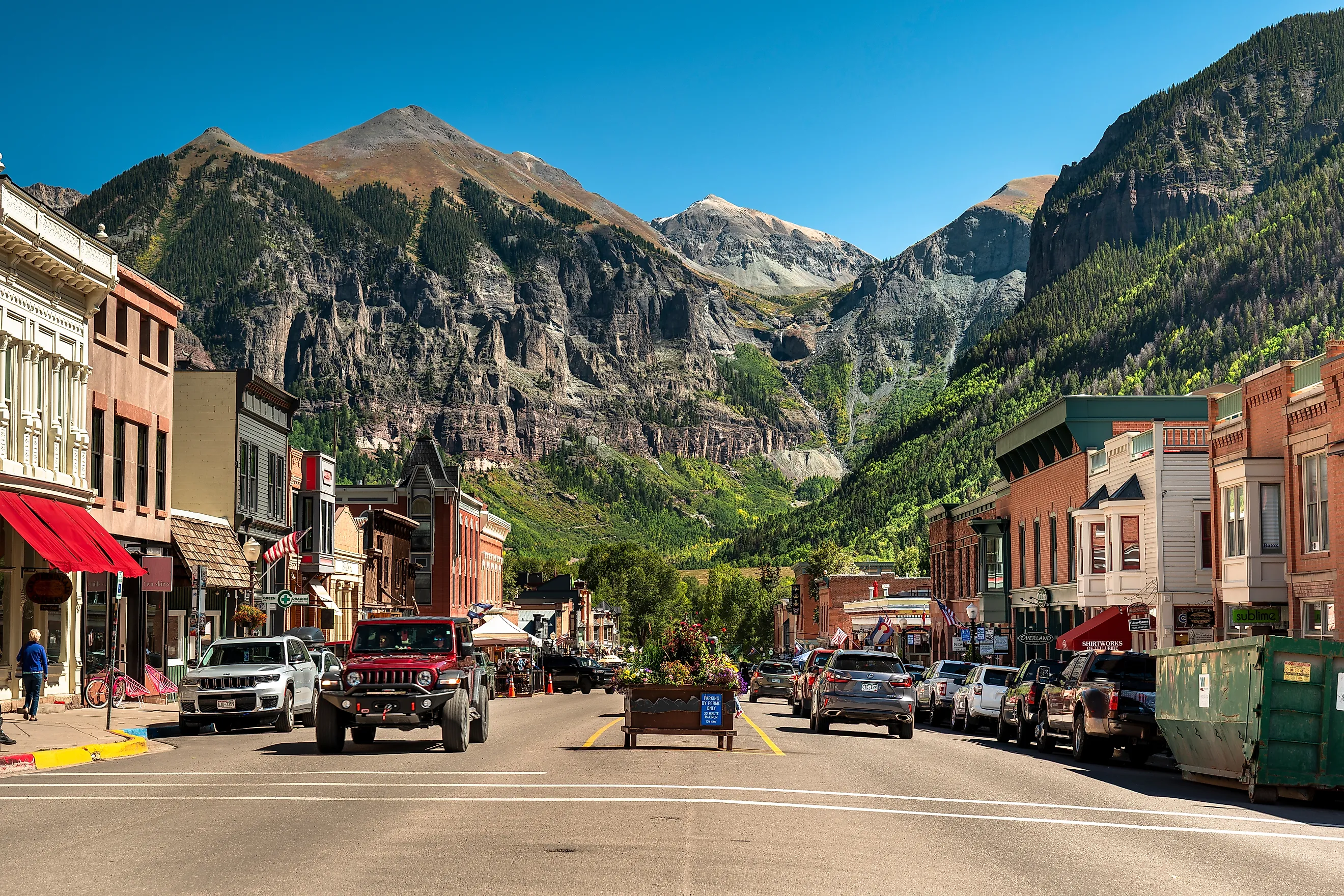
Telluride sits in a box canyon at 8,750 feet, surrounded by peaks on three sides with a single road in and out. The isolation made it attractive to outlaws like Butch Cassidy, who robbed his first bank here in 1889. Today, the town is known for its world-class skiing and arts culture, but the surrounding wilderness keeps people coming back.
Bridal Veil Falls, Colorado's tallest free-falling waterfall at 365 feet, sits at one end of the town. In summer, it pours white against dark rock; in winter, it freezes into blue ice that draws climbers worldwide. Colorado Avenue runs straight through town, and many of the turn-of-the-century buildings house various boutiques, galleries, and cafes. The town has a free gondola that climbs 2,000 feet to Mountain Village, passing over terrain where elk graze in the meadows. From there, the Bear Creek Trail gains 1,000 feet over 2.3 miles through aspen groves to Bear Creek Falls, where water crashes down through multiple tiers and spray creates rainbows on sunny days. Few places in the Rocky Mountain State pack this much beauty into one valley.
Crested Butte

Crested Butte sits at 8,885 feet with the massive pyramid of Crested Butte Mountain dominating the northern skyline. The summit at 12,162 feet rises almost directly from the valley floor, its distinctive profile resembling a crested crown. While winter brings plenty of skiing opportunities to the mountain, each summer brings wildflower displays that justify the town's reputation as Colorado's wildflower capital. Visitors come from across the state to see hillsides painted in purple lupine, red Indian paintbrush, blue columbine, and yellow mule's ear.
Elk Avenue runs through a historic district that has remained unchanged since the coal-mining days of the 1880s. The buildings are painted in bright colors, creating a cheerful contrast with the gray rock peaks beyond. Crested Butte kept its wooden false fronts and clapboard construction, giving downtown an authentic frontier feel.
The Snodgrass Trail climbs from Mount Crested Butte into alpine meadows that erupt with wildflowers in July. Hike up here on a summer morning, and you might see three other people all day, despite views that could grace any calendar. In late September, aspens turn gold across the surrounding slopes, and photographers line up at dawn to catch first light hitting the peaks.
Silverton

At 9,318 feet, Silverton is one of Colorado's highest towns, surrounded by San Juan Mountains peaks topping 13,000 feet. The town began as a supply center for miners drawn to the high peaks in search of fortune. Hillsides in every direction show old workings, weathered tramways, and ruined mills perched on impossible ledges. Today, the town thrives on tourism from the Durango & Silverton Narrow Gauge Railroad. The vintage steam locomotives run up 45 miles of track from Durango, offering views that have drawn travelers since 1882.
Greene Street preserves Silverton's mining heritage, with buildings from the 1880s and 1890s showing weathered wood and faded paint that tell stories of boom times. The entire downtown is a National Historic Landmark District. The Ice Lakes Basin Trail climbs a strenuous 3,000 feet over almost four miles to alpine lakes surrounded by thirteeners. Wildlife photographers often spot some of the state's most iconic animals along the trail, including bears, mountain lions, elk, and bighorn sheep. Spend some time here, and you'll appreciate the grit and fortitude it took to be a miner in these mountains.
Ridgway

Ridgway sits at 6,985 feet in the Uncompahgre Valley with direct views of some of Colorado's most photographed mountains. The town served as a railroad hub in the late 1800s and retains a frontier character with its original downtown buildings. Mount Sneffels rises to 14,150 feet to the south, its jagged summit visible from all over town. Ridgway State Park spreads across 1,000 acres just north of town, where a five-mile reservoir opens up views across the water to the San Juan peaks. On calm days, the water reflects the mountains so perfectly that you can't tell where the rock ends and the reflection begins.
The Dallas Divide offers some of the most spectacular views of Mt. Sneffels and the San Juan Mountains. People frequently pull over to photograph the view while traveling Hwy 62, especially in September when the aspens turn gold, and the mountainsides look like they're on fire. From the top of the pass, you're seeing mountains in every direction with no towns or development visible anywhere.
For the adventurous at heart, the Sneffels Highline Trail is a challenging climb of more than 12.2 miles to elevations above 13,000 feet. The trail passes through spruce forest before breaking out into alpine tundra, where you can enjoy the sight of the most majestic mountains in the state.
Lake City

Lake City sits at 8,663 feet in a valley where Henson Creek meets the Lake Fork of the Gunnison River. The town began in 1875 during the silver boom and remains one of Colorado's most remote communities to this day. The San Juan Mountains rise all around the town, and from its streets, you're looking up at five peaks topping 14,000 feet.
Lake San Cristobal spans 331 acres just south of town and is Colorado's second-largest natural lake. The water runs so clear you can see twenty feet down on calm days, and the surrounding peaks reflect in the surface for some of the most scenic images in the Rockies. Windy Point on the Silver Thread Scenic Byway offers views of the lake, with four fourteeners rising beyond it.
The Alpine Loop Scenic Byway connects Lake City to Silverton and Ouray via old mining roads. Engineer Pass and Cinnamon Pass, both topping 12,800 feet, are part of the journey. The route passes ghost towns where wooden buildings still stand a century after the mines closed. This region is four-wheel-drive country, with the road narrowing to one lane with no guardrails, but the high-altitude views make it one of Colorado's most dramatic drives.
Visit These Six Small Colorado Towns With The Best Views
These six towns share more than mountain scenery. Each preserves a slice of Colorado's mining past while offering access to wilderness that remains essentially unchanged. Whether you're soaking in hot springs below towering peaks in Ouray, riding the gondola in Telluride, or navigating the Alpine Loop's high passes, you're seeing landscapes that have drawn people to these mountains for over a century. The views haven't changed much since then, and that's precisely the point.