The Cheapest Beautiful Towns To Live In Maine
Living in a coastal or mountainous town lined with historical architecture and immediate wilderness access does not have to carry the $436,000 median price tag of a Maine home. Several communities across the state combine home values well below that figure with the same rivers, coastlines, and historic 19th-century downtowns that drive up prices elsewhere.
Eastport sells homes on a working island waterfront for a fraction of the state median. Millinocket offers direct views of Mount Katahdin at less than half that price. The capitol of Maine, Augusta, serves as a riverside hub where historic brick storefronts and a 224-acre urban arboretum exist alongside home values averaging almost $150,000 below the statewide median.
Eight towns across Maine show that affordable living and direct access to Maine's coastal, riverside, or mountain scenery are equally within reach.
Eastport

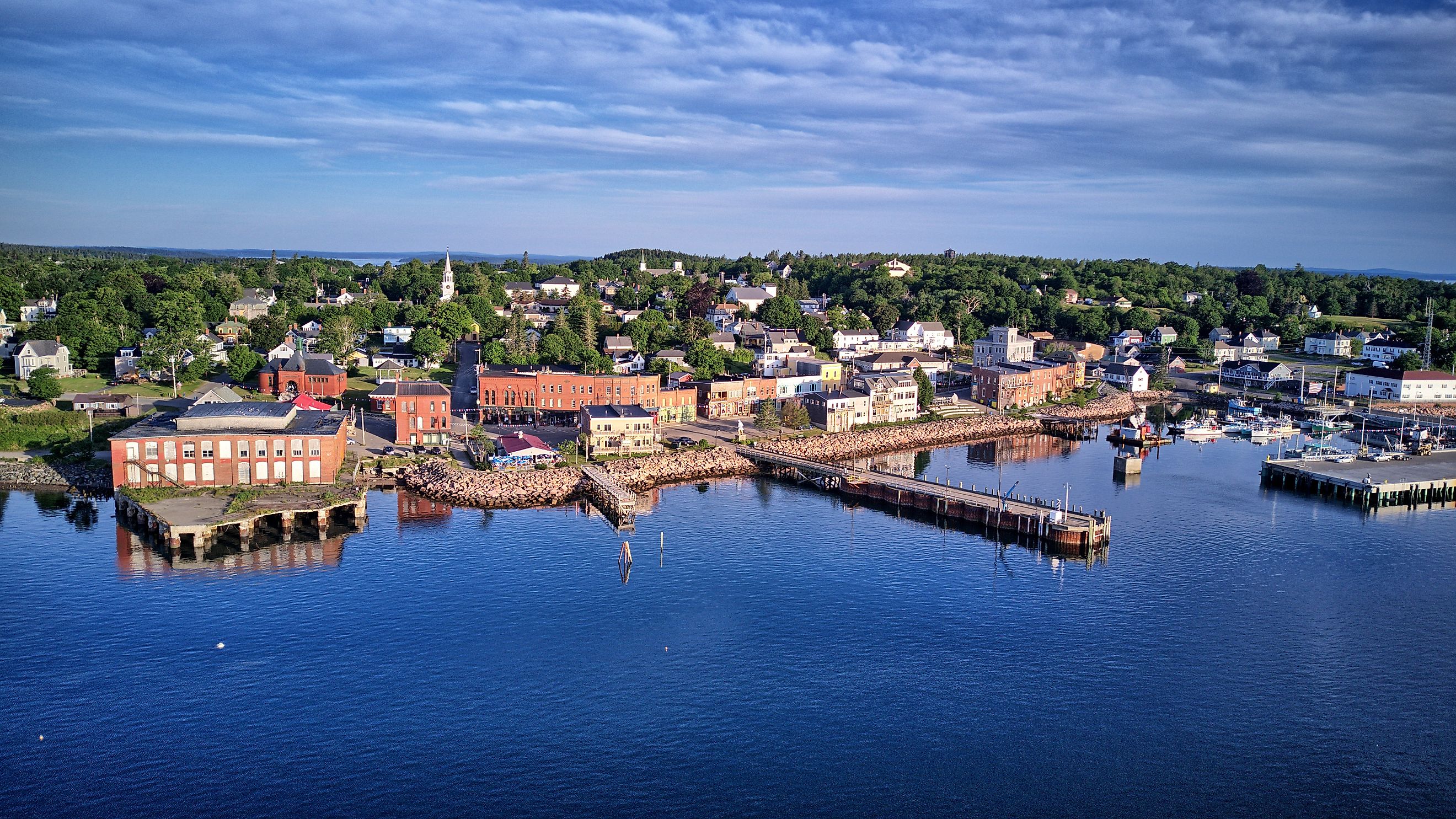
Eastport's real estate market offers coastal living well below the state average. Home values in Eastport run about $187,000 below the Maine median when comparing Zillow's June 2026 evaluations to state averages. At this price, buyers can own a home on Moose Island, where the historic maritime waterfront still supports active shops, residents, and local industries. Zillow put the town's typical home value at $249,035 in the end of June 2026, up 3.8 percent over the prior year. For renters, 2026 data from Zillow Rental Manager lists the median rent in Eastport at $1,575 per month, 21 percent lower than the national average.
Water Street still carries a row of Federal and Victorian brick buildings raised during the late 19th-century canning boom. Today, these buildings mostly hold working shops and apartments. Beyond its affordability, Eastport has built an artistic community centered around the Tides Institute & Museum of Art (TIMA). TIMA’s StudioWorks artist-in-residence program brings creators from around the globe to downtown, leaving a footprint of vibrant public art, galleries, and historic preservation throughout the neighborhood.
While Eastport’s population is just under 1,300 people, the town center features a grocery store, a medical clinic, and a library within walking distance of the residential streets. Major medical needs are handled about 45 minutes away at Down East Community Hospital in Machias. The local economy relies on fishing, aquaculture, and seasonal tourism, meaning year-round professional employment in the immediate area is limited.
Residents have direct access to Shackford Head State Park on the island's western shore, where hiking trails lead to pocket beaches and 173-foot-high clifftop overlooks facing the aquaculture pens of Cobscook Bay. A short drive along Cobscook Bay puts residents near the Old Sow, the largest tidal whirlpool in the Western Hemisphere.
Machias

The Machias River drops over a series of rugged granite ledges at Bad Little Falls Park, located just two blocks from downtown where home prices sit at less than half the state average. Zillow listed the median home value in Machias at $187,471 as of June, 2026, up 4.3 percent from the previous year. According to 2026 rental data from Zillow Rental Manager, the median rent in Machias is $1,375 per month, reflecting an annual increase of $425 compared to 2025.
While the presence of the university campus provides a stable base of employment and cultural events, Washington County has one of the lowest household median incomes in Maine, reflecting a highly competitive local job market. The University of Maine at Machias keeps a small population folded into the town's roughly 2,000 residents. Groceries, the hospital, and downtown shops are within walking distance of each other.
The Down East Sunrise Trail, the longest off-road section of the East Coast Greenway in New England, passes directly through town. The adjacent Machias River Preserve features 5.5 miles of hiking trails, with parts of the Heritage and Hemlock Trails passing along the historic waterway that hosts one of the nation's last self-sustaining Atlantic salmon runs.
Augusta

Maine's state capital presents some of the most affordable housing among the state's urban centers. An average home value of $287,111, reported in June 2026 on Zillow, keeps the state capital significantly below the statewide average home value. Monthly rent averages $1,650 as of 2026, positioning it 18 percent below the statewide average.
Granite storefronts dominate the aesthetics of the downtown district, where Water Street follows the path of the Kennebec River beneath the stone dome of the Maine State House. The residential side hills are populated by early 20th-century colonial revivals and traditional wood-frame double-deckers.
The 34-acre Capitol Park acts as a formal green space separating the state legislative buildings from the river bank. On the other side of the river, the no-fee Viles Arboretum spans 224 acres of conserved agricultural terrain and botanical collections, providing 5.2 miles of curated trails. This sanctuary is home to over 300 species of trees and shrubs, including a dedicated grove of American chestnuts, along with historic 19th-century granite quarries and aqueduct trenches preserved from the original State Hospital farm.
During the summer, residents gather at the Waterfront Park along the Kennebec River for weekly concert series. Downtown on Water Street, Augusta's art scene is supported by local performances, galleries, and exhibtions featuring Maine artists.
Bucksport

Bucksport hugs the banks of the Penobscot River, offering the riverside town lifestyle with a median sale price under the state figure. Zillow recorded a median home value of $291,715 in Bucksport as of June 2026, down 0.8 percent from the prior year. As of July 2026 data from Trulia, rent in Bucksport for a three-bedroom is about $1,750.
The town's waterfront is centered on the Bucksport Waterfront Walkway, a brick-paved less than a mile-long path that stretches along the harbor. Within the walkway are benches, gardens, and public art installations set against views of the Penobscot Narrows Bridge. Downtown entertainment is centered around the Alamo Theatre, which has showcased films and live community performances since 1916. Just a few minutes from the center of town, the Silver Lake Trails wind through a 67-acre preserve with a self-guided native species forest tour where visitors can identify local trees and plants.
The town's paper mill closed in 2014, eliminating about 500 jobs, and Bucksport has spent the years rebuilding around the waterfront rather than the old mill site. Today, a deep-water marina, bandstand, and a summer concert series occupies the area where the mill once operated.
Skowhegan

The gorge that once powered Skowhegan's paper and grain mills still splits the Kennebec River through downtown, next to home values running about $203,000 below the state median. Zillow recorded Skowhegan home values at $232,224 as of June 2026, an increase of just 0.3 percent from the previous year. Rental market data from Zillow in 2026 shows a median monthly rent of $1,175 for the town, down $175 from the previous year.
The streets along the river now hold breweries, restaurants, and shops following a revitalization of the area once dominated by mill operations. Maine Grains operates a working stone gristmill inside a Victorian-era building constructed in 1897 on Water Street. Downtown is also home to the Bernard Langlais Art Trail, which features 21 wooden sculptures gifted to the town, including a 62-foot-tall Abenaki fisherman sculpture. Five miles outside of town, the 320-acre Lake George Regional Park has public access to two sand beaches, boat launches, and hiking trails.
Skowhegan is the Somerset County seat, hosting regional schools, Redington-Fairview Public Hospital, and major retailers. The town is currently constructing the Skowhegan River Park project to create Maine's first whitewater park in the Kennebec River Gorge, complete with a riverfront boardwalk and trails.
Bangor

Built on 19th-century timber wealth, Bangor features a housing stock of historic homes priced well below the state median. A June 2026 Zillow real estate index listing the typical Bangor home value at $295,453, a minor 1.2 percent lift over the previous year, establishes this city as one of the most accessible major markets in the state. Rents average $1,500 per month, tracking significantly lower than the national average. For buyers, this translates to acquiring a three-bedroom, multi-story home with a yard for less than what an average studio condo costs in Portland.
In Bangor, brick buildings constructed from 19th-century timber wealth define the downtown commercial core, where three and four-story storefronts line West Market Square, a short walk from the convergence of the Penobscot and Kenduskeag rivers. The housing stock consists of sprawling Victorians on Broadway and dense New Englander-style builds extending outward from the center.
Along the Penobscot riverfront, a wide public walkway follows the water. Just north, the 7.4-acre Cascade Park features an exposed stone waterfall, walking trail loops, and a granite fountain built into the forested hillside. Cascade is attached by a short trail to the 75-acre Saxl park, which features meadows, wide walking paths, and a small pond on the northern end. Natural preservation exists directly inside the town limits via the 680-acre Rolland F. Perry City Forest, which features over nine miles of dedicated trail networks with access to the Orono Bog Boardwalk, a one-mile continuous wooden pathway looping through peatland ecosystems
As the commercial hub of northern and eastern Maine, the city holds Northern Light Eastern Maine Medical Center, the region’s primary trauma hospital. The presence of the University of Maine nearby infuses the downtown with grocery co-ops, independent bookstores, and a regular performance calendar at the Penobscot Theatre Company. The local school district maintains strong regional ratings, and Interstate 95 provides direct southern transit.
Millinocket

Millinocket's home prices sit at less than half the state median, a discount tied directly to the collapse of the paper mill that built the town. The Great Northern Paper mill that once employed most of the town closed for good in 2008, and Millinocket's population has fallen 42 percent from its 1970 peak of about 7,700 residents.
Zillow's trailing 12-month data from June of 2026 recorded a median home value of $165,514, down 2.8 percent from the previous year. According to Zillow Rental, the average rent in Millinocket as of July 2026 is $1,450, holding steady compared to the previous year.
While the mill may be gone, the view from Main Street of Katahdin, Maine's tallest mountain at 5,269 feet, has not changed. Millinocket serves as the closest town to the northern terminus of the Appalachian Trail and borders Baxter State Park.
The Northern Forest Canoe Trail, the longest inland water trail in the country, winds right through the local waterways. The town itself features the Michael Michaud Walking and Biking Trail, a 1.65-mile paved multi-use pathway that meanders alongside the Millinocket stream right through the center of the community. Jerry Pond, inside town limits, has a fishing pier, swimming area, and a picnic ground. Millinocket Lake and Ambajejus Lake, both a short drive out, hold camps and public boat launches.
Farmington

Situated in Maine's western mountain foothills, the college town of Farmington pairs affordable real estate with immediate river and trail access. Farmington's home value came to $284,618 as of June 2026, up .7 percent from the previous year, according to Zillow. Rent in Farmington averages $1,200 per month based on July 2026 Zillow Rentals data.
The Sandy River flows right past the athletic fields of the University of Maine at Farmington, providing easy access to fly fishing, kayaking, and riverside walks. About 10 miles of trails exist within walking distance from downtown. The Powder House Hill Trails network, comprising Flint Woods and Village Woods, is located just a few blocks north of the county courthouse, featuring a 4.5-mile system of shaded forest floor paths, vernal pools, old wells, and scenic ridge overlooks directly over the town. Adjacent to the campus edge, the Prescott Fields Trail system offers up to five miles of flat, easy walking, including an accessible loop that guides hikers straight to the pebbly shorelines and active fly-fishing currents of the Sandy River.
The University of Maine at Farmington keeps the downtown bustling with local shops and restaurants. The town also boasts a highly active downtown art community, highlighted by the annual Farmington Art Walk, downtown murals, and independent bookstores. Titcomb Mountain, a nonprofit ski hill run by the Farmington Ski Club since 1939, is located within town limits and offers lower-cost community lift tickets.
What These Affordable Maine Towns Offer
Ultimately, eight Maine communities demonstrate that living within immediate access to natural spaces, historical architecture, and cultural centers does not require paying a real estate premium.
Many of the towns have pivoted from historic industrial centers to cultural and outdoor recreational hubs, anchored by geographic assets like the Kennebec River, the Penobscot harbor, and Mount Katahdin. By actively repurposing historic spaces, whether through artistic revitalization in Eastport, public whitewater parks in Skowhegan, or sprawling urban trail networks in Farmington, these towns have adapted to modern pressures and maintained their affordability for new residents.
For buyers and renters navigating the housing landscape, these towns offer a high standard of beauty and local culture at a cost of living that remains well below the statewide average.