The 10 Friendliest Little Towns In Australia
Australia is climbing steadily on travellers’ lists, ranked the world’s fifth-best tourism destination in 2024 (World Economic Forum) and welcoming over eight million international visitors in 2025. From the Great Barrier Reef and the red heart of Uluru to the white sands of Jervis Bay and the rugged cliffs of the Great Ocean Road, the country’s landscapes are a major draw.
Hand in hand with the scenery, Australia’s reputation as a friendly nation makes a real difference. Travellers often remember the chats at local bakeries, the tips shared at weekend markets, and the easy welcome at small-town festivals. The friendliest little towns in Australia combine standout attractions with that everyday warmth. From penguin tours in Bicheno to music-filled weekends in Port Fairy, this article explores ten towns where community life is easy to step into, each ready to welcome visitors with open arms.
Montville

This hinterland village in Queensland's Blackall Range is 400 meters above sea level in the Sunshine Coast region. Every second Saturday morning, Montville Growers and Makers Market takes over the historic Village Hall from 7:30 am to 12 pm. Locals gather over pancake breakfasts and organic sausage sizzles while browsing stalls packed with fresh produce from nearby farms, homemade preserves, and fair trade coffee. You'll find gardeners swapping tips over seedlings and bakers explaining their sourdough starters. The circuit trail at Kondalilla National Park loops nearly three miles through subtropical rainforest just 6 minutes from town. Around 300 stairs descend to the base of the 90-meter waterfall before climbing back to rock pools at the summit, where swimmers cool off in clear water.
A few minutes away, Flame Hill Vineyard makes Verdelho, Shiraz, Merlot, and Chambourcin from estate-grown grapes and operates an open cellar door Thursday through Monday. Their restaurant serves lunch with vineyard views, featuring modern Aussie dishes made with Sunshine Coast produce. A small but unique stop is the Clock Shop, in a German chalet-style building where hundreds of cuckoo and grandfather clocks tick and chime throughout timber-walled rooms. German barometers, beer steins, Christmas pyramids, and hand-carved nutcrackers add to the collection, making it one of the town’s most distinctive stops.
Berry

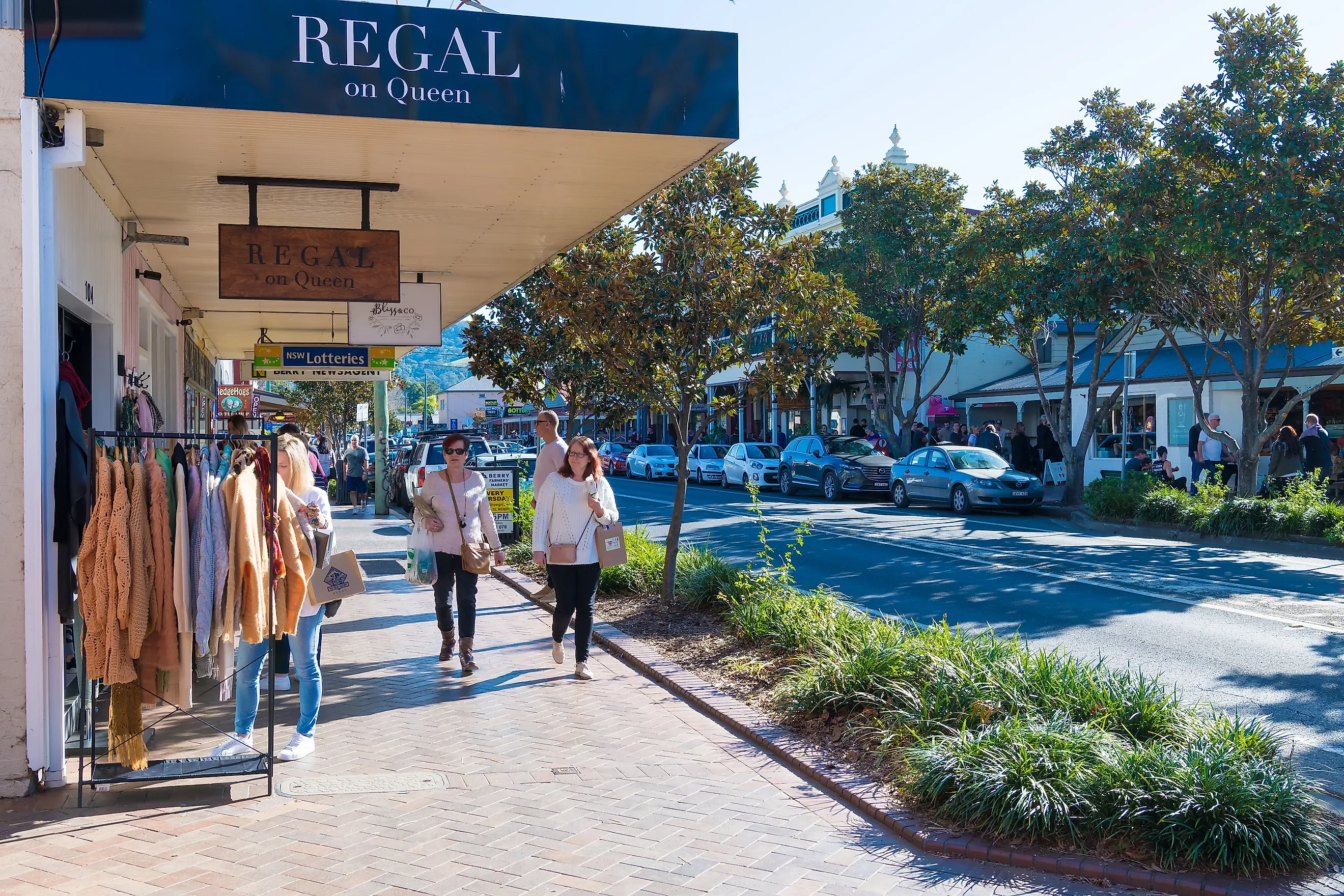
Sitting two hours south of Sydney in the Shoalhaven region, Berry grew from Alexander Berry's 1820s Coolangatta Estate into one of NSW's best-preserved Victorian towns. The biggest expression of that community spirit is the Berry Show, held every January. Now in its 138th year, this two-day agricultural event draws competitors from across the Shoalhaven with dairy and beef cattle, horses, showjumping, goats, poultry, hay-stacking, and the Young Farmer Challenge. The woodchopping ring draws big crowds, and the children's pet show keeps families occupied between the fireworks finale and the local arts and crafts pavilion. From the showground, the town's historical layers become easier to appreciate at the Berry Museum, currently in an 1880s Scottish Baronial-style bank building designed by colonial architect William Wilkinson Wardell. The collection walks through the area's dairy and timber industries through photographs, farming equipment, and donated tools, with a hands-on room where children can operate old typewriters, cash registers, and telephone switchboards.
Just north of the main street, Apex Park is a casual space with picnic areas under old trees, a nature play area with sand and water features, and 24-hour BBQ facilities. It connects naturally to a stroll back down Queen Street, where The Famous Berry Donut Van has been frying cinnamon donuts to order from the same spot since 1964.
Bicheno

Tucked between Douglas-Apsley National Park to the north and Freycinet National Park to the south, this small Tasmanian fishing village on the Great Eastern Drive has built a loyal following among those who keep coming back. Each October, the Bicheno Food and Wine Festival brings the town together around the best of East Coast produce in Tasmania, with tastings, cooking demonstrations by local chefs, live music, and cellar-door pop-ups from wineries like Devil's Corner. The rest of the year runs at a slower pace, anchored by the Bicheno Blowhole, a natural granite formation at the southern end of the Esplanade where the ocean forces itself through a sea cave carved over thousands of years, sending water skyward with every swell. The eruptions are unpredictable, visit at high tide for the most dramatic display, but never turn your back on it.
Come dusk, Bicheno Penguin Tours takes small groups to a private rookery just outside town where little penguins return from the sea every evening. Guides manage the 70-minute experience carefully, keeping lighting and noise to a minimum so the colony remains undisturbed. Furthermore, the Whalers Lookout, a short but steep 10-minute trail from the town centre, rewards the climb with 270-degree views stretching across the Tasman Sea, with the town and its beaches spread out below and, during winter and spring, the occasional migrating whale offshore.
Huskisson

Huskisson is right where Currambene Creek meets Jervis Bay, one of Australia’s most sheltered natural harbours, noted for some of the whitest sand beaches on earth. Every summer from Boxing Day through to Australia Day, the Husky Carnival takes over the playing fields on Tomerong Street for a nearly month-long run of rides and free family entertainment that has been a fixture for close to five decades. Year-round, the Jervis Bay Maritime Museum tells the story of the bay from its First Nations history through to its naval and shipbuilding past. The display features original artefacts, significant vessels, namely a full-size Sydney ferry, and maritime charts.
Huskisson Bakery & Cafe, or the ‘old Huskisson Bakehouse,’ has been serving guests delicious pies, gingerbread houses, cream buns, and coffee since 1917. For those wanting to get on the water, Jervis Bay Kayaks and Adventure Sports operates from the foreshore, offering guided and self-guided tours through the bay's protected waterways, where dolphins regularly swim alongside kayaks in the clear green water.
Hahndorf

30 minutes from Adelaide in the Adelaide Hills, Hahndorf was founded in 1839 by Lutheran settlers fleeing religious persecution in Prussia, making it Australia's oldest surviving German settlement. Each August, the Hahndorf Immersed Festival runs for two weeks, transforming the entire town into a program of small-group workshops, tastings, and installations organised by local businesses, artists, and makers. Events include pottery wheel throwing at the Hahndorf Academy, leather crafting at the Hahndorf Leathersmith, charcoal sketching sessions, gin masterclasses, and high teas. A truly captivating attraction is The Cedars on Heysen Road. It is the fully preserved 132-acre estate of landscape painter Sir Hans Heysen, where he lived and worked from 1912 until his death in 1968. Guided tours walk visitors through the original furnished home, Australia's oldest surviving purpose-built artist's studio, and Nora Heysen's studio, keeping more than 200 original pieces displayed in rotating collections.
An equally marvelous alternative is the Hahndorf Academy, ‘the second most visited gallery in South Australia.’ Here, gallery spaces host rotating contemporary exhibitions alongside the German Migration Museum, which documents the stories of Hahndorf's founding Prussian families, including a collection of drawings by Hans Heysen. Just down the road, Beerenberg Farm is a sixth-generation family operation that has been running strawberry picking since the 1970s. From November to April, visitors pick their own strawberries from the patch, then browse the farm shop stocked with over 100 of their own jams, relishes, and chutneys, all made on-site without artificial additives.
Portarlington

Portarlington claims the headlines as “Mussel Capital of Victoria," above the mussel beds of Port Phillip Bay that supply more than half of Australia's national harvest. Every January, the Portarlington Mussel Festival takes over the foreshore for one of Victoria's most popular coastal community events. Three live music stages, over 200 market stalls, cooking demonstrations, and mussels cooked every way imaginable stretch along the waterfront through the day. From the festival grounds, the town's history is just a short walk away at the Portarlington Mill. It is a four-storey sandstone flour mill built in the 1850s, which is one of the few remaining examples of Victorian-era milling in the country. The exhibition inside incorporates memorabilia from the steamship Edina, which once carried Melbourne holidaymakers across the bay to the Portarlington foreshore.
The Portarlington Pier extends in an L-shape across the bay on a timber boardwalk with uninterrupted views back to Melbourne's cityscape and the You Yangs beyond, while commercial fishing boats moor alongside the Port Phillip Ferry terminal. It remains a favourite spot for locals fishing for bream and flathead on summer evenings. For a short detour, the Portarlington Miniature Railway runs through the foreshore reserve every Sunday during January and the first and third Sunday during the rest of the year, carrying passengers on a circuit that has been a fixture of the foreshore for generations.
Yamba

Yamba is renowned as a thriving fishing port that also boasts world-class surf breaks, one of Australia's oldest surf clubs, and a main street that remains a vibrant hub. Jamba Yamba fills the town at the end of August with a three-day community-driven music and arts festival, where every available space becomes a venue, including bars, cafes, the museum, local shops, and outdoor parks. Local artists perform alongside acts from across the country, with art exhibitions, workshops, and talks woven through alongside the music.
Outside of festival season, Yamba’s Historical Walks trace the headland from Main Beach past the 19th-century Yamba Lighthouse, with views south across the beach and north toward where the Clarence River meets the Pacific. Heritage markers along the route document Yamba's history as a pilot station and maritime hub. Back in town, the ocean rock pool adjacent to Yamba Main Beach surf club offers safe, sheltered swimming year-round, with the town's headland wrapping around both sides to create one of the most sheltered beach settings in the region.
Bermagui

Bermagui, a former whaling port, has quietly become one of the most culturally distinctive small towns on the NSW coast. The biennial Four Winds Easter Music Festival is its signature event. This internationally recognised outdoor classical music festival is held on 30 acres of coastal bushland at Barragga Bay, where a 2,000-person outdoor Sound Shell and nearly 200-seat Windsong Pavilion host leading national and international musicians. The town's geography also beckons travelers. The Bermagui Blue Pool, carved into the rocks at the base of the headland, has been a community gathering place for generations. Its position between headland rock ledges and the open Tasman gives it a setting unlike almost any pool on the east coast.
The Bermagui Fishermen's Wharf remains a working wharf where boats unload daily catches of tuna, kingfish, and swordfish, and the Bermagui Big Game Anglers Club, operating since the 1930s, runs its annual Blue Water Classic Tournament each year, drawing competitors chasing marlin and yellowfin tuna from the deep water.
Tathra

Encircled by Bournda National Park to the south and Mimosa Rocks National Park to the north on the NSW Sapphire Coast, Tathra is a town that measures itself in ocean swims and mountain bike trails. The Tathra MultiSport Festival makes March fun by combining the Trail Run Australia Tathra event with the Tathra Wharf to Waves ocean swim, where participants race from Tathra Beach to the historic wharf and back through the bay. Hosted by the Tathra Surf Lifesaving Club and supported by local businesses and the Tathra MTB Club, the festival is community-built from the ground up.
The Tathra Wharf is the last surviving 19th-century coastal cargo wharf on the NSW east coast, built in the 1860s when sailing and steam ships carried wool and timber between the Bega Valley and Sydney. The heritage-listed structure houses a small museum inside the former cargo shed, and the wharf deck itself offers views back to the headland and down to where fur seals and fairy penguins from Montague Island occasionally rest on the pylons below. Then there is Kianinny Bay, a sheltered inlet known for its resident stingrays and exceptionally clear water, with a boat ramp, fish-cleaning station, and shallow rock pools that reward snorkellers year-round.
Port Fairy

Port Fairy is a well-preserved 19th-century fishing village on Victoria's southwest coast, where bluestone buildings and heritage cottages line the banks of the Moyne River. The Port Fairy Folk Festival transforms this town into a hub for one of Australia's largest music events during Labor Day. Now in its 49th year in 2026, the four-day festival spans multiple stages and venues across town, presenting folk, roots, and world music from over 100 artists alongside roving performances, a community market, film screenings, a writers program, and interactive workshops.
The Port Fairy Museum and Archives is in the 1859 Courthouse, one of the 60+ National Trust-classified buildings in town. Visitors can see that the original courtroom still holds its furniture and figures in costume, and five surrounding rooms cover themes including the town's whaling era, early pioneer families, and local shipping and coastal wrecks. From the museum, it's a short walk to the Griffiths Island Circuit, a short loop across a causeway onto the island where a colony of roughly 100,000 short-tailed shearwater burrows lines the reserve. The 1859 bluestone lighthouse, built by Scottish stonemasons, stands at the island's eastern tip and is still operational today.
Meet Friendly Locals Across Australia
The friendliest little towns in Australia show that small places can leave the biggest impression. In Hahndorf, you can pick strawberries at Beerenberg Farm before browsing local galleries, while in Huskisson, families return year after year for the Husky Carnival by the bay. These towns aren’t complicated or crowded; they’re easy to enjoy and easy to return to. If you’re planning your next trip, these ten spots prove that a warm welcome can be just as memorable as the view.