9 Offbeat Towns to Visit in Wales
Wales, part of the United Kingdom, is a land of breathtaking landscapes, ancient legends, and unexpected discoveries. Beyond its famous castles and bustling cities lie lesser-known towns brimming with quirky attractions and hidden treasures. In Llanwrtyd Wells, the smallest town in Britain, you will find bog snorkeling competitions and peculiar historical museums. Porthmadog is a gateway to heritage railways and secretive wildlife sanctuaries. Criccieth, meanwhile, offers more than just its iconic castle—its sandy expanses and Cardigan Bay are attractions in their own right. Delve into these offbeat towns that promise an unforgettable Welsh adventure.
Llanwrtyd Wells
Llanwrtyd Wells claims to be Britain's smallest town, though Fordwich in Kent disputes that. Either way, the population hovers around 850, and the place is far better known than it has any right to be. The World Bog Snorkeling Championships, held every August Bank Holiday since 1988, draw competitors from dozens of countries to a water-filled trench in the Waen Rhydd peat bog. Conventional swimming strokes are banned. The Man vs Horse Marathon, born from a pub argument in 1980, sends runners and mounted riders over 22 miles of hill country.
The town started as a spa. In 1732, a clergyman named Theophilus Evans reportedly cured his ailments by drinking from a sulfur spring nearby, and by the Victorian era, people were traveling here for the waters. The springs are long forgotten, but the surrounding Irfon Valley remains good walking and birdwatching country, particularly for red kites, which were nearly extinct in Britain before mid-Wales conservation efforts brought them back.
Portmeirion

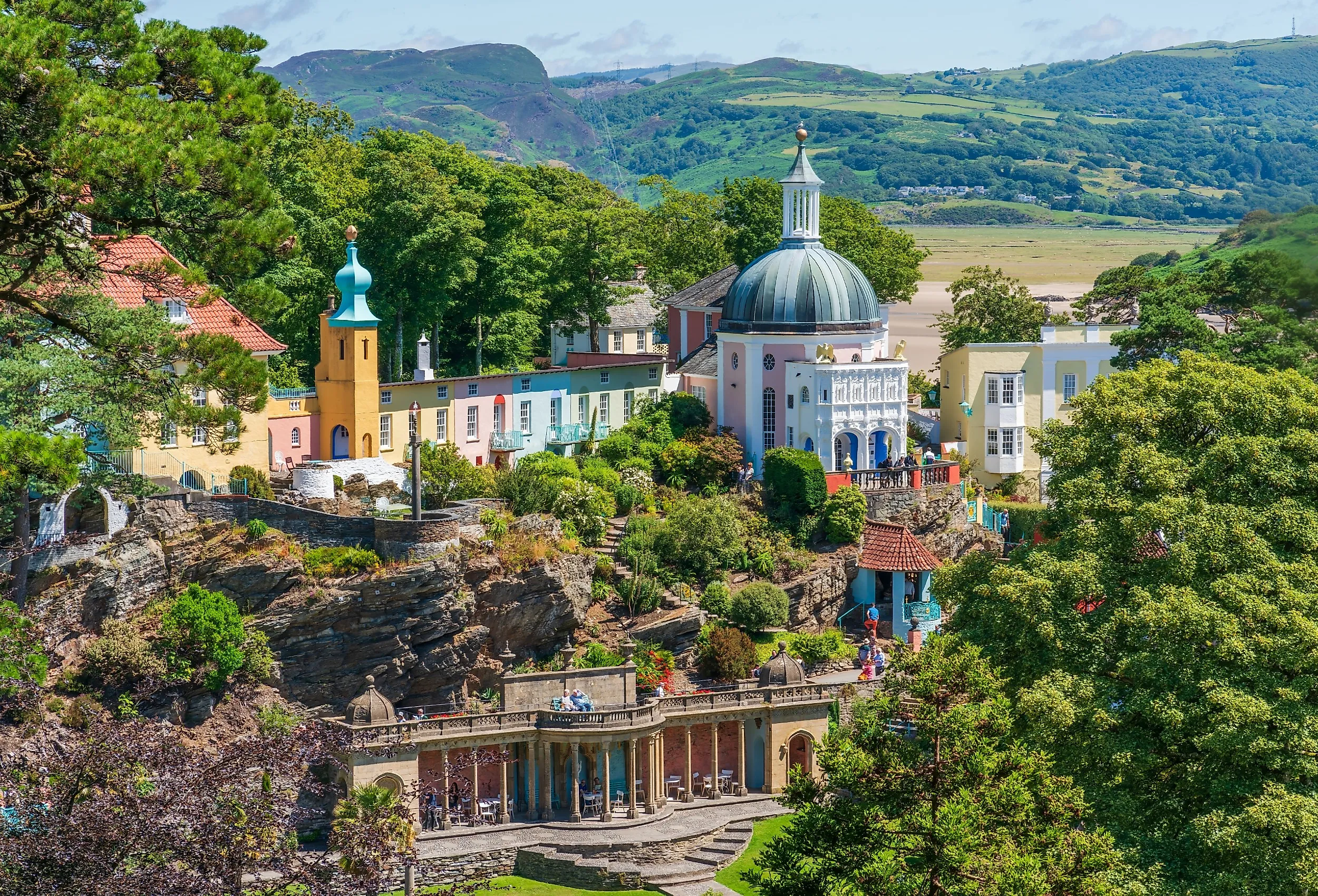
Portmeirion is not a town but an architectural folly: a private fantasy village on the Gwynedd coast that Sir Clough Williams-Ellis spent fifty years building, from 1925 to 1975. He placed pastel towers, colonnades, and salvaged fragments from demolished buildings across Britain along a wooded hillside above the Dwyryd estuary. He cited Portofino as an inspiration but insisted the village was not a copy. It was an argument that a beautiful setting could be developed without being destroyed.
The architecture is more eclectic than it first appears. Williams-Ellis mixed Baroque, Gothic, and Italianate elements with deliberate playfulness, incorporating pieces like a plaster ceiling from Emral Hall in Flintshire. Below the village, the Grade II* listed gardens known as Y Gwyllt ("The Wild") predate the buildings and are filled with rhododendrons and camellias. The village served as the set for The Prisoner, the cult 1967-68 television series starring Patrick McGoohan, and still draws fans of the show.
Machynlleth

Machynlleth calls itself the ancient capital of Wales. The claim has no official standing, but the history behind it is real. In 1404, Owain Glyndŵr convened a parliament here during his rebellion against English rule, with envoys from France, Scotland, and the Kingdom of León. He was crowned Prince of Wales and proposed two Welsh universities and a church independent from Canterbury. The rebellion failed. Glyndŵr's Parliament House, one of three surviving medieval buildings in town, still stands on the main street.
The Centre for Alternative Technology, founded in 1973 by Gerard Morgan-Grenville in a disused slate quarry nearby, was one of Britain's earliest experiments in sustainable living, with renewable energy demonstrations and organic gardens. In recent years it has shifted from general admission to group visits and courses. MoMA Wales, a gallery housed in a converted Wesleyan chapel called Y Tabernacl since 1986, gives a town of 2,200 people an institution with national-scale ambitions. The Victorian clock tower on Maengwyn Street, erected in 1874 and standing nearly 24 meters tall, fits the pattern.
Llanidloes

Llanidloes is the first town on the River Severn, the longest river in Great Britain. The Severn starts in a peat bog on the slopes of Pumlumon at about 2,000 feet, marked by a wooden post in wet ground, and flows 220 miles to the Bristol Channel. Walkers can trace it back to its source along trails through Hafren Forest northwest of town. There is no waterfall or gorge at the top, just sphagnum moss and open mountain.
The town has held a market charter since 1280 and was a center for weaving and flannel production by the late 18th century. The Old Market Hall, a rare timber-framed building dating to around 1600, still stands in the center. In 1839, during the Chartist uprisings, local protesters stormed the Trewythen Hotel on Great Oak Street to free three arrested men, one of the early flashpoints in a movement that reshaped British democracy. The Minerva Arts Centre keeps alive the tradition of Welsh quilting, and the Church of St Idloes contains a 15th-century hammer-beam roof worth a few minutes of looking up.
Porthmadog

Porthmadog exists because of the Cob, a mile-long stone embankment that the landowner William Alexander Madocks built between 1808 and 1811 to reclaim tidal marshland from the Glaslyn estuary. The town that grew behind it became one of the busiest slate ports in Wales. By 1873, over 116,000 tons of slate a year were shipped from its harbor, carried down from Blaenau Ffestiniog on the Ffestiniog Railway, built for that purpose in 1832 and the first narrow-gauge railway in Britain to carry passengers when it added service in 1865.
Both the Ffestiniog and Welsh Highland railways still run from Porthmadog as heritage lines. The Ffestiniog covers thirteen miles of mountain scenery; the Welsh Highland runs north through the foothills of Eryri (the national park formerly known in English as Snowdonia) to Caernarfon. About three-quarters of Porthmadog's residents are Welsh speakers. T.E. Lawrence was born in neighboring Tremadog in 1888, though the family left while he was still an infant.
Blaenavon

The ironworks at Blaenavon were established in 1788, when three investors put up £40,000 to build blast furnaces on the edge of the South Wales coalfield. The town grew fast, its population peaking above 20,000 by the late 19th century, and the landscape was reshaped by mines, quarries, tramways, and workers' housing. In 2000, UNESCO inscribed the Blaenavon Industrial Landscape as a World Heritage Site, covering 3,290 hectares with 24 scheduled monuments and 82 listed buildings.
Big Pit, a working coal mine until it closed in February 1980, reopened as a national museum in 1983. Visitors descend 90 meters in the original pit cage and walk through the tunnels where men and, in earlier centuries, children worked. The three surviving blast furnaces at the ironworks are Grade I listed, and at Stack Square, a row of workers' cottages has been furnished to represent domestic life from the 1870s through the 1970s. The novelist Alexander Cordell set several of his historical novels in this landscape, drawn to the contrast between the scale of the industry and the smallness of the lives it contained.
Llangollen

Llangollen sits where the River Dee runs fast through a narrow valley in northeast Wales, within an Area of Outstanding Natural Beauty. Just to the east, the Pontcysyllte Aqueduct carries the Llangollen Canal 127 feet above the valley floor on 18 stone piers. Built between 1795 and 1805 by Thomas Telford and William Jessop, it is the highest navigable aqueduct in the world. There is no railing on the towpath side. UNESCO granted it World Heritage status in 2009.

Above the town, the ruins of Castell Dinas Brân sit on a steep hill. The castle was built in the 1260s by the Welsh prince Gruffydd Maelor II and was already derelict by the end of that century. The climb is short and stiff, and the views from the top are worth it. Down in the town, Plas Newydd was the home of Eleanor Butler and Sarah Ponsonby, two Anglo-Irish women who fled arranged marriages in 1778 and lived together here for fifty years. They renovated the cottage in elaborate Gothic style, wore black riding habits and men's top hats, and received visitors including the Duke of Wellington and Wordsworth. They became known simply as the Ladies of Llangollen.
The town also hosts the International Musical Eisteddfod, held annually since 1947, which brings over 5,000 performers from roughly 50 countries to compete. It was conceived as a gesture of post-war reconciliation.
Tregaron

Tregaron is a market town of about 1,200 people in Ceredigion, holding a royal charter since 1292. Just outside town, Cors Caron National Nature Reserve protects what is considered the most intact raised bog landscape in the United Kingdom. Boardwalks cross 349 hectares of peat bog and wetland where otters, polecats, red kites, peregrine falcons, and hen harriers live or pass through. Mid-Wales was the last stronghold of the red kite when it was nearly extinct, and this landscape helped keep the species alive.
For centuries, Tregaron was a gathering point on the drovers' roads, where cattle and sheep were assembled before the long walk to English markets. The drovers doubled as informal postmen for isolated communities along their routes. A statue in the town square commemorates Twm Siôn Cati, born here in 1532, a real figure whose story was inflated over the centuries into the legend of the Welsh Robin Hood. His supposed hideout, a cave at Ystrad-ffin, is in the nearby hills.
A short drive southeast, the ruins of Strata Florida Abbey stand near Pontrhydfendigaid. The Cistercian monastery, established in 1184, became one of medieval Wales's most important cultural centers. Eleven princes of the House of Dinefwr were buried there, and the poet Dafydd ap Gwilym, widely considered the greatest Welsh-language writer, is traditionally said to lie beneath a yew tree in the grounds.
Criccieth

Criccieth is a small seaside town on the Llŷn Peninsula, facing south across Cardigan Bay. The castle, perched on a headland between two beaches, was built by Llywelyn the Great around 1230, extended by his grandson, then taken and reinforced by Edward I after the English conquest. Owain Glyndŵr's forces captured and burned it in 1404. It was never rebuilt, and the ruin now offers views across Tremadog Bay to the mountains of Eryri.
The town's other major association is David Lloyd George, Prime Minister from 1916 to 1922, who grew up in the nearby village of Llanystumdwy. The museum there, housed in a building designed by Clough Williams-Ellis, documents his political career through artifacts and a reconstructed Victorian schoolroom. He is buried in Llanystumdwy beside the River Dwyfor. Criccieth itself is a largely Welsh-speaking community, with about two-thirds of residents using the language daily. It has the feel of a place that exists for its own residents rather than for visitors, which is precisely what makes it worth the stop.
These nine towns don't have much in common beyond the fact that none of them appear on a standard tourist itinerary. A Victorian spa town that hosts bog snorkeling championships, a private architectural folly on the Gwynedd coast, a former coal town with UNESCO status, a market village that claims to be the national capital. What connects them is less a theme than a tendency: small Welsh towns punching above their weight, holding onto histories and eccentricities that larger places would have smoothed away long ago. The well-known parts of Wales, the castles of Caernarfon and Conwy, the peaks of Eryri, the nightlife of Cardiff, are not going anywhere. But the country gets more interesting the further you wander from them.