9 Most Walkable Town Centers In Missouri
The best way to discover, or rediscover, Missouri is to walk around and experience it firsthand. Whether you are strolling past the brick storefronts of Hermann’s Market Street or exploring the compact historic district of Ste. Genevieve, these town centers make it easy to slow down and take in the details. In places like Rocheport, where a museum, a riverfront park, and Katy Trail access all sit within a few blocks, you can spend more time exploring and less time moving from one attraction to another. Across Missouri, these nine towns stand out for their exceptional downtowns.
Parkville

Parkville, along the Missouri River northwest of Kansas City, has a historic downtown area that you can stroll end to end in minutes. It is packed with independent shops, coffeehouses such as Parkville Coffee, and galleries housed in preserved brick buildings. Visitors can begin at the center of downtown and browse independent shops and art galleries before walking west two blocks to English Landing Park, where 3 miles of paved riverfront trails stretch along the Missouri River. The transition from storefronts to open green space takes less than five minutes on foot.
From English Landing Park, walk back east through downtown and follow the sidewalks uphill toward Park University. The steady climb leads to Mackay Hall, added to the National Register of Historic Places, and overlooks the scenic river valley below. The complete route from the riverfront to Park University takes about 15 minutes at a relaxed pace. Together, Main Street, English Landing Park, and Park University form a simple walking loop that blends retail, green space, and scenic views.
Ste. Genevieve

Ste. Genevieve, one of Missouri's oldest settlements, has a preserved historic district that forms a tight cluster around Main Street. Travelers can park and walk on the pedestrian paths that link parks to centuries-old homes, museums, and shops without covering much ground. Start at the Centre for French Colonial Life on Main Street, then walk one to two blocks to the Ste. Genevieve National Historic Park that protects several French Colonial structures, including the Bolduc House and the Jean Baptiste Vallé House. A block away is the Green Tree Tavern, one of the oldest surviving houses in Missouri. All these sites are within a few minutes of each other, connected by sidewalks.
After touring the historic homes, continue south on foot toward Memorial Cemetery, one of Missouri's oldest burial grounds. From there, paved sidewalks extend toward the Mississippi River floodplain and nearby green space. Cafes and boutiques sit along the same walkable corridor, making it easy to pause for a moment between historic stops. The flat terrain and short distances allow travelers to see much of Ste. Genevieve on foot in a single afternoon, and most of Ste. Genevieve's key attractions lie within a 10-minute walking radius.
Rocheport

Rocheport may be small, with only 200 residents, but it draws a steady stream of visitors thanks to its direct access to the 240-mile Katy Trail State Park. The trail runs directly through town, linking the historic Rocheport Depot, river overlooks, and downtown storefronts in one continuous pedestrian route. Begin at the depot near the trailhead, then follow the wide crushed-limestone path toward the river overlooks. Walkers can step off the trail and reach galleries, restaurants, and bed-and-breakfasts within minutes in the Rocheport Historic District, an area with buildings dating from 1830 and listed on the National Register of Historic Places.
From downtown, continue west on the Katy Trail for scenic views along the Missouri River. Those who prefer elevation can walk uphill from the center of town along quiet streets toward nearby vineyards and bluff overlooks. Stop at one of the award-winning wineries, Les Bourgeois Vineyards, featuring a bistro, wines, and spectacular views atop the bluffs. The distance between the depot, downtown storefronts, and trail access points is less than half a mile, making Rocheport easy to navigate entirely on foot. It is also only two hours from Kansas City or St. Louis, Missouri.
Boonville

Boonville, a 1820s Missouri River port, has its historic downtown still reflecting that 19th-century layout. Main Street anchors the district with brick storefronts, antique shops, and museums such as the Cooper County Museum and the Mitchell Antique Motorcar Museum, a few blocks away. Brick sidewalks and short crossings connect these two attractions within five minutes. Antique shops and cafes also line the same corridor.
From Main Street, visitors can walk south toward Riverfront Park that borders the Missouri River. The stroll from the museum district to the park takes about 10 minutes. Once there, paved paths offer scenic river views and access to the Katy Trail; nearby is the River, Rails and Trails Museum. The connection back to downtown Main Street is rewardingly easy, as you explore the residential streets lined with historic homes. You can even take a walking tour of Cooper County's historic homes and buildings if you have more time.
Kirksville

Kirksville functions as a regional center in northern Missouri, yet its downtown remains compact and walkable. Begin near the Adair County Courthouse and walk a few blocks to the Adair County Historical Society and Museum, on the National Register of Historic Places. Shops and cafes line the streets between these two sites. A few blocks away is the Battle of Kirksville & Forest Llewellyn Cemetery. Visitors can walk between these landmarks in just a few minutes. There is even a self-guided audio tour of over 100 places of interest in Kirksville.
Sidewalks and paved paths connect downtown to nearby green spaces, including Rotary Park and Memorial Park. The walk from the courthouse square to these parks takes roughly 15 minutes. Trails inside the park's loop through wooded areas and open lawns before reconnecting with nearby streets that lead back toward the courthouse district. Kirksville's layout makes it easy to explore both its civic heart and recreational areas in a single continuous walk.
Cape Girardeau

Cape Girardeau's Mississippi Riverfront district is home to several attractions within easy walking distance. Begin along the Missouri Wall of Fame mural corridor near downtown, which runs along the floodwall. From the floodwall, follow sidewalks to the World's Largest Fountain Cup sculpture, then walk a few blocks inland to reach restaurants and shops housed in historic buildings. The river remains visible throughout much of the walk.
After exploring downtown, follow the sidewalks south toward Riverfront Park and connect to the Cape LaCroix Recreation Trail. The trail system allows pedestrians to continue along landscaped paths that follow the Mississippi River and weave through open green space. The trails let you walk to Shawnee Park and Osage Park without leaving the paths. The distance between the mural corridor, downtown shops, and the recreation trail falls within a 20-minute walking range.
Arrow Rock

Arrow Rock preserves a 19th-century village layout that encourages exploration on foot. Start at the Arrow Rock State Historic Site Visitor Center, then walk a short block to the J. Huston Tavern, the oldest continuously operating restaurant west of the Mississippi River, and then the Old Courthouse. Continue along the same street to view additional historic homes, all within a short five minutes. Streets remain quiet and easy to navigate, allowing visitors to wander between landmarks at a leisurely pace.
Beyond the central cluster of buildings, footpaths extend toward bluff overlooks and open countryside. The walk from the tavern to nearby scenic points takes about 10 minutes. Most landmarks sit within a few compact blocks.
Hermann

Hermann's German heritage is reflected in its brick architecture and tightly arranged downtown streets. Visitors arriving at the Amtrak station can step off and walk directly into the heart of town in under five minutes. Market Street forms the backbone of the town, connecting the Amtrak station to quilt shops, tasting rooms, boutiques, and museums sitting side by side in preserved brick buildings.
From the center of downtown, sidewalks slope gently toward Riverfront Park along the Missouri River. The walk from central downtown to the park takes about 10 minutes, passing historic homes and storefronts along the way. After reaching the riverfront, you can loop back uphill through residential streets to return to Market Street or stroll between wineries along the Hermann Wine Trail. Hermann's compact downtown keeps its most visited attractions within easy reach.
Weston

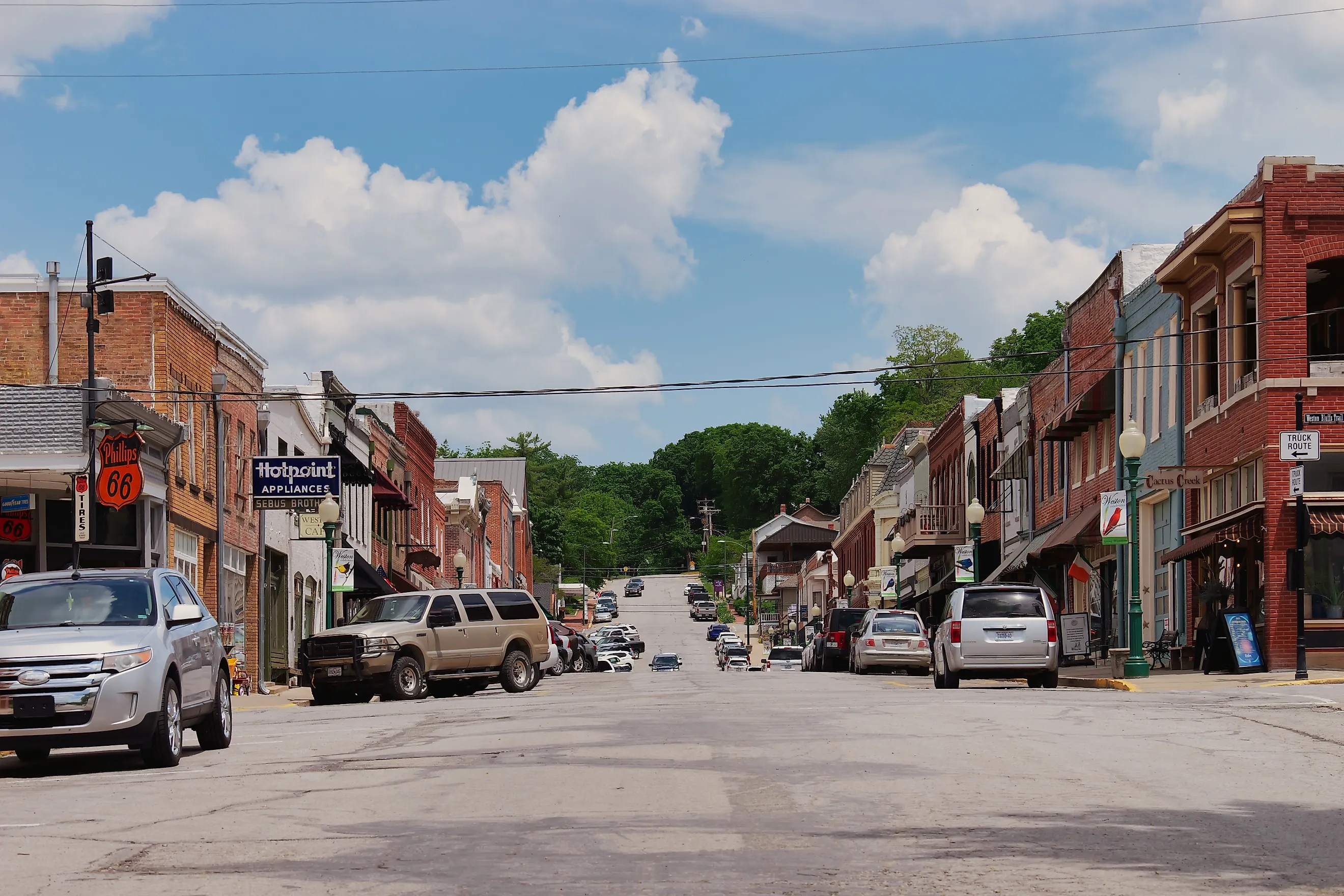
Weston's historic Main Street rises slightly above the Missouri River and spans only a few blocks. Start at the north end of Main Street and walk south past specialty shops, restaurants, and breweries, such as the Weston Brewing Company, which also offers tours, housed in 19th-century buildings. The entire commercial downtown district can be covered in less than 10 minutes.
Walk west from downtown toward the trailheads connected to Weston Bend State Park. Sidewalks and low-traffic streets allow you to get to scenic overlooks above the river easily. The park is also part of the Great Missouri Birding Trail, making it a fantastic spot for bird-watching, especially during spring and fall migrations. To get back to Main Street, many routes through residential streets lead to downtown. The distance from Main Street to park access points takes about 15 minutes on foot, allowing visitors to combine historic storefronts with outdoor views in one outing.
In these Missouri towns, walking isn’t just convenient — it’s the best way to experience them. In Parkville, a riverside trail begins just steps from Main Street. In Ste. Genevieve, French Colonial homes stand within sight of cafes and shaded sidewalks. In Rocheport, the Katy Trail runs past the depot and straight through downtown. In Hermann and Weston, historic storefronts sit only minutes from river overlooks and state park trails.
Leave your car behind, follow the sidewalks and paths, and let each town unfold at a relaxed pace. From museum to mural wall, courthouse square to green space, Main Street to trailhead, these nine small Missouri towns prove how effortless and enjoyable walkable downtowns can be.