8 Prettiest Main Streetscapes In Kansas
Council Grove's Main Street runs directly over the old Santa Fe Trail, its storefronts built from the same grey Flint Hills limestone that settlers passed on their way west. In Cottonwood Falls, a red mansard roof caps the 1873 Chase County Courthouse at the head of a brick-paved Broadway. Lindsborg fills its downtown with Dala horses and Swedish bakeries left by immigrants who arrived in 1869. Atchison lines Commercial Street with Victorian brick above the bluffs of the Missouri River. Each of these Kansas towns has kept a main street worth slowing down for. These are the prettiest main streetscapes in the state.
Council Grove

Walk along Council Grove's Main Street, and you are following the Old Santa Fe Trail, which is why this downtown is a federally designated National Historic Landmark District. This town was the last chance settlers heading further west had to restock supplies and rest before continuing the arduous journey. The Last Chance Store is the oldest commercial building in town, built in 1857. It is no longer a trading post and is privately owned, but you can drive past it and see the worn grey limestone blocks that are a key building component of this Flint Hills area of Kansas.

Throughout the town, you will see signs of those days in other limestone buildings that still stand from that era. Hays House, established in 1857, is billed as the oldest continuously operating restaurant west of the Mississippi River, a claim a few older establishments in Missouri and California also make. To give you a sense of just how well preserved Council Grove's history is, more than two dozen nationally recognized historic sites sit around town.
Drive outside the main village area, and you gain an even deeper sense of what Council Grove meant to those traveling the Santa Fe Trail when you find yourself surrounded by the tall grass prairie.
Cottonwood Falls

The soft, worn brick surface of Broadway Street carries visitors into this historic town. Kansas limestone buildings line the street, culminating in the Chase County Courthouse, built in the French Second Empire style of walnut and limestone. Completed in 1873, it is the oldest continuously operating courthouse in Kansas. Locals often describe the three-block stretch of historic architecture as a living movie set.
The street is also lined with boutiques, galleries, and eateries. A standout is the Grand Central Hotel, built in 1884. It holds ten western-themed rooms behind a brick exterior marked by tall windows and a large limestone cornice at the top.
The town is a good jumping-off point for the Tallgrass Prairie National Preserve, four miles down the road. Here you can hike amongst bison and visit Spring Hill Ranch House, a restored 11-room mansion with a wraparound porch and a red mansard roof. Like the courthouse in town, it is built in the French Second Empire style.
Abilene

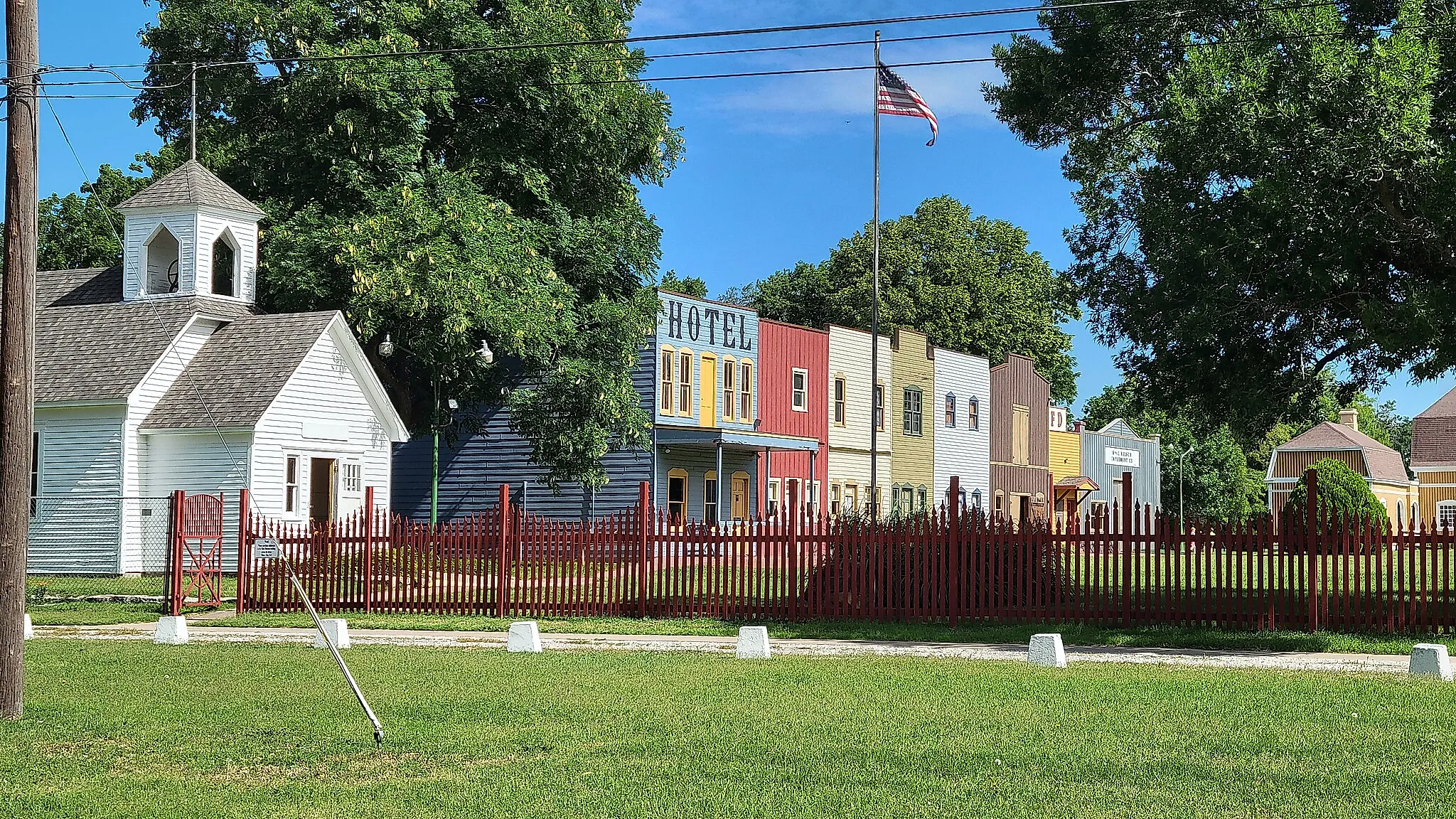
Abilene differs from the other towns here because its historic downtown spreads beyond a single main street. It is all part of the Abilene Downtown Historic District, listed on the National Register of Historic Places. In the 1870s, Abilene was a booming cattle hub where the likes of Wild Bill Hickok tried to keep order among those traveling the Chisholm Trail and new arrivals settling the area. In the Old Abilene Town area, you are surrounded by recreations of historic storefronts, wooden boardwalk sidewalks, and brick-paved streets. You can visit the Alamo Saloon, which served as Hickok's headquarters. The original was built in 1871 and is now gone, though the bar in the back came from the real saloon. Gunslinging reenactments and can-can dancing happen here.

Also within the historic district are fine examples of later railroad architecture, such as the Abilene Union Pacific Railroad Passenger Depot, built in 1928 in the Spanish Colonial Revival style. Abilene was the boyhood home of President Eisenhower, and his presidential library, museum, and home are key attractions.
Wander a couple of blocks to the outskirts of town and find yourself among Victorian-era and Italianate mansions, some of which can be toured.
Lindsborg

Visit Lindsborg, and you may think you have been transported to Sweden. Settled by Swedish immigrants in 1869, the town wears its heritage openly, especially in the downtown strip with its colorful, well-preserved Scandinavian architecture. Shops featuring the emblematic Swedish Dala Horse and Nordic knitwear sit throughout town. Several Swedish restaurants operate here, such as the Crown & Rye, where you can eat Smörgås and Swedish pastries.

Visit during one of the town's Swedish festivals, such as the Svensk Hyllningsfest or Midsummer (Midsommar), St. Lucia Fest, and Våffeldagen (Waffle Day), and the downtown feels even more evocative of Sweden. The Lindsborg Old Mill & Swedish Heritage Museum preserves the legacy of early Scandinavian pioneers. The property also houses the Swedish Pavilion, originally built for the 1904 St. Louis World's Fair.
Homage to Swedish art runs throughout the village. The prairie painter Birger Sandzen, born in Blidsberg, Sweden, in 1871, emigrated here. His work is celebrated at the Birger Sandzen Memorial Art Gallery, which holds the world's largest collection of his paintings and prints.
Atchison

Atchison sits on grey limestone bluffs overlooking the Missouri River. That setting, and a downtown plaza that overlooks the water, sets the tone for the rest of the streetscape. Victorian-era buildings stand along Commercial Street, the historic center of town. It is brick-paved and lined with container plantings and seasonal arrangements.

Atchison is where the Atchison, Topeka and Santa Fe Railway took its name and its early eastern anchor, and that history left a lasting mark on the town. The Atchison Santa Fe Depot was constructed in 1880 and is listed on the National Register of Historic Places. Today it serves as a community and cultural hub.
Amelia Earhart was born and raised in Atchison, and tributes to her life are everywhere, including the Amelia Earhart Birthplace and Museum and the Amelia Earhart Hangar Museum. Atchison is known for a quirkier reason, too. The town is thought to be a center of paranormal activity, and enthusiasts travel from around the world to visit the Sallie House and the McInteer Villa, both reputed to be haunted.
Fort Scott

The story of westward expansion is documented all over Fort Scott. Its walkable downtown is lined with buildings made from locally sourced brick in the 1800s that evoke the town's early history as a frontier military outpost. The nine-block area has period streetlights and is decorated with flowers. The 1914 First National Bank building, McDonald Hall, and the well-preserved Carnegie Library sit within this area, along with boutiques, antique shops, galleries, and restaurants. A fun night spot is The Green Lantern, which channels the vibe of a prohibition-era speakeasy. A historic trolley ride caps off the full flavor of the streetscape.
Dodge City

Dodge City once carried the nickname "The Wickedest Little City in America." It is famous for the gun slinging and lawless saloon history the Old West is known for. A strong civic effort to revitalize the downtown means the Dodge City streetscape now brings that history to life. Shootouts and cattle driving are gone, but Wyatt Earp Boulevard and Front Street are replete with 19th-century cowboy heritage.

The original Boot Hill Cemetery is another landmark, where many an outlaw was buried. Today the grounds of the cemetery are occupied by Boot Hill Distillery, a "soil-to-sip" craft distillery using local western Kansas grains. Restaurants such as Cowboy Capital Saloon & Grill, Firesides, and the I Don't Care Family Restaurant & Sports Bar draw on the Cowtown history.
The town has also built an open arts culture, showcasing galleries and murals that add to the streetscape.
Newton

Newton was founded in 1871 when the Santa Fe Railroad pushed through the tiny settlement that predated it. The town also served as the terminus of the Chisholm Trail, and it remains steeped in the history of the western expansion, boasting not one but three National Historic Districts. Local government has committed to preserving the Victorian railroad-era architecture, offering business owners grants to keep the aesthetic intact.
One popular preserved landmark is the Warkentin House, the Victorian home of Bernhard Warkentin and Wilhelmina Eisenmayer, built in 1886. Warkentin brought Turkey Red hard winter wheat to the region, the variety that made Kansas known as the breadbasket of the world.
Another standout feature of Newton's downtown is the trees. Parks and pocket green spaces reflect a deliberate effort to plant shade trees and floral displays alongside street art. The overall feel is Victorian architecture set among green pockets of nature.
The Streets That Kept Their Story
The prettiest streetscapes in Kansas share a common source: the Old West and the westward expansion that built these towns, preserved today through deliberate civic effort. Council Grove keeps the limestone of the Santa Fe Trail, Lindsborg keeps its Swedish downtown, and Dodge City rebuilt a frontier main street from the ground up. Old architecture, modern culture, and civic care together make these some of the finest main streets in the state.