8 Nicest Small Towns In Rhode Island
Rhode Island's small towns punch way above their size. Catch America's oldest Fourth of July parade in Bristol every summer. Ride a carousel older than the Civil War in Watch Hill. Walk Newport's cliffs past Gilded Age mansions with the Atlantic booming below. Sip New England's oldest wine on a Little Compton farm. Every one of these eight towns sits a short drive from the next.
Little Compton

Little Compton is one of Rhode Island's most rural, understated, and preserved towns. Originally known as Sakonnet, the area was home to the Indigenous Sakonnet/Wampanoag people, who lived there for centuries prior to English settlement. It was incorporated by English colonists in the late 17th century and formally became Little Compton in 1682. Serving as the headquarters of the Little Compton Historical Society is the Wilbor House Museum, where you'll find exhibits on farming and family life. Pay a solemn visit to the two-story Friends Meeting House and Cemetery, built by the Quakers in 1815 on the site of an earlier 1700 meeting house.
The Town Common is the civic center of the town, having served as a meeting place; burial ground (where Elizabeth Pabodie, daughter of Mayflower passengers John Alden and Priscilla Mullins, is interred); and a site for churches, schools, and town governance. When you need a break from all that history, the mile-long protected coastline at Goosewing Beach Preserve offers walking trails, dunes, and a quiet stretch of Atlantic shoreline ideal for birdwatching. Further inland, New England's oldest vineyard, Sakonnet Vineyards, boasts rolling fields and seasonal tastings across 169 acres.
Newport

Gilded Age opulence meets an active harbor-town atmosphere in Newport, which traces its roots to 1639 and grew into a major colonial port known for rum distilling, furniture making, and maritime trade before the British occupied the area during the American Revolution. It later evolved into a summer retreat for America's wealthiest families, a legacy still visible in the grand estates that line its shoreline.
The Breakers, the 1895 Vanderbilt mansion, remains one of Newport's best-known historic homes and headlines the town's collection of preserved estates. Along the coast, the 3.5-mile Cliff Walk threads between the crashing Atlantic and grand 19th-century mansions, delivering one of New England's most distinctive coastal walks. Downtown, Thames Street lines up restaurants and maritime-themed shops that reflect the town's enduring tie to the sea, and harbor cruises let you take in the skyline, historic forts, and shoreline from the water.
Bristol

Bristol, named for the city in England, fuses deep colonial history with one of Rhode Island's most scenic waterfront settings. It was founded in 1680 and remained part of Massachusetts until 1747, eventually becoming a bustling port town. Bristol sustained two British naval attacks during the Revolutionary War, the second of which came in 1778. Just seven years later, the town established what is now the oldest continuous Fourth of July celebration in the United States.
The waterfront is a defining feature here, particularly at Colt State Park, where bike paths, open lawns, and panoramic views of Narragansett Bay make it one of the town's most popular places to walk or bike. Nearby, Blithewold is a 33-acre estate featuring a grand manor and landscaped gardens, making it an ideal setting for concerts and other popular community events. Also worth visiting is Linden Place, an 1810 Federal-style mansion and history center that originally served as the home of the DeWolf family, which derived its fortune partly from the slave trade. Roger Williams University, named for Rhode Island's cofounder, is also set in Bristol.
Wickford

Wickford, a village with early-1700s roots, feels like a preserved postcard of colonial New England. During the Revolutionary War, it likely offered refuge for prominent Newport residents fleeing British-occupied seaport towns. The heart of town is the highly walkable Wickford Village, where 18th-century homes, cafés, art galleries, and small shops line narrow streets running down to the harbor. Its protected waters stay calm enough to draw kayakers and small sailboats.
Smith's Castle, one of the oldest surviving colonial-era houses in New England, is listed on the National Register of Historic Places. Just south of Wickford, in Saunderstown, the Gilbert Stuart Birthplace & Museum preserves the 18th-century home and mill site of painter Gilbert Stuart, who created the portrait of George Washington used on the U.S. $1 bill. A visit takes in a functioning snuff mill, historic home, art gallery, and nature trails along a pond.
Watch Hill

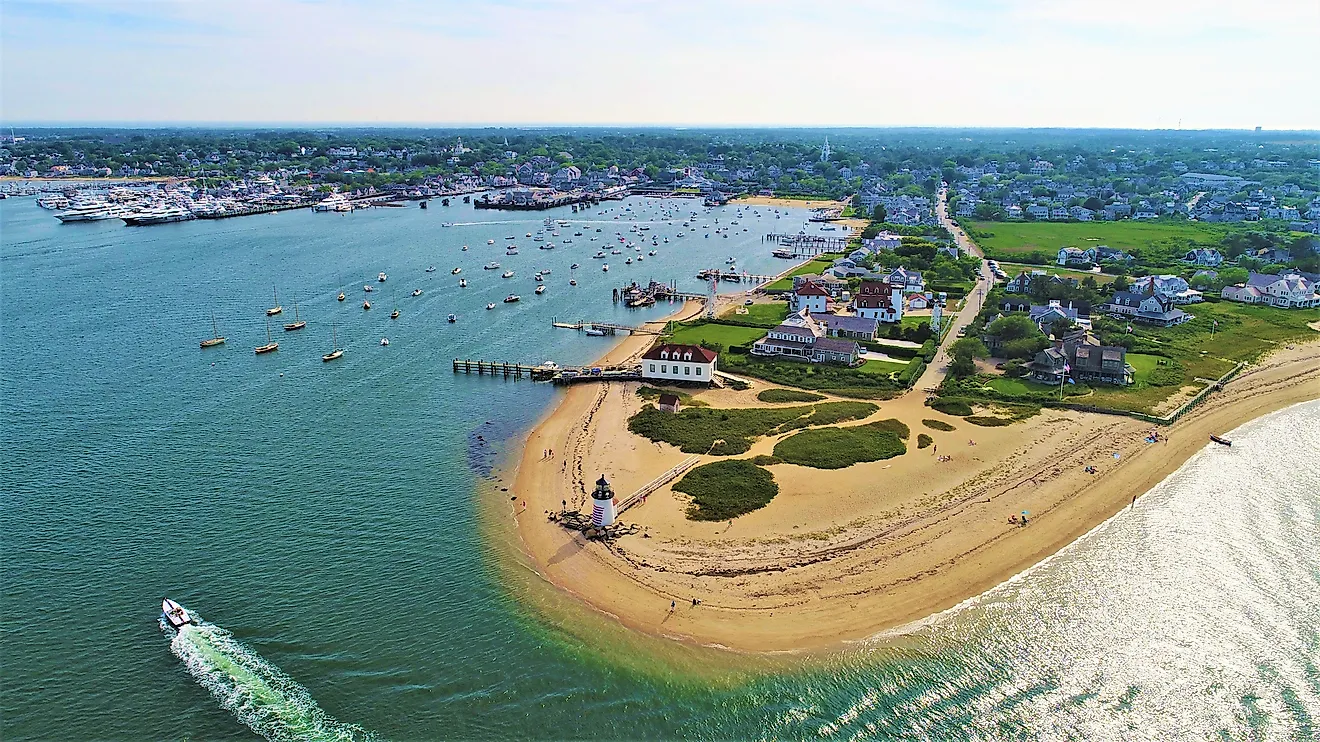
Located at the southwestern tip of mainland Rhode Island in Westerly, Watch Hill is one of the state's most exclusive coastal enclaves. The village takes its name from the hill where colonists kept watch during the French and Indian War and, later, the Revolutionary War. In 1806, President Thomas Jefferson authorized a lighthouse on Watch Hill Point; damaged by erosion, it was rebuilt in the 1850s and still stands today.
Beachgoers have several choices, including East Beach, known for its waves, and the family-friendly Watch Hill Beach. Beside the sand sits the Flying Horse Carousel, one of the oldest continuously operating carousels in the country. Overlooking it all is Ocean House, whose 2010 incarnation is the state's only AAA Five Diamond and Forbes Five-Star hotel. For a meal, the Olympia Tea Room has served an extensive menu of entrees and sandwiches for more than a century.
Jamestown

Sitting placidly across the bay from Newport, Jamestown suits travelers who prioritize nature and history over crowds. Its centerpiece is Beavertail State Park, where tide pools and rocky cliffs frame some of the most striking sightlines on the New England coast. The park's Beavertail Lighthouse, at the southern tip of Conanicut Island, traces its origins to a 1749 beacon, making it one of the oldest lighthouse sites in America; the current 1856 tower houses a museum of Rhode Island's maritime past.
The 61.5-acre Fort Wetherill State Park, a former coastal defense battery overlooking Narragansett Bay, opens up scuba diving, fishing, and hiking alongside views of Newport Harbor. History turns up again at the North Road windmill, built in 1787 and celebrated by the Jamestown Historical Society each July on Windmill Day. For a slower afternoon, the 265-acre Watson Farm offers walking trails and grazing livestock with sweeping views of the bay.
Warren

Warren is the kind of quiet New England town people retire to or escape to when bigger cities start to wear thin. This under-the-radar riverside spot, named in 1747 for the British naval hero Admiral Sir Peter Warren, blends maritime history with a growing culinary and creative scene.
Warren's walkable Main Street and Water Street Historic District ranks among the town's biggest draws, lined with well-preserved 18th- and 19th-century homes, churches, and former sea captains' residences that recall its whaling and shipbuilding past. For lunch, The Square Peg serves burgers and seafood inside a building dating to roughly 1790. Bargain hunters can browse antique shops and bookstores like Old as Adam and the woman-owned Ink Fish Books. When the weather turns fine, Warren Town Beach and Burr's Hill Park along the Warren River draw sunbathers, kayakers, and boaters.
South Kingstown

South Kingstown blends classic New England town life, easy beach access, and a palpable academic energy. The Narragansett people lived here for thousands of years before English settlers arrived around 1657, and the town was incorporated in 1723. The University of Rhode Island, founded in 1892, has shaped local life ever since and supplies much of that college-town buzz.
The village core along Main Street in Wakefield fills up with cafés, local shops, and inviting restaurants that form the town's social heart. A short drive away, East Matunuck State Beach offers a wide, surf-friendly shoreline popular through the summer. For an evening out, Theatre By The Sea stages Broadway-style productions in a restored seaside venue. History buffs can visit the South County History Center, set in a former jail, where exhibits document women's contributions and Black life in early New England.
Small Places, Classic Rhode Island History
None of these eight towns tops 50,000 people, and most sit within a short drive of the next. That closeness is the appeal. Jamestown's Beavertail Lighthouse marks a site first lit in 1749, the Gilbert Stuart birthplace near Wickford preserves the home of the painter who put George Washington on the dollar bill, and Little Compton farms the land around New England's oldest vineyard. You can walk a sea captain's street in Warren and stand above the Atlantic on Newport's Cliff Walk in the same afternoon.