8 Most Picturesque Small Towns In Michigan
In Michigan, the Great Lakes shoreline does a lot of the heavy lifting for scenery. Charlevoix sits with direct access to both Lake Michigan and Lake Charlevoix, with a drawbridge between them that raises for boat traffic. Along Lake Huron, East Tawas anchors a broad curve of bay around the historic Tawas Point Lighthouse. Up on Lake Superior, Marquette adds cliffs, forest, and sandstone outcrops to its waterfront. The eight towns below are among Michigan's best Great Lakes settings.
East Tawas

East Tawas is a small town of about 2,700 residents on Tawas Bay, a sweeping natural harbor formed by a hook of sand that curves out into Lake Huron. The Tawas Point Lighthouse, built in 1876 and still active, sits at the tip of that hook and is open for climbing during summer months, with wide views of the bay and open lake. The surrounding Tawas Point State Park covers most of the peninsula and includes some of the best sand beaches on Michigan's Lake Huron coast.
The Tawas Bay area is sometimes called the "Cape Cod of the Midwest" for its sheltered bay, sandy shoreline, and resort history. In neighbouring Tawas City, Gateway Park provides fishing access and picnic space along the water. The sheltered conditions inside the bay make it one of the better spots on Lake Huron for kayaking and paddleboarding, with bird migration in spring and fall drawing birders to the point.
Frankfort

Frankfort sits in Benzie County on Lake Michigan, with a population of about 1,200. The town's signature landmark is the Point Betsie Lighthouse, built in 1858 a few miles south, one of the oldest continuously operating lighthouses on Lake Michigan and widely regarded as the most photographed lighthouse in the state. The town itself runs along a small harbor that connects Betsie Lake to Lake Michigan, with the pier and breakwater offering a standard after-dinner walk.
The Garden Theater on Main Street is a restored 1923 cinema still running films. The Oliver Art Center, housed in a converted Coast Guard station on the water, serves as the town's arts hub with exhibits and classes. A short drive from downtown, Crystal Lake is one of the clearest and most famously turquoise inland lakes in Michigan, formed by glacial activity and fed primarily by springs, which explains the water colour.
Traverse City

Traverse City is the largest town on this list at about 15,500 residents and the regional hub of northwestern Lower Michigan. It calls itself the Cherry Capital of the World, producing roughly 75% of the tart cherries grown in the United States from the surrounding orchards, and hosts the National Cherry Festival each July, which has run since 1925. The city sits at the southern end of Grand Traverse Bay, a deep and sheltered arm of Lake Michigan.
Downtown has a dense commercial core with independent restaurants, bookstores, and the State Theatre, a restored 1916 cinema. Old Mission Peninsula, reaching 18 miles into the bay north of town, is lined with wineries along the 45th parallel, one of the better cool-climate wine regions in the country. Sleeping Bear Dunes National Lakeshore, 45 minutes west, pairs naturally with a Traverse City visit for its massive dunes and clear Lake Michigan beaches.
Alpena

Alpena, the only city in Alpena County, has about 10,000 residents and sits on Thunder Bay, a deep inlet of Lake Huron. The bay is the site of the Thunder Bay National Marine Sanctuary, which protects roughly 200 shipwrecks spanning 150 years of Great Lakes commerce. The Great Lakes Maritime Heritage Center runs exhibits on the sanctuary and offers glass-bottom boat tours over several shipwrecks during summer.
The Besser Museum for Northeast Michigan covers regional natural history and includes a planetarium and fossil exhibits drawn from the limestone and Devonian marine deposits that underlie the area. The Alpena Light, a small red pyramidal lighthouse on the Thunder Bay River known locally as "Little Red," is one of the more photographed small lighthouses in the state.
Mackinaw City

Mackinaw City sits at the northern tip of the Lower Peninsula, right at the Straits of Mackinac where Lake Michigan and Lake Huron meet. Despite having fewer than 1,000 year-round residents, it receives heavy summer traffic as one of the two mainland access points for Mackinac Island, which is reachable only by ferry (the island bans cars). The Old Mackinac Point Lighthouse, built in 1892 at the water's edge, is open for tours with views of the Straits.
The Mackinac Bridge, completed in 1957, spans five miles across the Straits to connect the Lower and Upper Peninsulas. By total length, it is the longest suspension bridge in the Western Hemisphere. Colonial Michilimackinac, a reconstructed 18th-century French fur-trading fort at the foot of the bridge, runs historical reenactments throughout the summer season.
South Haven

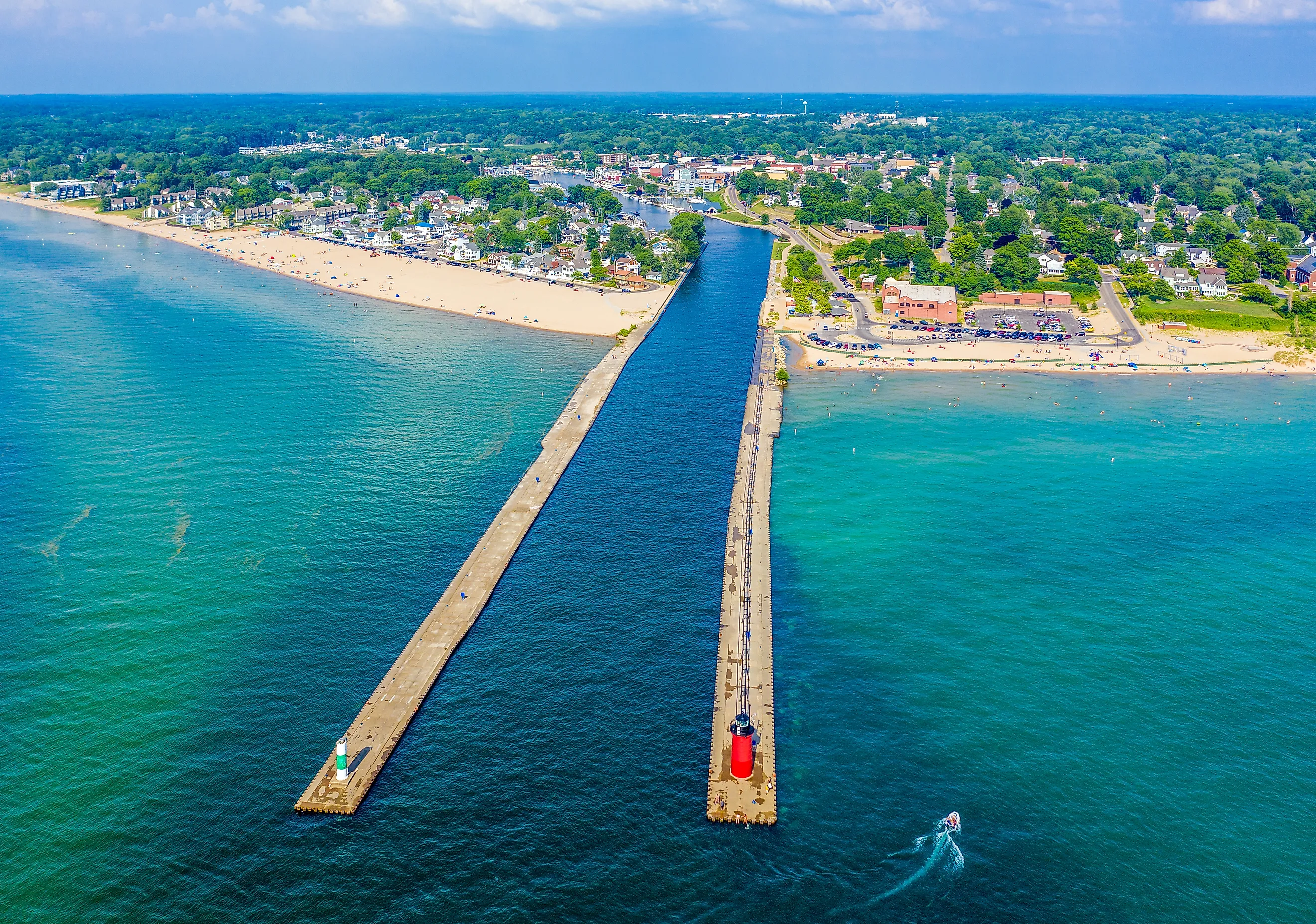
South Haven is a small city of about 4,000 on Michigan's southwest Lake Michigan coast, historically built around fruit farming and lake shipping. The town has seven public beaches along its shoreline and a red 1903 pierhead lighthouse that marks the harbor entrance. A network of marinas supports both recreational boating and a commercial charter fishing fleet. Downtown has kept its pedestrian-scale feel, with a mix of inns, bed-and-breakfasts, art galleries, and local restaurants within walking distance of the beach.
Charlevoix

Charlevoix sits on a narrow strip of land between Lake Michigan and Lake Charlevoix, with a channel running through downtown that connects the two. The drawbridge over that channel raises regularly during boating season for tall sailboats, an event familiar enough to locals that they plan lunch around it. Lake Charlevoix itself is Michigan's third-largest inland lake by surface area, supporting swimming, kayaking, and fishing. The town is also known for its Mushroom Houses, stone-and-timber cottages built by Earl Young between 1918 and 1950, with low-slung roofs and curved lines that look like a combination of storybook architecture and organic Prairie School influence.
Marquette

Marquette is the largest city in the Upper Peninsula at nearly 22,000 residents and sits on Lake Superior. The town began as an iron-ore shipping port in the mid-19th century, with ore docks still standing along the waterfront as a visible piece of the industrial history. Presque Isle Park, a 323-acre peninsula just north of downtown, offers some of the best Lake Superior overlooks in the region, along with a small lighthouse, cliff bands, and Sunset Point at the northwestern tip. Northern Michigan University gives the town a steady student population and supports an active arts and music scene. The city is also regarded as one of the best mountain biking towns in the Midwest, with the Noquemanon Trail Network running both within and around the city.
Eight Great Lakes Towns
Michigan has the longest freshwater coastline of any state, and these eight towns stretch across its different lakes and peninsulas. East Tawas, Alpena, and Mackinaw City sit along Lake Huron and the Straits. Frankfort, Traverse City, South Haven, and Charlevoix spread along the Lake Michigan coast. Marquette represents Lake Superior from the Upper Peninsula. Each one uses its lake in a different way, whether through historic lighthouses, shipwreck preservation, pier-end sunsets, or channel-cutting drawbridges, but all of them share a working relationship with the water that shapes everyday life.