12 Amazing West Virginia Day Trips That Are Worth The Drive
West Virginia offers deep river gorges, Appalachian mountain trails, and museums covering several layers of regional history. Day trips can lead to quirky stops like the legends at the Mothman Museum or haunting tours through a historic asylum. Other stops highlight art and science, with hands-on exhibits at the Clay Center for the Arts & Sciences and wide-ranging collections at the West Virginia State Museum. Places like Beech Fork State Park and Babcock State Park show off the landscapes that make West Virginia a rewarding place to drive through. Below are 12 day trips worth the drive, starting from Charleston and Huntington.
Starting City: Charleston
Clay Center for the Arts & Sciences (Within the City)

This 240,000-square-foot facility opened in 2003 and combines art exhibits with STEM experiences across multiple museums and theaters. The Avampato Discovery Museum is the child-facing centerpiece, with climbing sculptures, a music studio, a Space Lab for designing rockets, and a Wild Kratts Ocean Adventure covering various ocean ecosystems. The Caperton Planetarium & Theater handles night-sky programming. The other two anchors are the Juliet Art Museum with its Interactive Art Space and the Maier Performance Hall, which hosts performances from the West Virginia Symphony Orchestra and visiting jazz ensembles.
West Virginia State Museum (Within the City)

The state museum dates to 1890 and was previously known as the West Virginia Science and Culture Center. It covers history, art, culture, paleontology, and archaeology across its galleries. The Discovery Rooms walk visitors through the prehistory of West Virginia, life on the Appalachian frontier, and John Brown's 1859 raid on Harpers Ferry, which helped ignite the American Civil War. Additional rooms cover West Virginia's 1863 statehood (the state was carved from Virginia during the war) and its long heritage as a coal-mining state. Interpretive reconstructions throughout the museum recreate West Virginia landmarks including a classic soda shop, Harpers Ferry, and a coal mine.
Capitol Market (Within the City)

The Capitol Market in the heart of Charleston has been widely recognized as one of the best local shopping centers in the state. Set in a historic train depot, it houses produce merchants both indoors and outdoors. Inside, Johnnie's Fresh Meat Market handles meat, Mea Cuppa Coffeebar pours coffee, and Bogey's serves BBQ, fire-roasted corn, and homemade coleslaw. The outdoor section is where shoppers find flowers and greens from greenhouses like Bostic and Evans, along with fresh fruit and vegetables from Robbie's Produce out of Sissonville, West Virginia.
Kanawha State Forest (15 Minutes)

West Virginia is one of the most heavily forested states in the country, with forest covering roughly 79% of its total land area. That reality is easy to experience 15 minutes south of Charleston at Kanawha State Forest. At 9,300 acres, the forest was once a logging and mining site before the West Virginia Conservation Commission purchased it and converted it to public land. There are more than 60 miles of hiking and biking trails, with strong wildflower viewing in spring and reliable bird sightings, including 19 species of wood warblers during migration. Davis Creek offers fishing opportunities with wheelchair-accessible piers.
Mothman Museum (1 Hour)

West Virginia has its share of cryptid legends, and the state's most famous is Mothman, first sighted around Point Pleasant in November 1966 and described as a winged figure with glowing red eyes. The Mothman Museum in Point Pleasant calls itself the world's only museum dedicated to Mothman, with collected newspaper clippings, eyewitness accounts, and props from the 2002 film The Mothman Prophecies. Visitors can take pictures next to the nearby Mothman Statue or pick up Mothman-inspired shirts and souvenirs. The museum also runs the Mothman '66 Escape Room and a Mothman Blacklight Mini-Golf course, both fit for families willing to lean into the spookier side of the legend.
Hawks Nest State Park (1 Hour)

Hawks Nest State Park covers 270 acres along the cliffs above the New River. The water below produces fast rapids popular with experienced whitewater rafters. Away from the rapids, the park offers a scenic overlook down to the New River Gorge Bridge and 8 miles of hiking trails climbing up into the mountains. Hawks Nest Lake holds bass for anglers, though swimming is not allowed in the lake (the park has a separate pool and splash pad). Like many West Virginia parks, it was initially developed by the Civilian Conservation Corps in the 1930s, and the Hawks Nest Park Museum covers that history.
New River Gorge National Park and Preserve (1 Hour, 15 Minutes)

A few more minutes' drive from Charleston takes you down into the New River Gorge National Park and Preserve. The gorge was carved by the New River, which, despite its name, is actually one of the oldest rivers in North America at roughly 260 million years old. The gorge is the deepest in the Appalachian Mountains, with 1,000 feet of exposed sandstone and shale cliffs. Those cliffs support more than 1,600 established climbing routes, drawing climbers year-round. Hikers have nearly 100 miles of trails to choose from, along with scenic drives, whitewater rafting, and fishing access.
Babcock State Park (1 Hour, 30 Minutes)

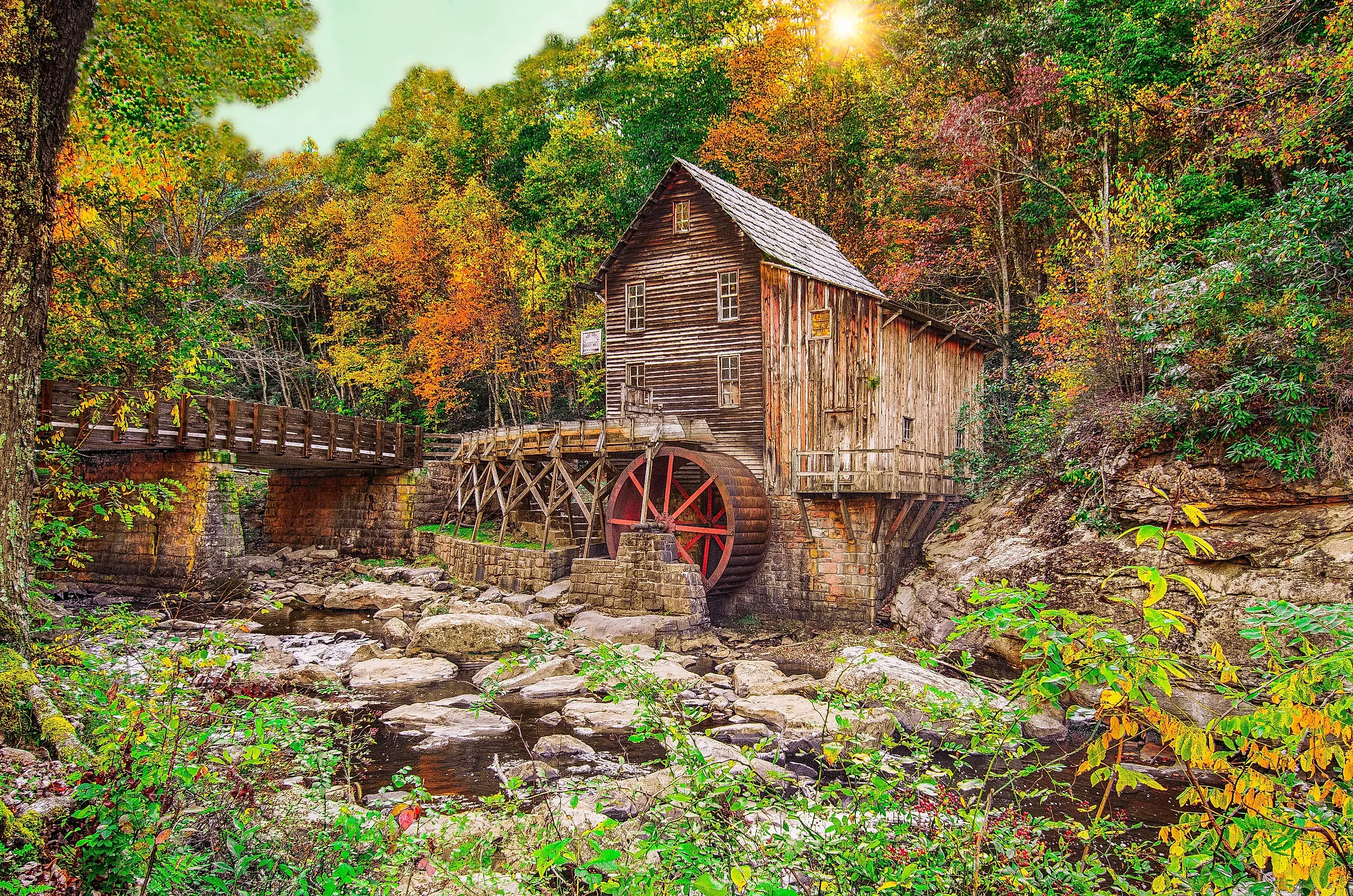
Babcock State Park's signature landmark is the Glade Creek Grist Mill, a working mill built in 1976 from parts of three historic West Virginia mills, most notably Cooper's Mill, which had been destroyed by fire decades earlier. The mill is one of the most-photographed spots in the state. Beyond the mill, the park has more than 20 miles of hiking trails winding up into the Appalachian hills, and Boley Lake offers paddle boat, rowboat, and canoe rentals at the marina. Geocachers have left trinkets throughout the park, especially near Glade Creek Waterfall.
Trans-Allegheny Lunatic Asylum (1 Hour, 45 Minutes)

Construction on the Trans-Allegheny Lunatic Asylum began in 1858, and it opened in 1864 during the Civil War to house psychiatric patients. At 1,300 feet long, it remains one of the largest hand-cut stone masonry buildings in the United States. Originally designed to hold up to 250 patients under the 19th-century Kirkbride Plan, which emphasized natural light, air, and space, the asylum eventually housed as many as 2,400 patients at a time, with the crowding leading to documented abuses. It also housed Union and Confederate troops during various Civil War raids. The asylum closed in 1994 and now offers historical tours Tuesday through Sunday, with separate ghost tours available in the evening.
Starting City: Huntington
Huntington Museum of Art (Within the City)

At nearly 60,000 square feet, the Huntington Museum of Art is the largest art museum in West Virginia. The collection is eclectic, spanning fine paintings alongside decorative crafts. The Touma Gallery displays Middle Eastern pottery, metalwork, and woodwork including pieces from Damascus, Syria. The Herman P. Deans Firearms Collection covers early firearms and crossbows as examples of historic craftsmanship. On the grounds, West Virginia's only plant conservatory showcases tropical and subtropical species, and 6 miles of hiking trails run through forested hills.
Heritage Farm Museum & Village (Within the City)

The Heritage Farm Museum & Village was the first Smithsonian Affiliate in West Virginia, recognized for its hands-on approach to Appalachian pioneer history. A former farmhouse converted into a multi-museum pioneer village, it covers specific aspects of Appalachian life across several buildings. The Progress Museum focuses on 1850s Appalachian settler life, while the Transportation Museum covers the railroad and frontier wagons. The Country Store Museum recreates a 19th-century general store, and the Children's Hands-On Activity Center lets kids try 19th-century chores. A Treehouse Trek trail on canopy bridges rises 60 feet above the forest and ends at a large treehouse.
Beech Fork State Park (30 Minutes)

Less than half an hour from Huntington, the 3,000-acre Beech Fork State Park sits on Beech Fork Lake, a reservoir built by the U.S. Army Corps of Engineers for flood control on Twelvepole Creek. The park's 31 miles of shoreline support canoes, kayaks, johnboats, and paddle boards, rentable at the dock. Fishing includes largemouth bass, hybrid striped bass, catfish, and bluegill, with a valid West Virginia fishing license required. Hiking trails wind around the lake and up to overlooks.
There's A Lot To See On These Country Roads
John Denver's "Take Me Home, Country Roads" is still the most familiar song about West Virginia's winding mountain roads, and along those roads are picturesque stops ranging from the Clay Center in Charleston to the Heritage Farm Village near Huntington. For travelers drawn to darker history, the Mothman Museum and the Trans-Allegheny Lunatic Asylum preserve the stranger and more haunting side of the state. All of these sites sit within an easy day-trip radius of Charleston or Huntington, so the drive itself becomes part of the experience.