8 Portugal Small Towns With Unmatched Friendliness
When visiting Portugal's Silver Coast or exploring Alentejo, you quickly stop feeling like a tourist. In Nazaré, you can chat with fishermen along Praia da Nazaré or watch surfers ride massive Atlantic swells at Praia do Norte. For a taste of Portuguese inland cooking, Almeirim is the place to try sopa da pedra or sample wines at estates like Quinta do Casal Branco. Each of the eight small towns below has its own identity, built on fishing, royal history, pilgrimage, or surf culture.
Nazaré

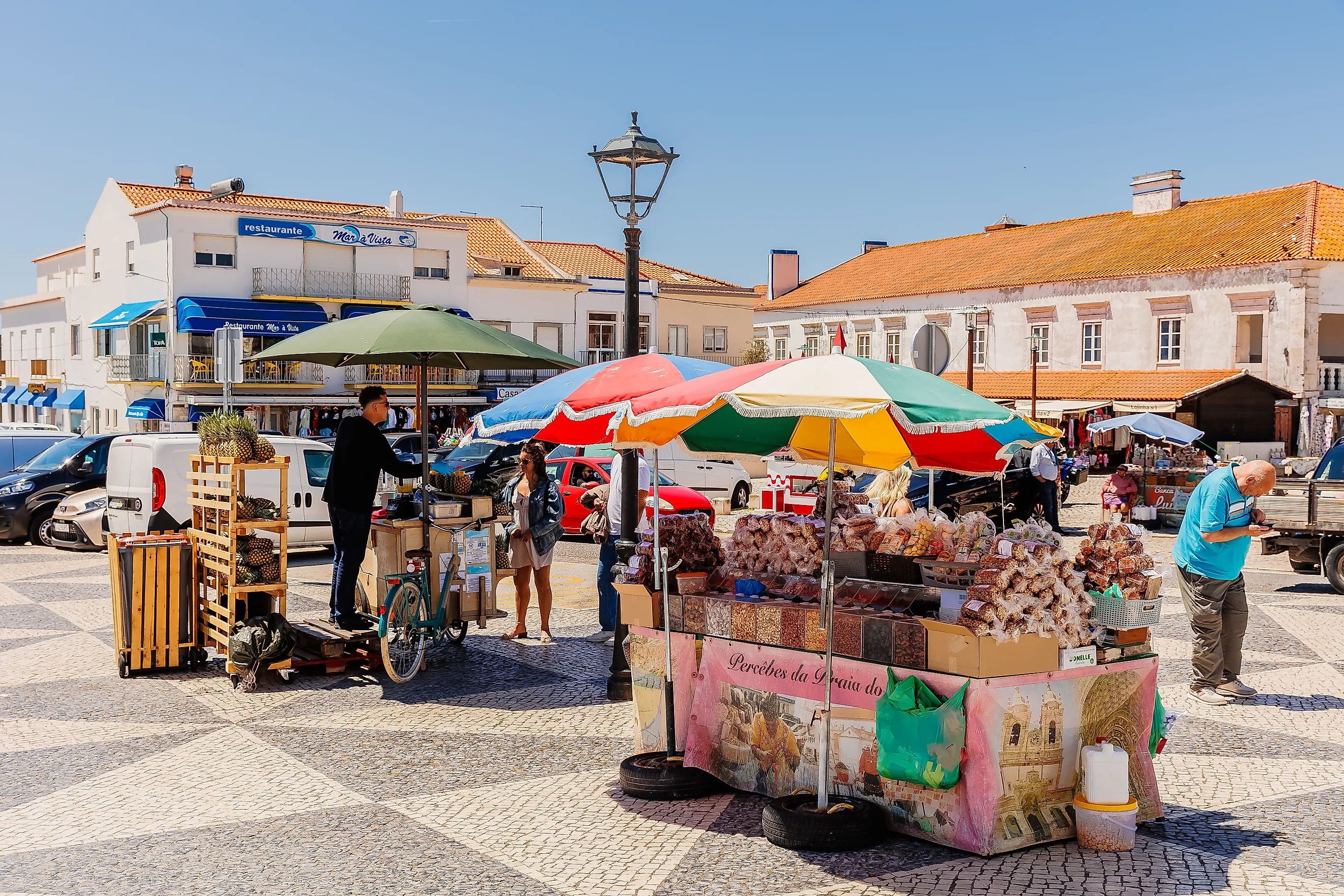
A fishing village turned resort town on Portugal's Silver Coast (Costa de Prata), Nazaré has held onto its old-school feel despite the crowds. Fishermen still mend their nets on Praia da Nazaré at the end of the promenade, while fish cure in the sun at the Sun-Dried Fish Museum. Most of the 15,000 full-time inhabitants now work in tourism, but the working harbour and daily rhythm remain central to town life.
The main draw is Praia do Norte, just past the Farol de Nazaré lighthouse (built into the 16th-century Forte de São Miguel Arcanjo), where an underwater canyon funnels Atlantic swell into some of the largest surfable waves on Earth. Surfers have ridden waves exceeding 25 metres here, with current records set by Sebastian Steudtner at 28.57 metres. When the sea is calmer, the Sanctuary of Our Lady of Nazaré, commissioned by King Fernando I in 1377, houses a revered image of the Virgin said by legend to have been carved in Nazareth itself. The Ascensor da Nazaré funicular climbs the cliff to the Sítio headland for shops, cafes, and panoramic views of the coast.
Tomar

Tomar, a town of about 20,000 a few miles off the A13 motorway, is built around the UNESCO-listed Convent of Christ, a former Knights Templar stronghold. The Convento de Cristo includes the famous Manueline window of the Chapter House and the round Charola (the Templar rotunda), modelled on the Church of the Holy Sepulchre in Jerusalem. Next door, Tomar Castle was founded in 1160 by Gualdim Pais, Grand Master of the Order of the Temple in Portugal, to defend the town's strategic position.
Away from the castle, Rua Serpa Pinto (also known as Corredoura) runs between the Nabão River and City Hall, lined with independent shops. Every four years, the town hosts the Festa dos Tabuleiros, whose signature event is a procession of women carrying elaborately stacked trays of bread and flowers on their heads, a tradition with medieval roots. The next festival is scheduled for 2027.
Odeceixe

Odeceixe sits near the mouth of the Ribeira de Seixe, about 4 km inland from the Atlantic coast, within the Southwest Alentejo and Vicentine Coast Nature Park. The park's network of hiking trails draws outdoor enthusiasts from across Europe, particularly walkers following the long-distance Rota Vicentina. In the village centre, A Tasca and Casa Verde serve traditional Portuguese dishes, and backpackers regularly pass through on their way between trailheads.
A short drive west, Praia de Odeceixe is a crescent of sand framed by cliffs and split down the middle by the Ribeira de Seixe where it meets the ocean. The beach draws surfers looking for mellower waves than the bigger breaks further south. Kiosk Agapito and Restaurante Dorita handle the casual beachfront food.
Évora

Évora, the historical capital of the Alentejo region, has more than 2,000 years of history layered into its walls. Founded by the Romans as Liberalitas Julia, the city's compact historic centre is a UNESCO World Heritage Site packed with Roman, medieval, and Renaissance landmarks. The Chapel of Bones, a small chapel inside the Igreja de São Francisco, was built in the early 17th century by Franciscan monks to address cemetery overcrowding. Its walls are lined with the bones of around 5,000 monks, with the inscription above the entrance reading, roughly translated: "We bones that are here await yours."
For more conventional architecture, the Sé de Évora is a massive Gothic-Romanesque cathedral begun in 1186, with a rooftop walk offering views across the old town's whitewashed walls and terracotta roofs. Each year in late June, the Feira de São João brings handicrafts, exhibitions, live music, and traditional food to the city for Portugal's regional take on the midsummer festival.
Sintra

Sintra sits 30 kilometres northwest of Lisbon in the Sintra Mountains, with Cabo da Roca (the westernmost point of continental Europe) on its municipal coastline. Portuguese royalty used the hills as a summer retreat, and the National Palace of Pena, perched on the town's highest peak, is the most visible result: a 19th-century Romantic palace in yellows, reds, and purples built by King Ferdinand II. The Quinta da Regaleira, built between 1904 and 1910 by Italian architect Luigi Manini, blends Neo-Manueline, Neo-Gothic, and Renaissance revival styles with its gardens, tunnels, and famous Initiation Well.
The Initiation Well is a 27-metre inverted tower sunk into the ground, with a spiral staircase descending nine levels past landings symbolically associated with Dante's nine circles. The design was inspired by Masonic and Templar initiation symbolism and connects via underground tunnels to grottoes and a lake. Each June, the Festival de Sintra brings classical music, opera, and ballet performances to historic venues including the National Palace of Sintra and Pena Palace.
Salema

Salema is a working fishing village on the western Algarve coast that has held on more tightly to its character than most of the region. Salema Beach sits at the centre of it, framed by yellow sandstone cliffs and backed by narrow streets of whitewashed buildings with colourful trim. Fishing boats still pull up on the sand each morning. The village has seen steady development in recent decades, with villa complexes like NAU Salema Beach Village on its outskirts, but the village core remains small. Restaurants like Em Lume Brando and O Lourenço serve tapas and fresh-caught seafood from the daily harbour landings.
Peniche

About 90 km north of Lisbon, Peniche is a world-class surf destination and a geological oddity. Once a true island, it became a peninsula as sand accumulated in a tombolo connecting it to the mainland over the last several thousand years. The town is dominated by the Peniche Fortress, begun in 1557 and completed in 1645, which served as a political prison under the Estado Novo dictatorship from 1934 until the 1974 Carnation Revolution. In 1960, ten political prisoners pulled off one of the most famous escapes in Portuguese history, including Álvaro Cunhal, leader of the Portuguese Communist Party. The fortress now houses the National Museum of Resistance and Freedom. Outside the historic buildings, Peniche's modern identity is built around surf competitions at nearby Supertubos beach, with Bar do Quebrado serving rooftop views and Gamboa handling the beachfront crowd at Praia da Gamboa.
Almeirim

Almeirim served as an important royal retreat for Portuguese monarchs in the 15th and 16th centuries, favoured for its proximity to the Tagus River and surrounding hunting grounds. King João II ordered significant expansion of the royal palace here, and several important meetings of the Cortes (the Portuguese parliament) were held at the site. The palace was damaged in the 1755 Lisbon earthquake and fell into ruin over the following decades. Today, a surviving portico marks the former palace grounds. The town is better known nationally as the home of sopa da pedra (stone soup), a hearty bean-based dish with potatoes, meats, and sausages, served at restaurants like Restaurante Sopa da Pedra. The surrounding farms remain the region's main economic driver, producing tomatoes, melons, and wines from estates like Quinta do Casal Branco.
Eight Towns, Eight Portugals
Each of these eight towns represents a different thread of Portuguese life. Nazaré and Peniche are built on the Atlantic, with traditional fishing economies reshaped by world-class surf. Tomar carries the legacy of the Knights Templar in one of Portugal's most important medieval sites. Évora preserves 2,000 years of layered history in its UNESCO-listed centre. Sintra's royal palaces sit in forested mountains above Lisbon. Odeceixe and Salema hold on to coastal village character in the Alentejo and Algarve. Almeirim anchors the country's inland farming tradition. The towns differ in climate, landscape, and economy, but all reward visitors who slow down long enough to notice.