8 Most Eccentric Towns in New Mexico
In 1935, New Mexico’s Tourist Bureau described the state as The Land of Enchantment in one of its brochures in an effort to attract visitors. And it is the towns that embody the true spirit of the nickname, long before the tourism board adopted the phrase. These are places where annual pie festivals bring people together, and where old adobe churches stand as silent witnesses to Spanish colonial history. Here, you will find communities that have transformed their peculiarities into points of pride: towns with ghost sightings from the Wild West era, and villages where centuries of Native American, Hispanic, and Anglo traditions have blended together. The eight towns aren't just quirky roadside stops; they are living examples of how New Mexico's communities have preserved their eccentricities while welcoming curious travelers from all corners of the globe.
Chimayó

Chimayó draws visitors seeking spiritual healing, maintaining traditions that date back centuries while welcoming people from near and far. El Santuario de Chimayó houses "holy dirt" that believers credit with healing properties, attracting people who gather small amounts from the well inside the chapel. The Santuario de Chimayó Gift Shop offers handcrafted religious items and locally woven textiles, allowing visitors to support artisans who keep ancestral crafts alive. Adjacent to the sanctuary, pilgrims and tourists can find the Chimayó Museum, which preserves the village's weaving heritage through demonstrations of traditional techniques passed down through generations of Hispanic families.

Rancho de Chimayó restaurant serves authentic New Mexican cuisine in a historic hacienda, where diners can taste family recipes while seated in rooms that once housed Spanish colonial families. What makes Chimayó truly eccentric is this seamless fusion of the sacred and everyday, where visitors scoop miraculous soil, purchase gorgeous locally woven textiles, and have a satisfying meal in a historic hacienda.
Cimarron

Cimarron is an unconventional town where you can sleep in a hotel that may be haunted, explore hiking trails once used by outlaws fleeing the law, and walk streets where men were engaged in gunfights, all serving as an authentic reminder that the Wild West wasn't just Hollywood mythology. The town earned its reputation as one of the most dangerous towns in the West during the late 1800s, and it has preserved that legacy through haunted historic buildings. The St. James Hotel, built in 1872, operates as both a functioning hotel and paranormal hotspot where guests report encounters with spirits in rooms that once hosted Jesse James and Annie Oakley.
Philmont Scout Ranch, located just outside town, is the Boy Scouts of America's premier high adventure base, where thousands of young people annually trek through mountains once traversed by mountain men and outlaws. The Cimarron Canyon State Park provides outdoor fans access to granite palisades and trout streams, where hiking trails wind through landscapes that explain why this location attracted everyone from prehistoric peoples to desperados.
Madrid

Madrid's uniqueness stems from its improbable transformation, from a coal town to a bohemian enclave. The town transformed from a near-ghost town into a thriving artist colony, attracting creative individuals who find inspiration in its weathered buildings and rich mining heritage. Visitors explore the Old Coal Town Museum, where mining equipment and historical photographs document the community's boom-bust cycles through its abandonment in the 1950s. Just down the main street, dozens of galleries and studios showcase local artisans' work, ranging from traditional Southwestern pottery to sculptures.

The Java Junction coffee shop doubles as a music venue, hosting performers who appreciate the town's atmosphere while fueling up on locally roasted coffee. Engine House Theatre completes the cultural circuit by staging original productions in a converted fire station, where audiences sit a few feet from performers in one of New Mexico's most unconventional performance spaces.
Cloudcroft

Cloudcroft's eccentricity lies in its location. The town perches at nearly 8,700 feet in elevation in the Sacramento Mountains, offering visitors an unexpected alpine experience. The historic Lodge Resort and Spa, built in 1899 as a retreat for railroad workers of the long-defunct Alamogordo and Sacramento Mountain Railway, welcomes guests with elegance and reports of Rebecca, the resident ghost who allegedly haunts the property's hallways. The Sacramento Mountains Historical Museum occupies the restored Cloudcroft railroad depot, where exhibits chronicle the logging industry and railroad history that gave birth to this mountain community.
The Sunspot Solar Observatory, located south of town, opens its facilities to visitors who wish to explore solar science and gaze at the sun through specialized telescopes operated by professional astronomers.
Las Vegas

New Mexico has its own Las Vegas, and no, it is not a mecca of casinos and bars. Las Vegas predates its namesake in Nevada and was a town that once served as a critical stop on the Santa Fe Trail. The Plaza Hotel, built in 1882, stands as a testament to the town's prosperity during the railroad era, welcoming guests into ornate rooms where Doc Holliday once recovered from tuberculosis and countless Western films have captured Old West authenticity. Visitors wander through a historic district containing hundreds of buildings on the National Register of Historic Places, representing the largest concentration of Victorian architecture in New Mexico's small towns. The City of Las Vegas Museum and Rough Rider Memorial Collection honors Theodore Roosevelt's famous cavalry unit, many of whose members hailed from New Mexico and reunited annually in Las Vegas for decades after the Spanish-American War.
Montezuma Castle, located six miles northwest of town, rises from the landscape as a massive resort built in 1886, now serving as part of United World College while offering public tours of its eccentric architecture.
Pie Town

Pie Town transformed a quirky name into a legitimate tourist destination along the Continental Divide. The Pie Town Pie Co serves pies like those that gave this community its name, continuing a tradition started during the Great Depression when a baker named Clyde Norman attracted travelers with his exceptional pastries. The Very Large Array, about 40 miles east of town, presents one of the world's premier astronomical radio observatories, where 27 massive dish antennas scan the cosmos.
The annual Pie Festival, held each September, celebrates the town's unusual identity with pie-baking contests, pie-eating competitions, and a country fair atmosphere that proves how residents can create a memorable event when united by baked goods and community pride.
Aztec

Aztec defies its ancient-sounding name by combining prehistoric ruins with unexpected extraterrestrial interests. The Aztec Ruins National Monument, misleadingly named by early settlers who attributed the structures to Aztec builders, preserves an exceptionally well-maintained ancestral Puebloan great house constructed in the 1100s, featuring a fully reconstructed Great Kiva that allows visitors to step inside a massive ceremonial chamber.
Downtown Aztec's historic buildings house antique shops and local businesses, creating a charming contrast to the ancient ruins just blocks away while showcasing architecture from the town's founding era. The Aztec UFO Incident, an alleged flying saucer crash in 1948, receives commemoration in an annual symposium that attracts UFO fans who consider Aztec part of New Mexico's extraterrestrial triangle, enhancing its quirky reputation. The Aztec Museum and Pioneer Village preserves frontier era artifacts, including a full-scale oil field exhibit that documents northwestern New Mexico's petroleum industry alongside homesteader cabins and vintage farming equipment.
Tucumcari

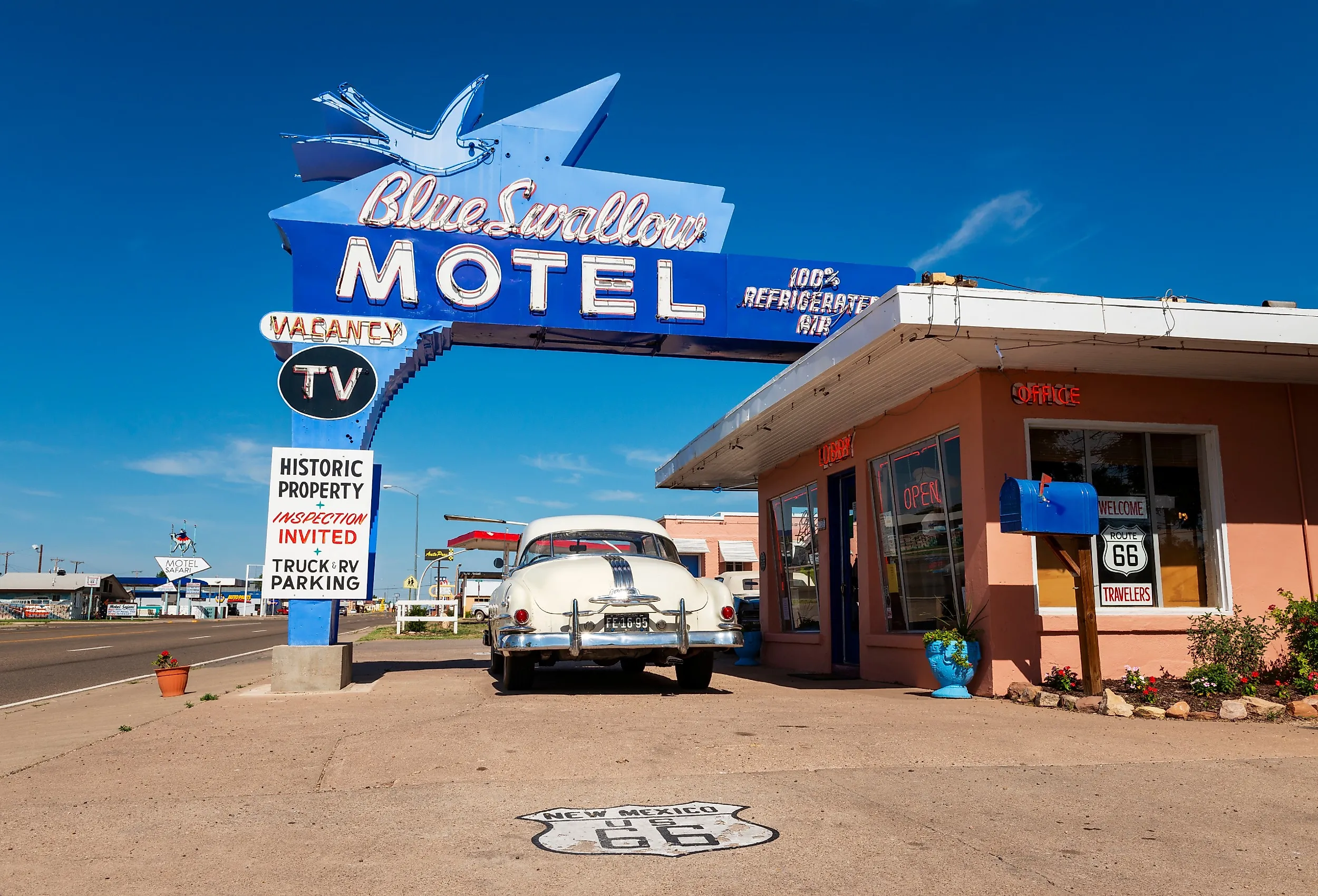
Tucumcari's peculiarity stems from its devotion to a highway that is a part of American history, where neon signs still flicker to life each evening, all while the famous "Tucumcari Tonite!" billboards still beckon travelers to exit the interstate and experience what road travel felt like in the past. The town is a living museum of Route 66 culture, where motels and neon signs refuse to fade despite the interstate highway that bypassed this once thriving road.

The Blue Swallow Motel, operating continuously since 1940, preserves the classic motor court experience with vintage neon signage and the kind of personal hospitality that defined pre-interstate travel, earning National Register of Historic Places designation. The Mesalands Dinosaur Museum houses an impressive collection of prehistoric fossils and a bronze casting foundry, creating an unexpected scientific and artistic attraction where visitors examine actual dinosaur specimens discovered in New Mexico while watching artists create bronze sculptures. Tucumcari Mountain, dominating the landscape east of town, provides hiking opportunities and panoramic views that reveal why this location attracted travelers long before Route 66 existed, with trails leading to mesa tops where visitors survey the surrounding plains that stretch toward Texas.
Eccentric Experiences
New Mexico has a talent for attracting visitors seeking experiences beyond conventional tourism. Whether exploring prehistoric ruins, sleeping in hotels where spirits allegedly linger, photographing neon signs that refuse to surrender to modernization, or exploring a location where potential aliens crashed their spaceship, travelers will get unique glimpses into why it's called the Land of Enchantment. New Mexico's eccentric towns preserve and celebrate their distinctive stories with passion that other tourist destinations lack.