8 Iowa Towns Where Time Stands Still
Founded in 1846 as the Hawkeye State, Iowa is defined by its two rivers: the Mississippi on the eastern border and the Missouri River on the west. The state is also noteworthy for its communities where time stands still due to their diverse immigrant history, famous residents, and well-maintained settler dwellings.
In these towns, you can see the birthplace of two great American showmen, stroll through a network of utopian villages, witness the ingenuity of Dutch and Norwegian immigrants, or marvel at the largest grotto in the world. You can learn more about these eight Iowa towns where time stands still below.
Decorah

Originally the site of a Ho-Chunk reservation, Decorah was officially settled in 1849. The settlers chose the name Decorah to honor the Ho-Chunk leader Waukon Decorah, who had been unjustly removed from the land despite helping the US in the Black Hawk War. In the mid-19th century, Decorah became a major center for Norwegian immigrants, who would call the land Vesterheim, meaning "Western Home."
The Vesterheim Museum will make you feel like you've stepped into Norway with its collections of traditional Norwegian art and tools. There are also 12 historic buildings, including the 1851 Painter-Bernatz Mill and the 1880 Haugan House, built in the traditional husmann (Norwegian farmer) style. Decorah also contains landscapes you won't find elsewhere in Iowa, like an ice cavern that stays frosty all year round at the Decorah Ice Cave State Preserve.
LeClaire

This town has been the home of many enterprising Americans, including the founder for whom it is named: Antonie LeClaire. Originally of French Canadian and First Nation descent, LeClaire was a fur trader who acquired the land around modern-day LeClaire from the Sauk and Fox tribes in 1832. A decade later, William Frederick Cody would be born here, although he is better known by his stage name: Buffalo Bill.
LeClaire will transport you back to his days of Wild West showmanship at the Buffalo Bill Museum, with artifacts on his life, show, and Native American contributions to the traveling show. LeClaire is also famous for being the home of the History Channel show American Pickers, which catalogs impressive vintage and antique American items. You can see some of their best "picks" at the Antique Archeology shop. Lastly, enjoy a cruise on the Mississippi River aboard the 19th-century Riverboat Twilight.
Clear Lake

Clear Lake is named after its beautiful natural lake, which has drawn in visitors for centuries. The Dakota and Winnebago Native Americans would come here during the summer, and white settlers began to arrive in the 1850s. Unfortunately, this gentle place was the site of a great tragedy when the Beechcraft Bonanza aircraft crashed into Clear Lake in 1959, killing all the musicians on board. Don McLean would later memorialize the event in his song "American Pie."
Today, you can visit the Crash Site Memorial, honoring the memories of Buddy Holly, Richie Valens, and J.P. Richardson, who perished in the crash. You can also see one of the original rock 'n' roll stages at the Surf Ballroom & Museum, which hosted rock shows in the mid-1950s. To get the full Clear Lake experience, visit the Clear Lake State Park for its trails, fishing, and Scenic Woodford Island. You can also see Northern Iowa's most extensive public garden at the Central Gardens of North Iowa.
West Bend

West Bend is an old-timey railroad town that gets its name from the sharp western turn the Des Moines River makes near the city. Residents here have always been enterprising, as they convinced the railroad company not only to build a railroad here but also to place a station within the town's borders. This enterprising nature can be seen throughout West Bend's well-maintained historic buildings, from a one-room schoolhouse and Post Office to a Sod House replica. These temporary dwelling structures were built on the treeless prairie until lumber arrived, allowing the construction of more permanent dwellings.
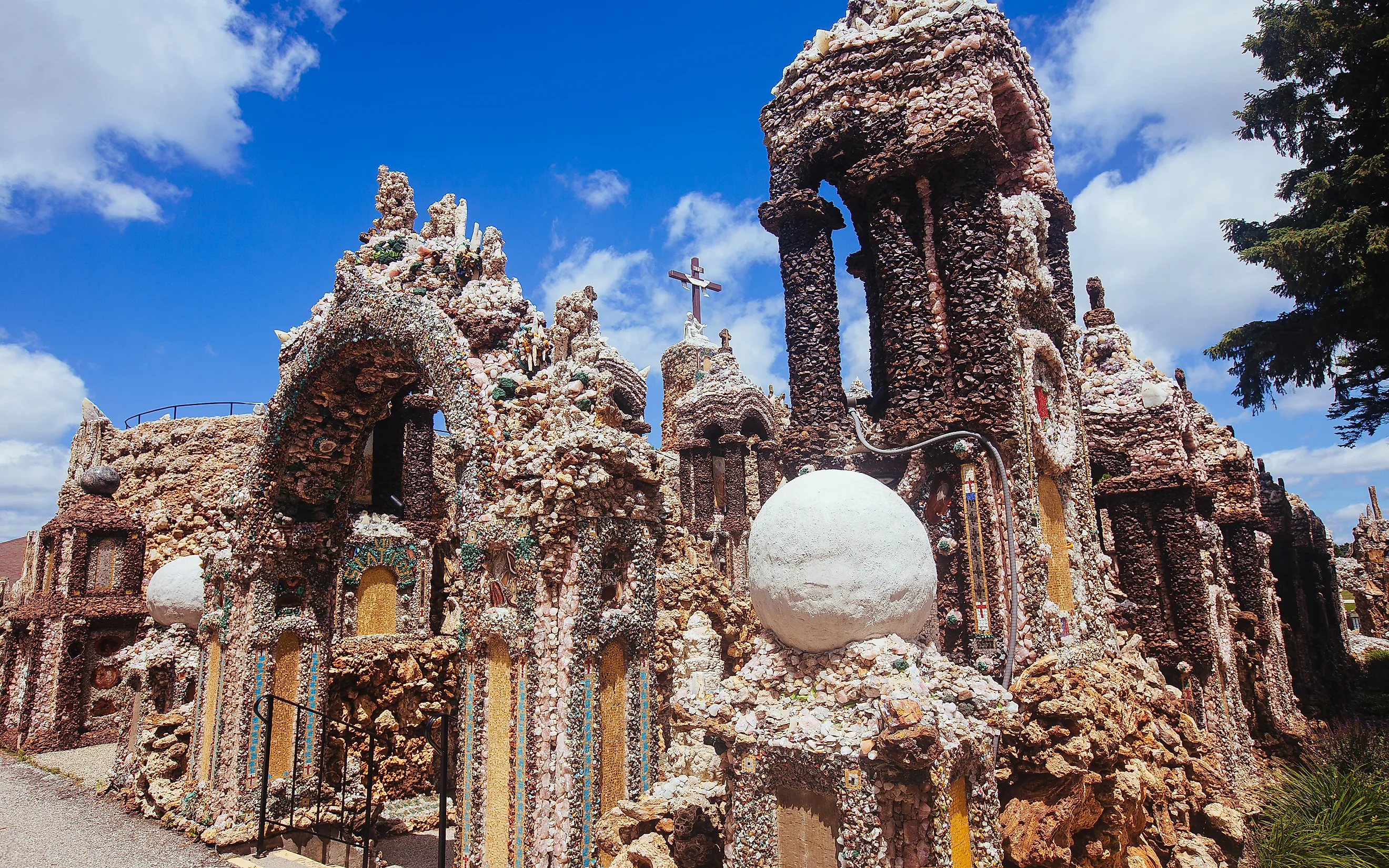
The West Bend Historical Museum offers a broader overview of the past, from a display on how clothing and military uniforms changed over the years to a 1950s-era barber/beauty shop display and a vintage medical exhibit. The most beautiful place in West Bend is the Shrine of the Grotto of the Redemption. It has nine grottos made of minerals and petrifications representing the life of Jesus. This man-made work of art is one of the largest grottos of its kind in the world.
Burlington

Originally called Shokokon, meaning Flint Hills, by the Sauk and Meskwaki peoples, Burlington is one of the oldest towns in Iowa. The town was officially founded in 1833 by the American Fur Company, and within five years, it was chosen as the first territorial capital of the Iowa Territory. One of the town's oddest historical places is Snake Alley, a very curvy and crooked street built in 1894. Built atop Heritage Hill, this crooked road of limestone and blue-clay bricks has five half curves and two quarter curves.
Every Father's Day, the town holds the Snake Alley Art Fair. In Burlington, you can step back in time to the earliest days of Iowa history at the Hawkeye Log Cabin, which is nestled on a bluff where Lieutenant Zebulon Pike raised the first American flag in Iowa. Despite the name, Mosquito Park is another excellent spot in Burlington, offering some of the best views of the Mississippi River and eagle-watching opportunities.
Amana Colonies

The Amana Colonies are a collection of seven villages founded by German Radical Pietists in the 1850s, who came to America to escape persecution by Lutheran authorities in what is now Germany. These Germans aimed to create an ideal, utopian Christian society, and today their colonies serve as quirky historical landmarks and cultural centers.
Go back in time to this communal utopia at the Amana Heritage Museum, a collection of four sites, including the museum itself, the Communal Kitchen, the High Amana General Store, and the Homestead Church. The Amana Colonies also hosts multiple German festivals throughout the year, from the classic Oktoberfest in September to the Maifest in May, which celebrates spring with decorated Maipoles and dancers.
Winterset

Winterset gets its name from a strangely cold summer day. Settlers originally planned to name it Summerset in 1849, but chose Winterset instead because of the cooler weather. Perhaps this cool town contributed to the stoic personality of Winterset's most famous resident: Marion Robert Morrison, also known as John Wayne. Despite his fame, Winterset is home to the world's only museum dedicated to this Western movie star, the John Wayne Birthplace & Museum.
Winterset also keeps the past alive through its Covered Bridges Scenic Byway, which was featured in the Clint Eastwood film called The Bridges of Madison County. Just within town limits is the 1883 Cedar Bridge, a 78-foot structure that has been lovingly preserved and protected over its long history. This quaint rural town inspires many quilters, and many of their creations are on display at the Iowa Quilt Museum in downtown Winterset.
Pella

Much like Decorah, Pella was founded by a group of Northern European immigrants, namely the Dutch. In 1847, Dutch immigrants came to Iowa to escape persecution by Calvinists in the Netherlands, as they were firm believers in the separation of church and state and opposed the state church.
While touring Pella, you will experience a mixture of old-world Dutch buildings alongside American heritage. For example, there's the 124-foot working mindcall, the Vermeer Mill, alongside the Pella Historical Society's Amsterdam School, a hands-on museum that gives visitors a taste of what a school day was like in the 1930s. Fields of tulips bloom at Central Park and the Sunken Gardens Park, while the Volksweg Trail winds for 17 miles along the Des Moines River and the North Overlook woods.
The Homes of Enterprising Americans
Time stands still in these towns for many reasons: their historic structures, villages, byways, museums, and culture. But one reason for their timeless nature may come from the enterprising Americans who called these communities home. Men and women like John Wayne, Buffalo Bill, and the many Dutch and Norwegian immigrants left a lasting legacy that still reverberates today.
Citizens of these towns walk in the footsteps of these figures, and you can as well by visiting one or all of these eight historic Iowa settlements.