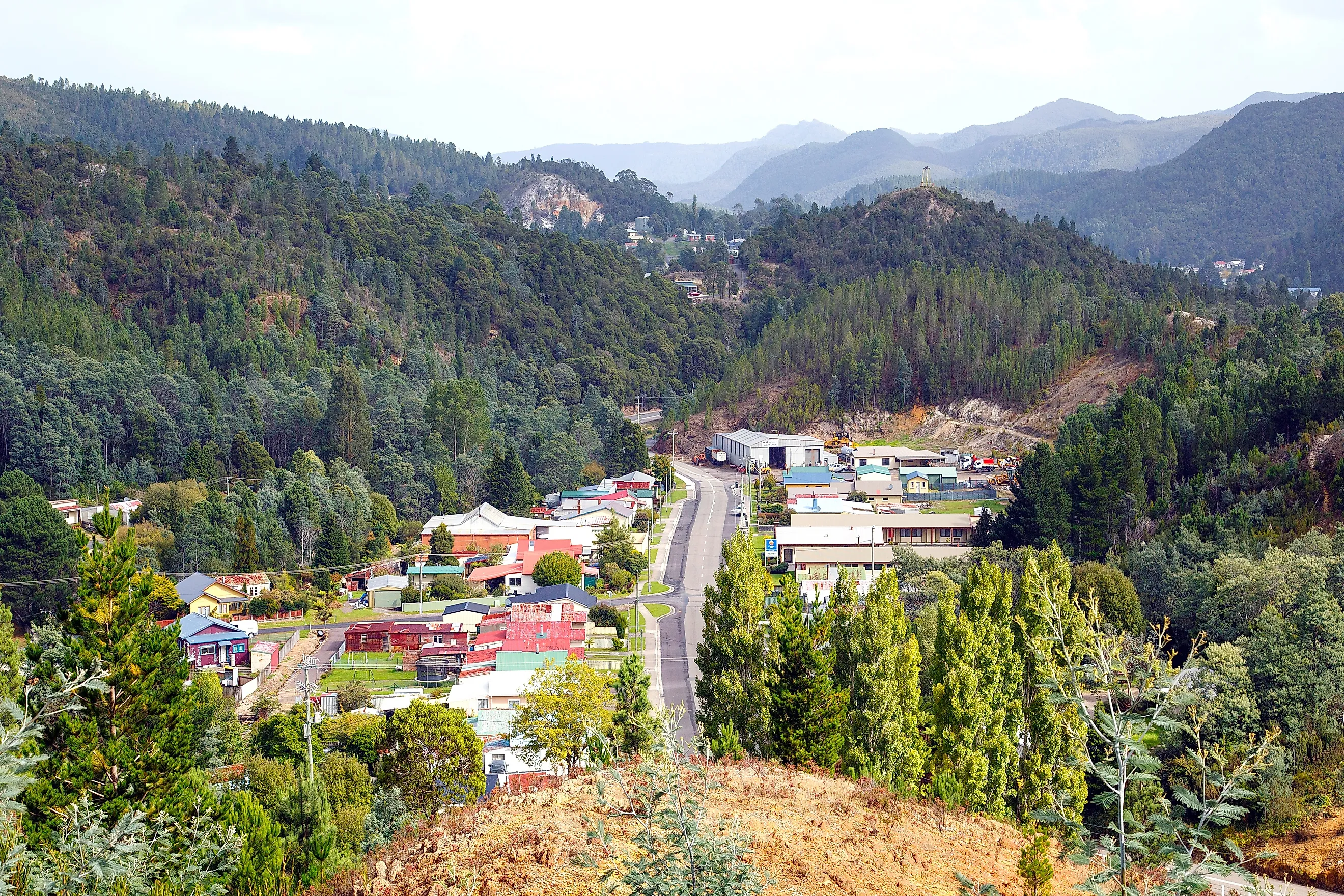
You Won't Believe This Town Is In Australia
Queenstown looks more like Mars than the rest of Tasmania and the difference is entirely industrial. The bare slopes around town show bands of rust and acid green where a century of copper smelting stripped the soil down to mineral-stained rock. The Queen River below town runs orange from acid drainage that has not stopped flowing since the smelters quieted. The mining sits dormant rather than fully closed so the town keeps the surreal landscape plus most of the population that used to work the ore. The Empire Hotel still serves drinks. The Wilderness Railway still runs to the King River Gorge.
A Landscape Shaped By Industry

At its copper mining peak in the early 1900s, Queenstown was home to more than 8,000 people and ranked among the world's biggest copper mining towns. Today only around 1,800 residents remain. The mine sits dormant rather than fully closed, and the town has reinvented itself as one of Tasmania's most distinctive visitor destinations.
What created Queenstown's other-worldly look was a century of industrial activity that began with a gold discovery at Mount Lyell in the 1880s. Copper was found shortly after, and by the early 1900s several smelting furnaces were burning here around the clock.

That intensive logging stripped the surrounding hillsides of everything that could be used to fuel the furnaces. Tasmania's heavy rainfall eroded the shallow topsoil down to the bare mineral-stained rock below. At the same time sulfur dioxide fumes from the smelters poisoned what little soil remained which made natural regeneration nearly impossible.
Where the River Runs Orange

The result is a landscape that hasn't been able to recover the way other disturbed environments have. Mount Lyell and Mount Owen, the two peaks looming over Queenstown, are now almost entirely devoid of soil and vegetation.
Their conglomerate rock is exposed in bands of orange, red, purple, and green created by chemical reactions between iron, manganese, and other minerals over millions of years. Topping it all, the Queen River as it flows out of town still runs an unnatural almost eerie orange from acidic mine drainage.

Some of the best views of this landscape come on the route into Queenstown. Considered one of the most dramatic drives in Australia, the Lyell Highway runs 99 bends along Goranson Hill and reveals more of the stark mountain scenery as it descends.
It's an especially remarkable experience at sunset as the summits of Mount Lyell and Mount Owen turn orange and pink. The display draws photographers and tourists from across the country.
Downtown Queenstown

Despite its surroundings, Queenstown's commercial center is genuinely pleasant to walk around. Notable downtown landmarks include the old two-story Empire Hotel on Orr Street. This Victorian-era building opened in 1901 to cater to the wealthy mine owners and investors who passed through during the boom years. Still a functioning hotel, interior highlights include its elegant staircase hand-carved from Tasmanian blackwood.

Across the street, the Paragon Theatre is an attractive Art Deco building that opened in 1933 as one of the first "talkie" cinemas in the region. Now fully restored, it also hosts live music and community events alongside regular film screenings.
A block away is the Eric Thomas Galley Museum. Known locally as "the Galley," the museum occupies the former Imperial Hotel from the 1890s and features 30 rooms of old photos and a collection of mining-era artifacts including personal effects, gems, and minerals.
Queenstown's Sporting Past and Present

Queenstown's sporting heritage has also been shaped by its mining past. The Queenstown Oval (known locally as "The Gravel" or "The Rec") is the only Australian Rules Football ground in the country surfaced with crushed gravel rather than grass.
Built in 1895 when mining-era pollution made it impossible to establish turf, gravel became the practical solution. The oval is so notoriously hard on players that it was inducted into the Tasmanian Football Hall of Fame, and catching a local game of "Aussie Footie" is a real local experience.
Explore More of Queenstown's Alien Landscape

By far the best place to take in the scale of Queenstown's alien landscape is Spion Kop Lookout. A short but steep walk from the edge of town, the summit gives 360-degree views over the town and the stripped mountains around it. Time a visit for late afternoon to catch the last light as it turns the bare peaks through their full color range.
Just outside town, Iron Blow Lookout overlooks the former open-cut copper mine. Now filled with emerald-coloured water, the contrast between it and the surrounding bare ochre rock is one of the most photographed sights in western Tasmania. A short drive further along the Lyell Highway, the walk to Horsetail Falls gives a tangible sense of the scale of Queenstown's industrial scarring.

The West Coast Wilderness Railway is another solid way to see the region. Opened in 1899 to haul copper ore from the mines, it remains an epic feat of engineering that uses an Abt rack-and-pinion system, the only one in the southern hemisphere, to tackle the steep mountain terrain. It now runs as a heritage train trip from Queenstown along the King River Gorge, a round trip of around five hours.
A Tasmanian Town Like No Other
For a state that trades heavily on its green image, Queenstown is something of an anomaly. Its bare chemically stained mountains and acid-orange river are quite unlike anything else on the island, which makes it more appealing as a travel destination. Sure, getting there from Hobart takes around three and a half hours, but Queenstown's distinctive landscape makes it all worthwhile.