8 Best Small Towns In New Jersey For A Crowd-Free Summer
In Ocean Grove, the boardwalk has no arcades, no vendors, and no soundtrack but the surf and the occasional hymn drifting out of the Great Auditorium. That is the kind of summer this list is after: the New Jersey that does not hand its beaches and Main Streets over to July. Most of these towns are small enough to cross on foot in an afternoon, whether the draw is a Victorian tent colony, a red gristmill above a river, or square miles of blueberry farms. A few sit right on the ocean and simply decline to behave like it. Here are eight New Jersey towns built for a quieter season.
Ocean Grove

Founded in 1869 as a Methodist camp meeting, Ocean Grove still runs on a slower clock than Asbury Park next door. Its centerpiece is the Great Auditorium, a vast wooden hall finished in 1894 that seats thousands and still fills with summer concerts and Sunday services. Around it stands Tent City, a cluster of about a hundred canvas-topped summer cottages that the same families return to year after year, ringed by one of the largest collections of Victorian architecture in the country. The beach and boardwalk are the real case for a quiet summer here, with no arcades, no vendors, and a long tradition of keeping the sand peaceful enough to read a book or nap. It is a square mile built for rest, and it has kept that promise for more than 150 years.
Spring Lake

Spring Lake claims the longest non-commercial boardwalk in New Jersey, nearly two miles of oceanfront without a single arcade, food stand, or Ferris wheel to break the walk. The town earned the nickname Irish Riviera for its Irish-American summer families, and mystery novelist Mary Higgins Clark set several of her books on its quiet streets. Third Avenue is the downtown, a few walkable blocks of independent shops where Jean Louise Homemade Candies has turned out chocolates since 1947 and the Third Avenue Chocolate Shoppe sits a few doors down. For an evening out, the Spring Lake Theatre Company stages Broadway-scale productions inside a landmark community building. The beach stays calm even in July, which on the Jersey Shore is the entire point.
Avalon

Avalon sits at the north end of Seven Mile Island and reaches a full mile farther into the Atlantic than its neighbors, which is why locals call it cooler by a mile. What it lacks is the part that matters here: no commercial boardwalk, no neon arcade strip, and little of the crush that fills the bigger shore resorts. The town has spent decades protecting its high dunes, and the Avalon Dune and Beach Trail threads through a rare maritime forest right behind the sand. Families still find plenty to do, whether that is a round at Pirate Island mini-golf on Dune Drive or the free Friday-night events at Surfside Park near the beach. Golfers drive a short way inland to the Avalon Golf Club, which despite the name sits over in Cape May Court House.
Frenchtown

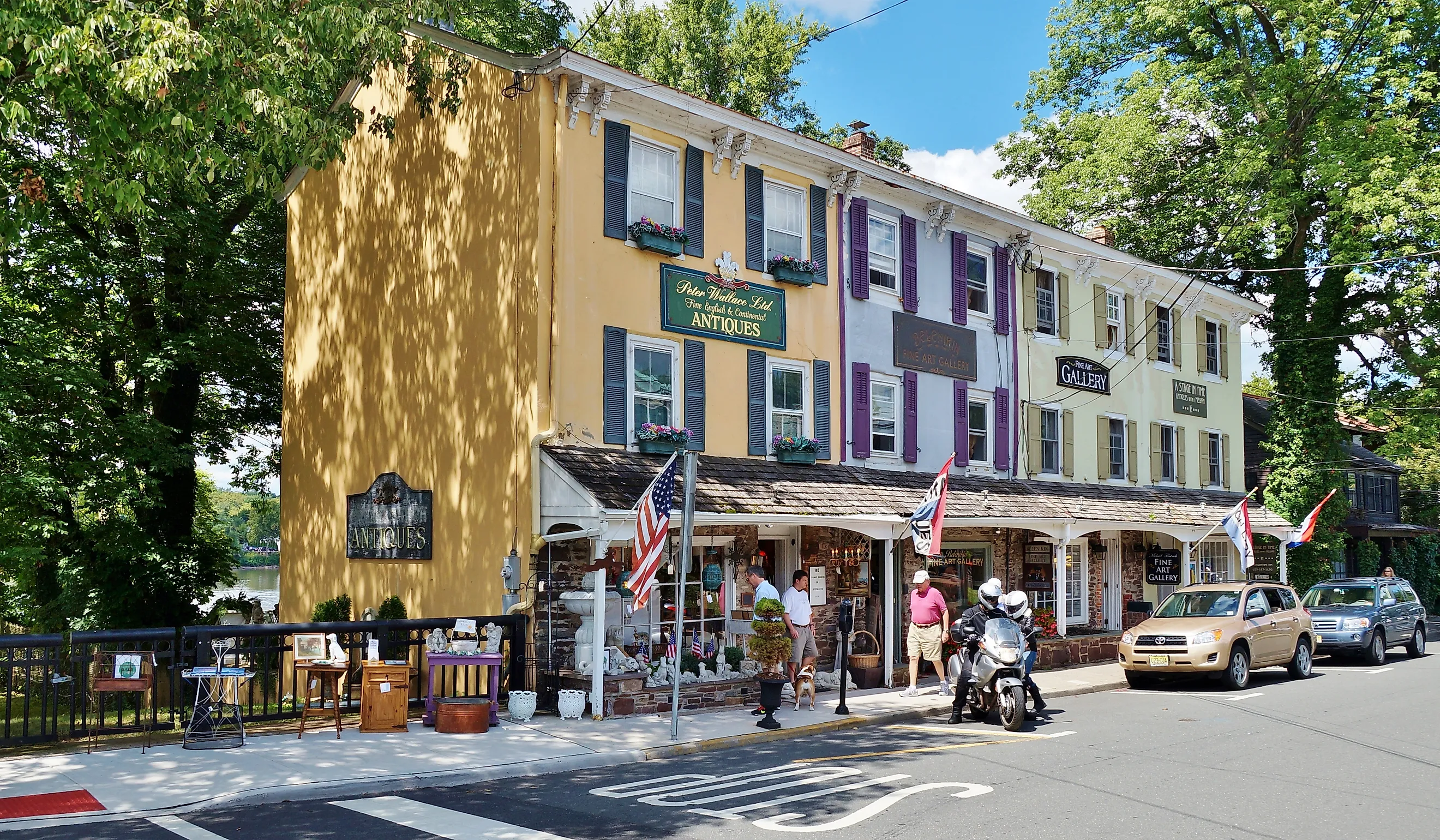
Small enough to cross on foot in a few minutes, Frenchtown sits right on the Delaware River in the rolling farmland of Hunterdon County. Summer here is about the water: Delaware River Tubing floats visitors downstream to a private island for a barbecue lunch, and the Delaware and Raritan Canal towpath runs flat along the riverbank for walking and biking. The downtown is one artsy stretch of 19th-century storefronts, galleries, and the ArtYard contemporary arts center, with the Bridge Cafe serving pastries and breakfast inside the town's restored train depot. For an unhurried afternoon, the area's vineyards and a drift over the valley by hot-air balloon are both within easy reach. Few towns this small fit in this much without ever feeling busy.
Clinton

The red gristmill standing over the falls of the South Branch Raritan River is often called the most photographed scene in New Jersey, and it anchors one of the state's prettiest small downtowns. That building is now the Red Mill Museum Village, a ten-acre open-air museum with a blacksmith shop, a one-room schoolhouse, and an old quarry, while directly across an 1870 iron bridge the Hunterdon Art Museum shows contemporary work inside a second historic stone mill. Clinton's Main Street fills the few blocks between them with family-run shops and restaurants. When the heat climbs, Spruce Run Recreation Area is a short drive away with a reservoir for swimming, boating, and fishing, and the Raritan itself is good for a slow paddle. It is the rare history-and-art outing that doubles as a place to cool off.
Hammonton

Hammonton bills itself as the Blueberry Capital of the World, and the claim has teeth: more than fifty farms ring the town, and the surrounding Pine Barrens grow the large majority of New Jersey's blueberries. Summer is harvest season, which means pick-your-own fields, roadside farm stands, and, each June, the Red, White and Blueberry Festival with its pie-eating contest and car show. The sandy, acidic Pinelands soil that suits blueberries also suits grapes, so the area's wineries, among them the long-running Tomasello Winery, pour reds, whites, and dessert wines. Beyond the farms, the restored 1766 ironworks village of Batsto and the trails and paddling of Wharton State Forest open up the largest stretch of wild Pine Barrens in the state. This is South Jersey farm country at its quietest and sweetest stretch of the year.
Madison

Madison wears the nickname Rose City and spends its summers as one of the leafier, lower-key towns in commuter-belt Morris County. The walkable downtown centers on the Museum of Early Trades and Crafts, set in a stately 1900 building, which runs a free Friday-night concert series on its lawn through the warm months. Nearby, the Florence and Robert Zuck Arboretum and the wooded campus of Drew University make for an easy green walk, and the paved Traction Line Recreation Trail connects the town with neighboring Morristown. A Saturday farmers market and a downtown of independent shops, including the novelty Snooki Shop, round out a slow summer Saturday. It is a town people ride past on the train without realizing it is worth getting off.
Morristown

Morristown served as the Continental Army's winter capital twice over, most grimly in the snowbound winter of 1779-1780, when Washington quartered at the Ford Mansion while his troops hutted at Jockey Hollow. All of it is preserved today as Morristown National Historical Park, the country's first, and the trails through Jockey Hollow make for a shaded, uncrowded summer walk. Downtown wraps around the Morristown Green, a Revolutionary-era parade ground that is now the heart of town, with the modern American restaurant 1776 by David Burke just off it. For more green, the Frelinghuysen Arboretum has themed gardens and self-guided paths, and the Great Swamp National Wildlife Refuge protects more than 7,700 acres of woods and marsh laced with boardwalk trails just south of town. It is the busiest place on this list, and its best summer hours are still its quietest ones.
Summer in New Jersey
What ties these eight together is restraint. None of them chases the summer crowd, and several have gone out of their way to keep it at arm's length, whether by banning boardwalk vendors, fencing off a dune line, or simply sitting far enough inland that the beach traffic never finds them. The tradeoff is real: you give up the midway rides and the marquee nightlife for a calm stretch of sand, a walkable downtown, and a parking spot you can actually find in August. For a certain kind of summer, that is the better deal.