6 Off-The-Beaten-Path Towns On The Pacific Coast
At Glass Beach in Fort Bragg, the surf is full of smooth, rounded glass, the worn-down leftovers of the sixty years the town spent dumping its trash over the bluff. The Pacific Coast keeps its best stories in towns like that, the ones the maps thin out around, where the breakfast diner has eight tables and the lighthouse keeper remembers your name. Most got their start in timber, fishing, or harbor-defense forts, and most still have the original storefronts. These six off-the-beaten-path towns trade tourist traffic for ocean views and elbow room.
Fort Bragg, California

Glass Beach, two miles north of downtown Fort Bragg, looks the way it does because the town used the spot as an ocean dump for decades. Between 1906 and 1967, broken bottles, dishes, and household waste went over the bluff into the Pacific. The waves did the rest. Decades of saltwater tumbling smoothed every shard into rounded pebbles, and the beach is now part of MacKerricher State Park. Visitors can walk the beach but cannot legally collect glass.
The Skunk Train, built in 1885 as a logging line, earned its nickname in the 1920s when riders joked the gas-powered railcars stank so badly you could smell them before you saw them. It still climbs through the redwoods up the Noyo River canyon between the Fort Bragg depot and Northspur, a round trip of a couple of hours. For something more interactive, the same operator runs railbike tours where small four-person rail cars roll the same track under pedal power. Mendocino Coast Botanical Gardens on Highway 1 covers 47 acres of cliffside gardens that bloom with rhododendrons, banksias, and dahlias depending on the month.
Yachats, Oregon

Yachats (pronounced "yah-hots," from a Siletz word for the dark water at the foot of the mountain) is one of the few Oregon coast towns where the headlands come right down to the shoreline. Cape Perpetua, the 803-foot bluff just south of town, marks the highest point on the Oregon coast that motorists can drive to. The Cape Perpetua Scenic Area covers 2,700 acres and connects to a 26-mile network of trails through Sitka spruce forest, with Thor's Well and the Devils Churn drawing photographers at high tide.
The Yachats Mushroom Festival in October brings naturalists and foragers to town for guided walks through the forest and tasting menus built around wild fungi. Independence Day brings the much weirder La De Da Parade, a community parade where the Yachats Precision Umbrella Drill Team is a regular feature. The Adobe Resort along the surf and the Overleaf Lodge with its rooftop spa are the two main places to stay.
La Conner, Washington

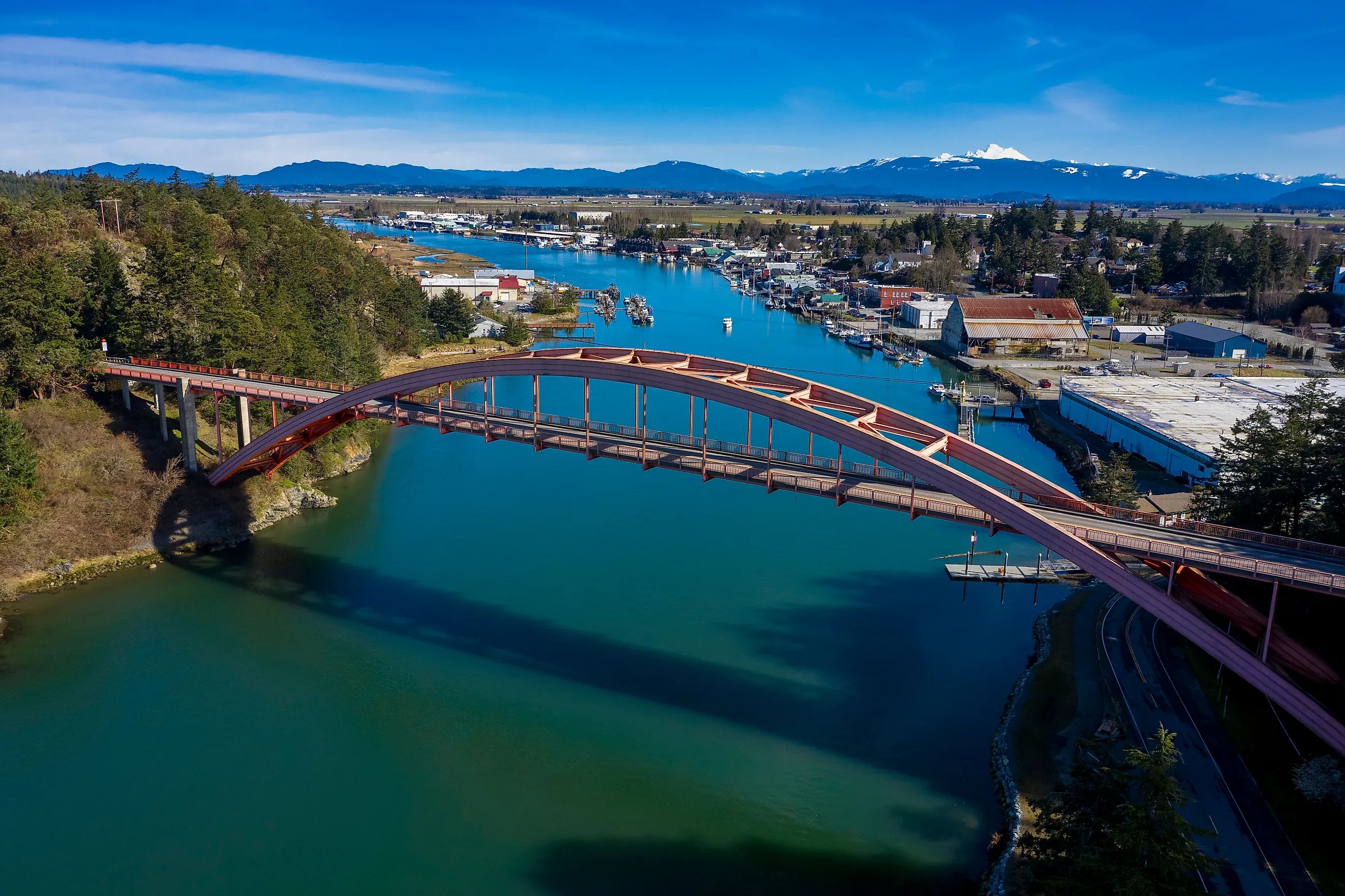
The Skagit Valley Tulip Festival, held every April for the entire month, turns the farmland around La Conner into hundreds of acres of blooming tulips, daffodils, and irises across two main growers: Tulip Town and RoozenGaarde. The festival shuttles visitors between fields and draws hundreds of thousands of people across the four weeks. La Conner sits 70 miles north of Seattle on the Swinomish Channel and runs about 950 year-round residents.
The town's arts scene runs deep. The Museum of Northwest Art on First Street features the so-called Northwest School artists, including Mark Tobey, Morris Graves, and Guy Anderson, who used the Skagit Valley landscape as their primary subject in the mid-20th century. Katy's Inn, a Victorian bed-and-breakfast in an 1876 house, and the La Conner Channel Lodge, with waterfront rooms over the harbor, are the two main downtown stays.
Cambria, California

Hearst Castle sits on the bluffs above Cambria, William Randolph Hearst's 165-room hilltop estate that took 28 years to build and operated as his California residence between 1919 and his death in 1951. The estate became a state historic monument in 1958 and offers four tour options of the Casa Grande main building plus the Neptune Pool, which holds 345,000 gallons of water under an Italian-imported temple façade.
Down in Cambria itself, Moonstone Beach Drive runs along the bluffs above a beach where moonstone pebbles wash ashore (the namesake stones are translucent feldspar). Nitt Witt Ridge, Art Beal's folk-art house built between 1928 and the 1970s out of abalone shells and beer cans, is a state historic landmark visible from East Village. The Cambria Scarecrow Festival in October lines Main Street with about 500 hand-built scarecrows, and the Cambria Christmas Market in December lights the Pinedorado Grounds with over 2 million LEDs.
Bandon, Oregon

Bandon Dunes Golf Resort, opened in 1999 by Mike Keiser, has grown into one of the most highly regarded golf destinations in the world. The resort now operates Bandon Dunes (designed by David McLay Kidd), Pacific Dunes (Tom Doak), Bandon Trails (Bill Coore and Ben Crenshaw), Old Macdonald (Doak and Coore-Crenshaw), and Sheep Ranch (Coore-Crenshaw), plus the par-3 Bandon Preserve. All five 18-hole courses are walking-only, designed in the Scottish links tradition.
Bandon was named after the town of Bandon in County Cork, Ireland, by founder Lord George Bennett, who arrived in 1873. Face Rock State Scenic Viewpoint runs along the bluffs south of downtown with views over a series of haystack-shaped sea stacks, including the Face Rock formation itself. Coquille Point and the Bandon Marsh National Wildlife Refuge protect prime whale-watching and bird-watching habitat through the migrations of December through March.
Port Townsend, Washington

Port Townsend boomed in the 1880s as a candidate to become the major Pacific Northwest port and built the elaborate Victorian homes and brick commercial buildings to match. When the Northern Pacific Railroad chose Tacoma instead, the boom collapsed almost overnight and the buildings froze in time. The town's 200-acre Historic District, designated a National Historic Landmark in 1977, is one of only three Victorian seaport districts on the National Register, alongside Galveston and Cape May.
Fort Worden State Park, on the bluffs north of downtown, covers 434 acres and was one of three coastal artillery forts (with Fort Casey and Fort Flagler) built to defend Puget Sound between 1898 and 1917. The park keeps the original concrete batteries, an 11-mile trail network, the Port Townsend Marine Science Center, and the Centrum arts center, which programs the popular Centrum Jazz and Centrum Acoustic Blues festivals each summer.
The Coast Beyond The Postcard
The Pacific Coast keeps its better stories outside the obvious city stops. Glass Beach is a former dump turned wonder. Bandon Dunes turns Scottish links golf into an Oregon weekend. Port Townsend froze its boomtown architecture intact because the railroad went somewhere else. These six off-the-beaten-path towns work best for the kind of trip that gets planned around what the small print mentions rather than what makes the cover.