5 One-of-a-Kind Small Towns in Michigan
Several towns in Michigan stand among the most unique in the United States. The geography of the state, defined by the Great Lakes, inland waters, islands, and mineral-rich areas, helped create environments where settlements developed differently across the state. Over the course of its history, Michigan was shaped by shipping routes, copper mining, and waves of immigration that left lasting physical and cultural marks. Each town on this list qualifies as one of a kind because it developed a characteristic that shapes how people travel, work, and socialize in daily life. Visiting these towns allows travelers to experience places shaped by clear histories and local rules, offering settings that feel purposeful and distinct.
Hell

Sometimes you have to take the advice and go to Hell. No, seriously. Here, Visitors can serve as mayor for a day. For $100, a visitor can become Mayor of Hell for a full day, receiving a key to the city, horns, a T-shirt, a mug, a badge, a wallet card, symbolic property ownership in Hell, dirt from Hell, and official proclamation certificates for both the mayoral term and the ceremonial impeachment that ends it. A short walk brings visitors to the Gates of Hell, the town’s best-known landmark and visual marker of arrival. The nearby stretch of the Huron River adds a natural element early in the visit, grounding the town’s civic satire in a landscape shaped by water and wetlands.

The route continues across the pedestrian bridge over the river, where couples leave padlocks as symbols of commitment, echoing the ritual associated with Paris’s Love Lock Bridge through Hell’s own dark humor. From there, the walk leads to the Chapel of Love, an operating venue that hosts legally recognized weddings and vow renewals tied directly to the town’s identity. A final stop at Damnation University (Dam U) extends the experience into mock academia, offering themed credentials and memorabilia.
Colon

Add a bit of magic to everyday life, and it can be done here, in Colon, the Magic Capital of the World. The visit often begins at Abbott’s Magic Co., a company founded in 1934 that remains one of the largest producers of magic equipment in the United States. The storefront and workshop format places production at the center of community activity. The store sells equipment intended for working magicians rather than display, and also houses the Sterling Magic Theatre, which features a small stage for live illusion shows focused on technique, timing, and close audience interaction.

From there, the visit turns toward legacy and gathering. Over forty professional illusionists are buried at Lakeside Cemetery, commonly known as the Magicians’ Graveyard or The Final Act. Between August 5 and August 8, 2026, thousands of magicians from around the world will gather for Abbott’s Magic Get-Together at the auditorium of Colon High School. The convention fills the village with performances, lectures, and informal demonstrations late into the night.
Mackinac Island

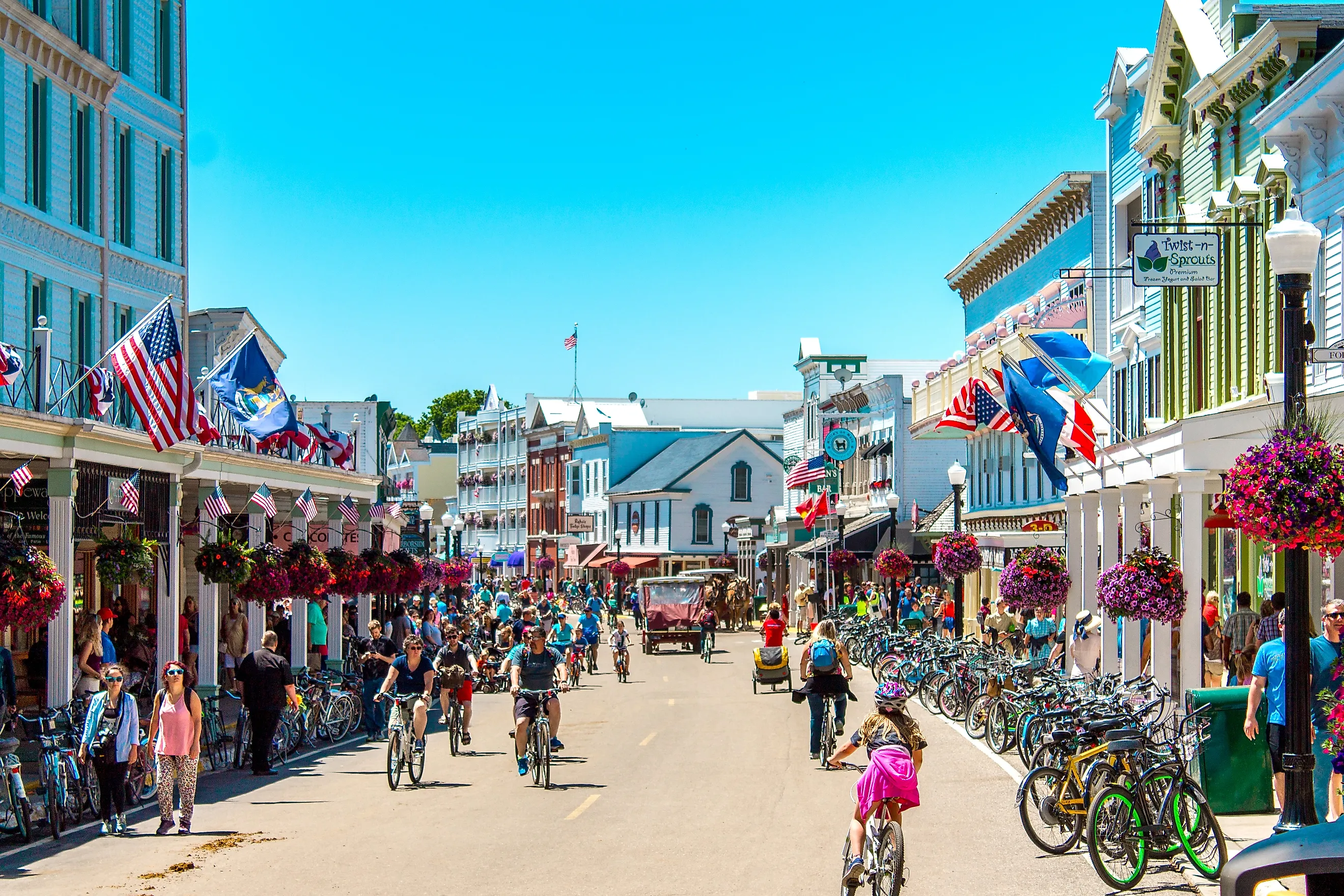
Mackinac Island stands apart as a town built to operate without cars. That structure was established early. In 1898, the Village of Mackinac enacted a ban on automobiles, followed in 1901 by the Mackinac Island State Park Commission extending the rule across park land. Early cars disrupted horses and carriages, leading residents to request their removal. Movement today relies on walking, bicycles, and horse-drawn carriages, shaping how visitors experience distance and pace. Many itineraries begin at the docks with a bike rental, following the shoreline road that loops the island before climbing toward Arch Rock, a limestone formation reached by a short ascent above open water.

The route then turns inland toward culture and history. Wings of Mackinac Butterfly Conservatory offers a controlled tropical environment filled with free-flying butterflies. A short walk leads to the Richard & Jane Manoogian Mackinac Art Museum, which presents works tied to the island’s artistic legacy. The sequence continues uphill to Fort Mackinac, whose elevated grounds overlook the town and water.
Charlevoix

A town marked by one architect’s refusal to follow straight lines gives Charlevoix its singular identity. Visitors often begin in the Earl Young Mushroom Houses, a collection of small, rounded homes built from the 1920s onward using boulder stones, curved walls, and cone-shaped roofs. These houses sit within everyday residential neighborhoods, allowing visitors to walk along streets between homes and observe how each structure responds to slope, shoreline, and natural light. Short walking distances between the houses allow comparisons of form while maintaining consistent materials and scale, making the design unique to Charlevoix.

From the neighborhoods, the route leads toward the water. The Charlevoix South Pier Lighthouse marks the channel between Lake Michigan and Round Lake. Nearby, the US 31 Round Lake Outlet Bridge lifts throughout the day to allow boat traffic to pass, shaping how pedestrians and vehicles move through downtown. Near the docks, the Beaver Island Boat Company operates a scheduled ferry service to Beaver Island.
Calumet

Calumet exists because of a geological condition found almost nowhere else on Earth. The town developed above massive deposits of native copper, occurring in pure metallic form rather than mixed into ore. That condition produced the only American town built entirely around large-scale native copper mining, shaping street patterns, building materials, labor systems, and wealth. The walk often begins in the former Calumet & Hecla Mining Company district, a dense concentration of stone and brick structures constructed to support extraction, processing, and administration.

From the mining blocks, the route moves into civic and cultural spaces shaped by copper wealth and labor history. The Calumet Theatre, completed in 1900, brought opera and touring performances to a remote industrial town. Nearby, the Coppertown USA Mining Museum explains how native copper was extracted and transported. A short walk leads to the Italian Hall site, marking the 1913 Italian Hall disaster, when seventy-three people, largely striking mine workers and their families, died during a crowded Christmas Eve gathering after a false cry of fire.
Distinct Towns Across Michigan
These towns show how a defining feature can shape how a town is built and experienced. These towns illustrate how a unique approach can shape an entire town. Hell turns civic identity into an experience visitors actively participate in through its mayor-for-a-day tradition and themed institutions. Colon functions as the Magic Capital of the World, supported by manufacturers, theaters, burial sites, and international conventions tied to the craft. Mackinac Island operates without cars, structuring movement and space around walking, cycling, and horses. Charlevoix remains defined by Earl Young’s stone houses integrated into daily neighborhoods. Calumet exists because of native copper, with its streets, buildings, and labor history shaped directly by geology. Together, these towns offer travelers clear examples of places built around rules and conditions rarely found elsewhere in the United States.