5 Of The Oldest Incorporated Towns In New Hampshire
Home to some of the oldest towns in America, New Hampshire was an ideal place for settlers from Europe to start new lives. The state’s spectacular Seacoast Region was especially suitable, particularly around the Piscataqua River and its tributaries. Here, English fishermen and traders arrived in the early 1620s to establish crude outposts that would eventually grow into the thriving permanent settlements we see today. The oldest of New Hampshire’s incorporated towns have managed to maintain their historical character, making a trip to the state’s 18-miles of Atlantic coastline a must-do. From the state’s only seaport to its smallest municipality, each of these small New Hampshire towns tells fascinating tales of America’s origins.
Dover

New Hampshire’s oldest permanent settlement, Dover, was established as a fishing and trading post in 1623. Gradually spreading from Hilton’s Point along the banks of the Cochecho River, colonists were attracted by its abundance of wood and fish, as well as trade with the native Pennacook people. Officially named in 1637 after the English port town, Dover’s frontier location led it to look to Massachusetts for protection.

Its then remote location saw settlers construct fortified log homes to (hopefully) withstand attacks by Native American tribes. These garrison-like structures provided refuge during the devastating Cochecho Massacre of 1689, when a coordinated assault killed or captured dozens of settlers. Built in 1675, the William Damm Garrison House, the last surviving example of Dover’s original 14 garrison structures, can be seen at the must-visit Woodman Museum. Other notable collections here include military artifacts, as well as a saddle used by Abraham Lincoln.
Hampton

Hampton received formal incorporation from the Massachusetts General Court in 1639, making it one of the four original townships in what would become New Hampshire. English colonists had arrived a year earlier, attracted by the area’s salt marshes, which were ideal for livestock grazing. As time passed and the frontier moved ever westward, the town’s pleasant coastal scenery began to spark interest among travelers looking for an escape from bustling Boston.

Hampton Beach, a nearly 14-mile stretch of sandy shoreline, emerged as a tourist destination in the late 1800s and remains one of New England’s busiest summer resorts. In addition to its boardwalks and arcades, you can still see the Casino Ballroom which has hosted musical acts since 1899.
Exeter

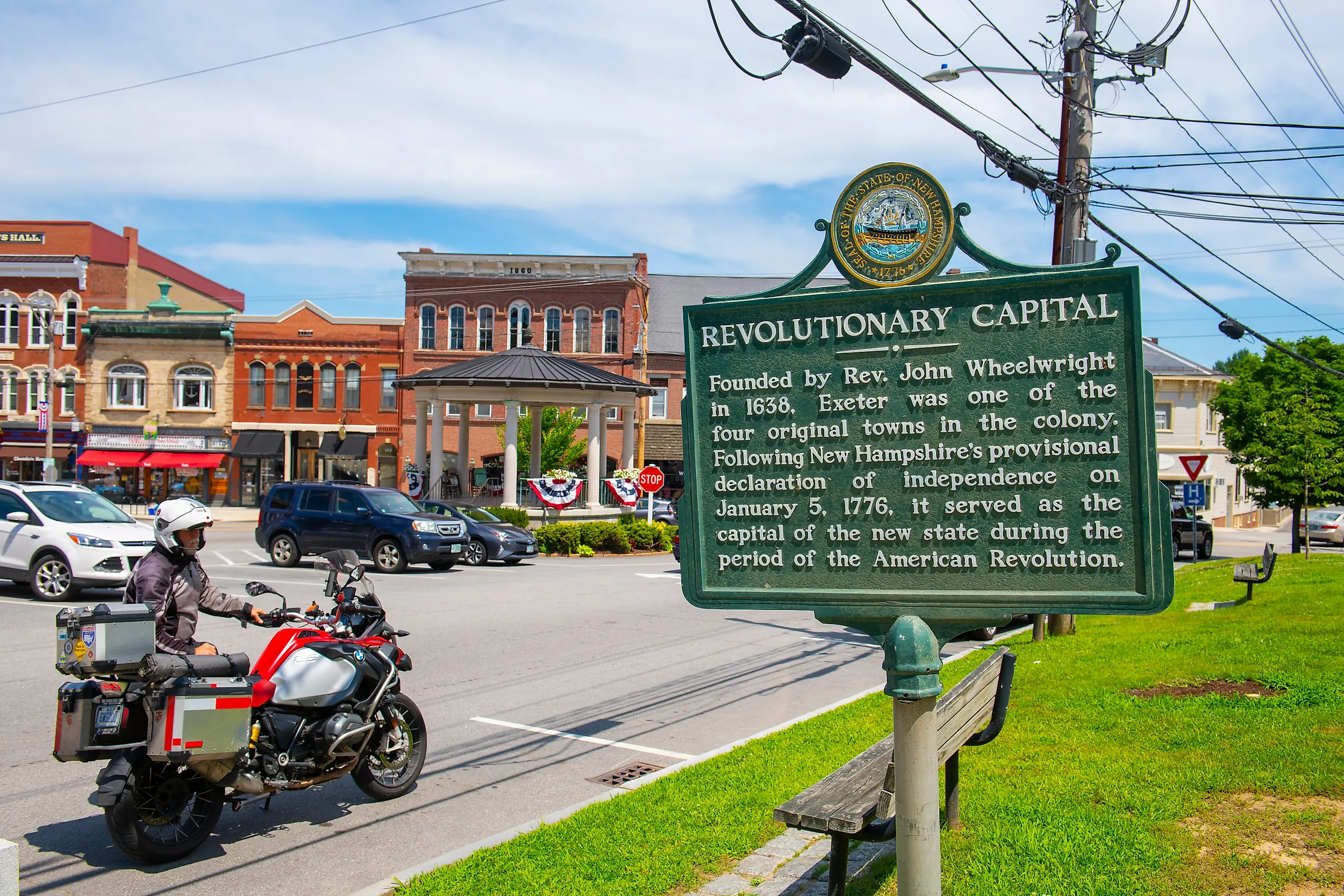
Founded in 1638 by former members of the Massachusetts Bay Colony, Exeter’s location at the falls where the fresh-water Exeter River meets the tidal Squamscott River made it ideal for settlement. Despite flip-flopping for several years between self-governance and falling under the jurisdiction of Massachusetts, Exeter eventually ended up as New Hampshire’s capital between 1775 to 1788.

A visit to the American Independence Museum provides plenty of fascinating details of the state’s early years, as well as its revolutionary heritage. Located in Ladd-Gilman House, built in 1721 and used as the state treasury during the American Revolution, the museum holds a rare first printing of the Declaration of Independence discovered in the building’s walls. The adjacent Folsom Tavern, dating to 1775, hosted President George Washington during his tour of New England in 1789.
Portsmouth

English settlers established Strawbery Banke in 1630, naming the new outpost after the wild strawberries growing in abundance along the western shore of the Piscataqua River. The state’s only seaport, it grew into a prosperous maritime center and received formal incorporation in 1653. Renamed Portsmouth that same year after the port in England, it was also crowned New Hampshire’s colonial capital.
Much can be learned about the state’s early years at the first-rate Strawbery Banke Museum. Set on 10 acres of the original waterfront neighborhood, more than 30 buildings dating from 1695 to 1955 are preserved here on their original foundations. These structures, which include the William Pitt Tavern, built in 1766 and once host to revolutionaries, and the opulent Goodwin Mansion, provide a fascinating glimpse at life down the centuries.

Several other important landmarks can be seen around Market Square in the Portsmouth National Historic District. These include The Music Hall, a Victorian-era theater built in 1878 that still puts on concerts, and Prescott Park, a pleasant place for a stroll along the waterfront.
New Castle

Settlement of what is today New Castle on Great Island began in 1623, the same year as Dover, when English traders established fishing stations at the mouth of the Piscataqua River. Originally part of Portsmouth, the island community was incorporated in May 1693. In addition to being New Hampshire's smallest town by population (just 1,001 people live here), it’s also the state’s easternmost municipality and its only island town.
Given its strategic position, New Castle has played an important role in the region’s military history. Island fortifications have guarded Portsmouth Harbor since the 1630s, and Fort Constitution (originally named Fort William and Mary) witnessed one of the first acts of the American Revolution.
On December 14, 1774, local Patriots stormed the garrison and seized a large quantity of gunpowder. Warned of British reinforcements by Paul Revere after his famous ride from Boston, some of the captured powder later supplied American forces at the Battle of Bunker Hill. The fort's current ruins date primarily from 1808 renovations, but it - along with the Portsmouth Harbor Lighthouse, completed in 1878 - is well worth a visit.

You can learn more about the island’s military past and landmark events at Fort Stark State Historic Site. Occupying the island's southeastern point, concrete fortifications built during World War II overlook Little Harbor and the Atlantic Ocean, and a small museum displays artillery and other military artifacts.
Visit Hampshire’s Oldest Towns
Together, these five historic communities in New Hampshire's Seacoast Region paint a fascinating picture of early America. It was here that the earliest permanent European settlements in New Hampshire (and some of the first in North America) were established, setting the country on the road to its foundation, its independence, and in 2026, celebrations of its 250th anniversary.