14 Small Towns in Florida Were Ranked Among US Favorites
The towns below have all landed on US "best small town" lists in the last decade. The common thread among them is the absence of high-rise development. Most also keep some kind of working industry running alongside the tourism, which is why they have held their character. Oyster boats. Sport-fishing fleets. New Urbanist planning experiments. Audubon-managed bird sanctuaries. 14 small Florida towns below.
Apalachicola

Apalachicola Bay produced roughly 90% of Florida's oysters before the fishery collapsed in 2012 and was placed under a multi-year harvest closure. The town at the head of the bay still organizes itself around oysters anyway. The working waterfront, the brick buildings on Water Street, and the local restaurants all still treat the oyster as the organizing fact. The Apalachicola National Estuarine Research Reserve protects 246,000 acres of bay and surrounding marsh and is a major birding stop for migratory songbirds. The Raney House Museum on Market Street preserves an 1838 cotton-merchant's home with original furniture. Oyster City Brewing Company on Avenue D pours Mangrove IPA and Apalach IPA on tap, both of which use the bay water as the brand.
Winter Park

The Charles Hosmer Morse Museum of American Art on Park Avenue holds the most comprehensive collection of works by Louis Comfort Tiffany in the world. The headline piece is the Tiffany Chapel, originally built for the 1893 World's Columbian Exposition in Chicago, reassembled in Winter Park in 1999 across 1,082 square feet of the museum floor. The rest of Park Avenue runs nine blocks of independent shops and restaurants past Central Park and the Rollins College campus. Winter Park sits a few miles north of the Orlando theme parks and otherwise has no relation to them.
Mount Dora

Mount Dora is one of the few Florida towns that sits on actual hills. The downtown looks down over Lake Dora from about 184 feet of elevation, which counts as a vista in this state. The Mount Dora Arts Festival in early February brings hundreds of handcraft and fine-art vendors into Donnelly Park. The Modernism Museum on Donnelly Street holds the largest collection of mid-century American studio furniture open to the public anywhere in the country. CatBoat Adventure Tours runs small catamaran trips on the lake. Wekiwa Springs State Park is about 30 miles south for paddling on the spring-fed run.
Seaside

When developer Robert Davis hired architects Andrés Duany and Elizabeth Plater-Zyberk in 1981 to plan a new Florida Panhandle beach community, the result was Seaside. It became the first built example of New Urbanism in the United States and has been imitated dozens of times since. The town runs as a walkable grid of pastel cottages and white picket fences, with shops along a central commercial loop and the Seaside Amphitheater running open-air concerts in season. The Saturday farmers market draws Panhandle-area vendors with grass-fed beef, honey, and bakery goods. The 1998 film The Truman Show used Seaside for almost all of its exteriors, and the geometry of the streets still gives the place the same staged-on-purpose feel.
Vero Beach

The unbuilt stretches of Atlantic shoreline along Indian River County form one of the most important sea-turtle nesting grounds in the world. Loggerhead, green, and leatherback turtles all nest along this coast from May through October, with the Sea Turtle Conservancy monitoring the major sites. Vero Beach sits at the heart of that stretch and ranks among the most beautiful beaches in Florida. The Vero Beach Museum of Art on Riverside Park Drive runs a working art school alongside its rotating exhibits. McKee Botanical Garden, an 18-acre tropical garden restored from a 1930s roadside attraction, holds the annual Waterlily Celebration and a rotating program of outdoor glass-sculpture installations.
St. Augustine

Spanish admiral Pedro Menéndez de Avilés established St. Augustine in 1565, making it the oldest continuously occupied European-founded city in what is now the United States. Castillo de San Marcos, the stone fort completed by the Spanish in 1695, still anchors the harbor. St. George Street runs through the colonial-era historic core with small shops along the pedestrian-only stretch. Flagler College occupies the former Hotel Ponce de Leon, built by oil and rail magnate Henry Flagler in 1888, and runs guided tours of the building's Tiffany stained glass (the largest collection of Tiffany windows still in their original location) and gilded dining hall. Scenic cruises along Matanzas Bay leave from the city marina year-round.
Fernandina Beach

Eight different flags have flown over Fernandina Beach since the 1500s, more than any other place in the United States. The Isle of Eight Flags Shrimp Festival each May commemorates that history with a shrimp-boat parade and an open-air market down Centre Street. Fernandina Beach sits at the northern end of Amelia Island, with Centre Street running straight from the historic Victorian-era downtown to the harbor. Fort Clinch State Park preserves a brick Civil War-era coastal fort, with full living-history programs the first weekend of every month. The local B&B selection (Fairbanks House, Hoyt House, and The Addison) keeps most of the lodging within a walkable few blocks of the harbor.
Stuart

Stuart calls itself the "Sailfish Capital of the World" for the offshore sport fishery that runs out of the St. Lucie Inlet. The town sits on the Treasure Coast at the confluence of the St. Lucie River and the Indian River Lagoon, with a downtown Riverwalk tying the shopping district to the water. Sailor's Return on the waterfront and Lola's Seafood Eatery handle the catch-of-the-day end of dinner. Jonathan Dickinson State Park lies 12 miles south of Stuart in Hobe Sound, with hiking trails, the Loxahatchee River for canoeing, and Hobe Mountain, an 86-foot sand dune that ranks as one of the highest points in coastal South Florida.
Matlacha

Matlacha is a strip of painted shacks and galleries along a single causeway connecting Pine Island to the Cape Coral mainland. The Gallery of Matlacha and Leoma Lovegrove Gallery and Gardens both show local work shaped by the mangroves and waterways. Matlacha Pass Aquatic Preserve covers the surrounding seagrass flats, mangrove islands, and oyster bars, with kayak access from several launch points along the causeway. Hurricane Ian hit Matlacha hard in September 2022, taking down a significant share of the buildings. Most of the galleries and restaurants have reopened by 2026, though the rebuild is still visibly ongoing.
Anna Maria

A long-standing height-limit ordinance keeps Anna Maria at low-rise scale despite sitting on Gulf-coast beachfront in Manatee County. The city occupies the northern end of a 7-mile barrier island, with the Gulf of Mexico to the west and Anna Maria Sound to the east. Pine Avenue and Gulf Drive carry the small commercial mix of independent shops and seafood restaurants. Bean Point Beach at the northern tip looks out toward Tampa Bay and the Sunshine Skyway bridge. Local outfitters handle bike rentals for the flat island roads and paddle trips into the mangrove tunnels along the Sound side.
Cedar Key

Cedar Key is a cluster of small islands on Florida's Nature Coast in the Big Bend region, about 50 miles southwest of Gainesville. The town runs about 700 residents and no high-rise development of any kind. The Cedar Keys National Wildlife Refuge protects Seahorse Key and the surrounding rookery islands, where thousands of reddish egrets, white ibis, and night herons nest each year. Hurricane Helene made landfall just north of Cedar Key in September 2024 as a Category 4 storm and caused major damage to the waterfront. The 2026 town is well into a multi-year rebuild, with most of the inns and seafood restaurants back online.
Islamorada

The Florida Keys National Marine Sanctuary protects the third-largest barrier reef system in the world, and Islamorada sits at the heart of the most active sport-fishing and dive section of it. The village (which calls itself the "Village of Islands") spreads across the Upper Florida Keys with the Atlantic Ocean on one side and Florida Bay on the other. Theater of the Sea on Windley Key has operated since 1946 as one of the oldest continuously running marine parks in the United States. Islamorada Brewery and Distillery pours small-batch beer and ages its own spirits in-house at the end of the day.
Crystal River

Crystal River is the only place in the United States where snorkelers can legally swim with manatees in the wild. The Crystal River National Wildlife Refuge protects Kings Bay, where several hundred West Indian manatees gather each winter in the constant 72-degree spring water. Three Sisters Springs and Hunter Springs Park anchor the in-town swim spots. Crystal River Archaeological State Park preserves a major Native American ceremonial complex with temple mounds and burial mounds dating roughly 250 BCE to 1400 CE, one of the longest continuously occupied pre-Columbian sites in Florida. The city sits on the Great Florida Birding and Wildlife Trail.
Naples

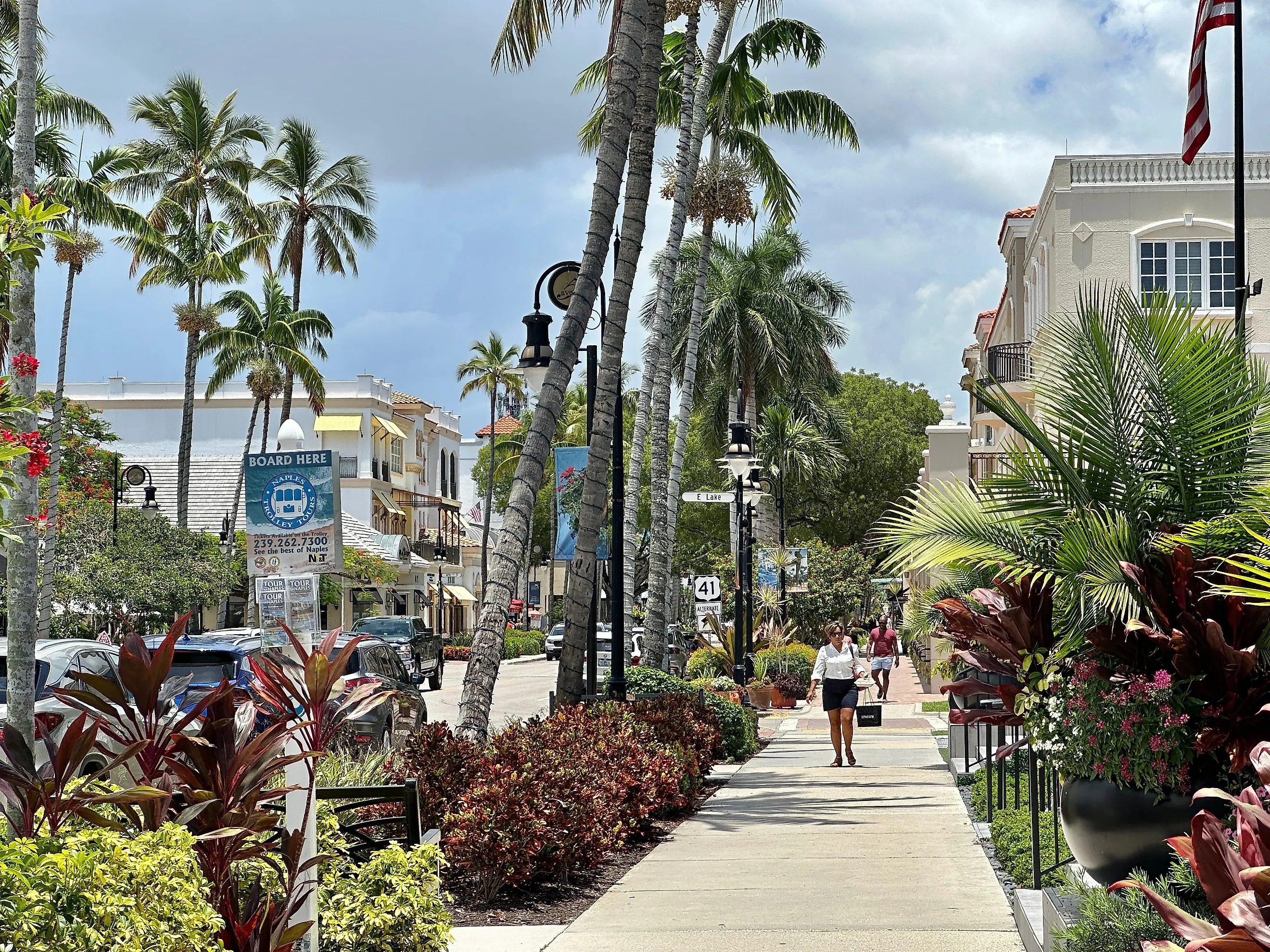
Fifth Avenue South in Naples runs about a quarter mile of palm-shaded restaurants and high-end shops opening straight onto a wide white-sand beach. The Naples Pier at the foot of 12th Avenue South was first built in 1888 and has been rebuilt several times after hurricanes, most recently after Hurricane Ian damaged it severely in 2022. The Naples Botanical Garden across town runs themed gardens across 170 acres. Corkscrew Swamp Sanctuary, an Audubon-managed boardwalk through old-growth bald cypress 20 miles east of the city, holds one of the largest remaining stands of virgin bald cypress in North America. Everglades National Park sits about an hour east for guided paddling.
Why These Fourteen
Each town here keeps the absence of high-rises through a different mechanism. Anna Maria does it through a height ordinance. Seaside does it through master-planned New Urbanism. Cedar Key does it through sheer geographic isolation on the Nature Coast. Apalachicola does it because the oyster economy never made anyone rich enough to build tall. The result across all 14 is the version of Florida that the rest of the state has built over since the 1960s.