11 Prettiest Downtown Strips In Iowa
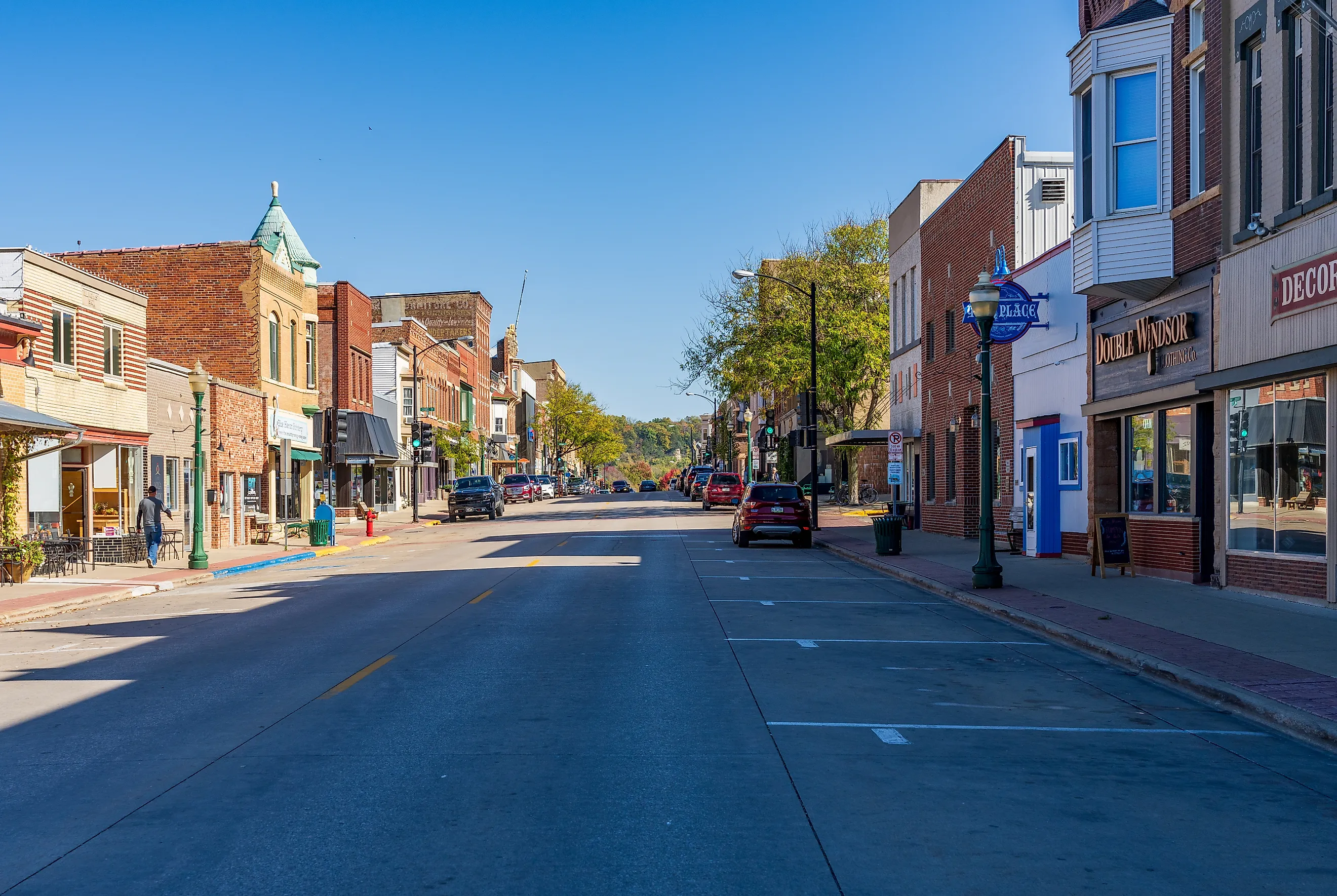
The most visually appealing downtown strips in Iowa center on well-planned main streets and historic buildings backed by green spaces. Many of the districts ahead lie within the state's northeast hill country where steep valleys influence town layouts. Others have courthouse squares rising over the rolling farmland to the south. A few hold direct riverfront frontage along the state's eastern border. Several pair their old commercial blocks with state parks and prehistoric earthworks just outside town. Each of the eleven downtowns stands out for how closely its layout, architecture, and surroundings connect into a recognizable town center.
Pella

Founded in 1847 by Dutch immigrants, Pella has a downtown that contains a well-preserved grid of red brick storefronts, tulip gardens, and Dutch-inspired architecture. The Klokkenspel on Franklin Street features mechanical figures that emerge throughout the day to perform to the music of a 147-bell carillon. Just east of the square, Molengracht Plaza holds a Dutch-style canal with a working drawbridge running through the heart of downtown. The Pella Historical Village and Vermeer Mill on Franklin Street groups log cabins, a general store, and a towering windmill into one highly photographable space. It is the ideal spot to tour the full sweep of the town's Dutch past in a single afternoon.
Central Park gives Pella's downtown its most festive and visually striking public setting. The square holds a Civil War statue, a 1900s fountain, a sundial, and thousands of tulips that bloom each year. Sunken Garden Park on Main Street, a short walk from the square, features a wooden-shoe-shaped pond, formal tulip beds, and a windmill. People can walk the Volksweg Trail, a paved path that winds through the surrounding landscape and connects key points across the town.
Mount Vernon

Shaped by the presence of Cornell College, Mount Vernon's Uptown district is a compact and handsome stretch of historic storefronts, public art, and independent businesses centered along First Street. The Cornell College campus, one of only two college campuses in the country listed in its entirety on the National Register of Historic Places, rises on a wooded hilltop just above the commercial strip. Its 19th-century stone buildings and mature trees give the town an architectural dignity that spills down into the streets below. The First Street Community Center occupies a beautifully repurposed former school building that now houses more than a dozen small businesses, studios, and performance spaces.
Mount Vernon's natural surroundings give its downtown a green edge that makes the district feel remarkably alive. Palisades-Kepler State Park, located west of town across Highway 30, preserves dramatic limestone bluffs and dense forest above the Cedar River. Hikers can take in long overlooks along a network of wooded trails. Running through downtown, a public sculpture trail curated by the Mount Vernon Area Arts Council passes murals, installations, and rotating exhibits placed throughout the district.
Decorah

Decorah's downtown Water Street is an attractive corridor of 19th-century red brick storefronts rooted in a deep Norwegian immigrant heritage. That heritage is reflected at the Vesterheim Norwegian-American Museum. Its galleries hold a 25-foot wooden sailboat, an 1853 log house, and intricate examples of Norwegian folk art and woodcarving. Heritage Park, which is part of the museum, groups 12 historic Norwegian settler buildings within one site. People can walk among humble cottages, storehouses, and a timber church transplanted from rural northeast Iowa.
The natural setting around Decorah's downtown is dramatic and deeply rooted in the rugged terrain of the northeast Iowa hill country. Dunning's Spring Park, located about a mile from the center of Water Street, features a 200-foot waterfall fed by a natural spring. A stone arch and staircase lead up through the ravine to the falls. The Upper Iowa River runs along the edge of town, where people can kayak or canoe through a landscape of limestone bluffs and forested ridges.
McGregor

McGregor's Main Street is a narrow corridor of 19th-century storefronts pressed between wooded limestone bluffs and the broad Mississippi River. The McGregor Commercial Historic District, listed on the National Register of Historic Places in 2002, holds 51 contributing buildings in Italianate and Greek Revival styles. The McGregor Historical Museum on Main Street holds one of the street's most remarkable treasures. Local deaf artist Andrew Clemens spent years creating intricate sand paintings inside glass bottles, using 45 shades of sand scraped from a nearby cave.
McGregor's downtown sits at the edge of dramatic natural scenery, with easy access to parks, trails, and prehistoric landmarks along the upper Mississippi River. Pikes Peak State Park, just south of Main Street, rises 500 feet above the river and holds 11 miles of hiking and skiing trails with long panoramic views. About five miles north of McGregor along the Mississippi River, Effigy Mounds National Monument preserves 206 prehistoric Native American burial mounds, including 31 sculpted in the shapes of bears and birds. Hikers can cover 14 miles of scenic trails through the monument's river valley landscape.
Le Claire

Le Claire's downtown sits along a tightly packed stretch of Mississippi Riverfront where 19th-century stores, history museums, and levee walkways reflect its legacy as a steamboat and river-pilot town. The Buffalo Bill Museum on North Front Street honors the area's deep ties to William F. Cody, a frontiersman and showman better known as Buffalo Bill. Its exhibits cover his early life and the preserved wooden hull of the Lone Star, one of the last surviving wooden-hulled steam towboats on the Mississippi River. The Scott County Freedom Rock, a large painted boulder along the LeClaire Levee, pays tribute to Iowa's veterans. The boulder carries vivid hand-painted imagery of local military heroes covering its surface.
The Mississippi River gives Le Claire's downtown its most striking natural setting, wide and unhurried along the levee's edge. A paved levee path runs alongside the river, offering long views of wooded bluffs and passing river traffic. At the end of the levee, the Riverboat Twilight, a replica Victorian boat, takes passengers on sightseeing cruises that glide through the river's wooded island channels.
Fairfield

Fairfield's downtown square holds a rich collection of historic architecture, civic landmarks, and green public spaces woven together over 180 years of community life. The Jefferson County Courthouse presides over the square with 19th-century stonework. The 1893 Carnegie Historical Museum at the corner of Court Street and Washington Avenue occupies a warm red brick Richardsonian Romanesque building. Its galleries hold Native American artifacts and Underground Railroad history that people can spend a full afternoon absorbing. Central Park, right on the square, adds a green and tree-shaded breathing space to the district, with a bandstand, bronze sculptures, and benches where people can linger.
The Fairfield Arts and Convention Center, just blocks from the square, gives the downtown an elegant and lively cultural presence. The center's Sondheim Center for the Performing Arts was the first performing arts venue in the United States named for composer Stephen Sondheim. Its adjacent Parsons Alumni Hall is graced with a stained-glass window salvaged from the chapel of the former Parsons College. It hosts national and international touring performances throughout the year. The attached Fairfield Art Association Gallery displays rotating exhibitions of local and regional work.
Elkader

Elkader's Main Street slopes gently toward the Turkey River, its two-story Victorian masonry buildings forming one of northeast Iowa's best-preserved historic commercial strips. The Elkader Downtown Historic District, listed on the National Register of Historic Places, holds brick facades dating to the mid-1800s. The Elkader Opera House, completed in 1903 and restored in 2003, presides over the north end of Main Street with its ornate pressed brick facade. Inside, a horseshoe balcony, a ruby glass chandelier, and a period stage curtain make it a striking setting for live performances throughout the year.
The Turkey River gives Elkader's downtown its most dramatic and recognizable natural edge. The Keystone Bridge, an 1889 twin-arched stone span at Bridge Street, arcs gracefully over the rushing water below. Just beyond it, the Elkader Riverwalk hugs the riverbank where kayaking and fishing are steps from Main Street. Founders Park, overlooking the river at the foot of the bridge, offers an open grassy bank with long views of the surrounding limestone bluffs.
Winterset

Winterset's Courthouse Square is a historic district of warm limestone storefronts, museums, and civic buildings that has changed little since the early 1900s. The Madison County Courthouse rises at the center of the square in elegant limestone. The Iowa Quilt Museum on East Court Avenue displays rotating exhibitions of historic and contemporary quilts. The John Wayne Birthplace Museum on South John Wayne Drive holds the largest collection of Wayne memorabilia in the world. Its galleries sit beside his modest 1907 birthplace home, open daily for tours.
Winterset City Park, located near the square and accessible from the intersection of South 9th Street and East South Street, gives the downtown a beautifully landscaped natural retreat. A live English hedge maze winds through the grounds, drawing curious walkers into its leafy puzzle. The Clark Tower, a rugged limestone observation structure, rises above the treetops with panoramic views of the Middle River Valley. The Cutler-Donahoe Covered Bridge, relocated to the park for preservation, adds a weathered 19th-century grace note to the landscape.
Burlington

Burlington's downtown is a compact historic district of Gilded Age commercial facades rising from the Mississippi River in a natural hillside amphitheater. The grandest of its civic buildings is the Des Moines County Heritage Center. Its interior is graced with an original stained-glass Hypatia window and elegant marble chip mosaic floors. Three floors of exhibits inside span thousands of years of regional history. The Art Center of Burlington, an organization serving the community since 1966, features monthly exhibitions of local and regional art at its downtown Jefferson Street home.
Snake Alley, a one-block brick roadway built in 1894, winds down from the Heritage Hill Historic District to Washington Street in five half-curves and two quarter-curves, covering 275 feet. Its twisted limestone curbing and locally-fired blue clay bricks give it a rich, tactile character. Walking its full length and then strolling through the district's spacious 19th-century mansions makes for a visually rich experience. At the top of Snake Alley, the Garrett-Phelps House Museum occupies a magnificent 1851 mansion, its tower and mansard roof overlooking the entire downtown below.
Clear Lake

Clear Lake's downtown sits on the shore of a natural spring-fed lake, its compact commercial strip combining historic architecture, rock and roll legacy, and a glittering waterfront setting. The Surf Ballroom on North Shore Drive is a Caribbean-styled 1940s dance hall where Buddy Holly, Ritchie Valens, and J.P. Richardson performed their last concert on February 2, 1959. The Surf was designated a National Historic Landmark in 2021. Its ornate interior and storied stage make it one of the most striking buildings on the strip. Three Stars Plaza, located half a block west of the ballroom, holds a 15-foot interactive sculpture of stacked vinyl records paying tribute to the three musicians.
The lakefront gives Clear Lake's downtown an open waterfront edge that defines the entire district. The Lady of the Lake, a double-decker cruise boat, departs from the downtown waterfront for 90-minute tours across the open water. Central Gardens of North Iowa, just blocks from the strip, spread across nearly three acres of themed gardens with waterfalls and flowering beds. The downtown docks are a popular spot for walleye fishing throughout the warm months.
Corning

Corning's Main Street holds a rewarding collection of significant buildings, performance venues, and cultural landmarks within a walkable and photogenic historic district. The Corning Opera House, built in 1902 and fully restored in 2012, hosts live performances and historic tours. Its slanted, raked stage and ornate brick facade give it a theatrical presence. The Adams County House of History on Benton Avenue, a two-story historic jailhouse listed on the National Register of Historic Places, houses artifacts including military uniforms and the original prisoner cells, which remain intact.
Corning's downtown blends creative energy and green public space into a district that rewards a slow afternoon walk. Central Park on 8th Street provides a tree-shaded walking circuit with views of Main Street and hosts the Green Hills Produce Farmers Market during summer months. The Birds of Icaria mural on Davis Avenue, painted by local artist Zack Jones, covers an entire wall of the revitalized Sally's Alley corridor in vivid depictions of Iowa birds. The Corning Center for the Fine Arts rounds out the district with rotating exhibitions and hands-on art classes.
Eleven Iowa Downtowns That Reward A Closer Look
The prettiest downtown strips in Iowa bring together historic buildings, local landmarks, and nearby natural settings within compact, clearly defined districts. In towns like Pella and Winterset, central squares organize civic landmarks and cultural institutions within compact layouts. Along the Mississippi River, places like McGregor and Le Claire draw their character from steep terrain and direct waterfront access. Districts such as Decorah and Elkader reflect valley settings and limestone features tied to the northeast hill country. Each downtown stands apart through the way its layout, architecture, and surroundings form a clear and lasting identity.