11 Most Welcoming Towns In California's Countryside
Ask anyone in Etna about the Friday-night crowd at the Avery Theatre and you will get directions before you finish the question. That kind of answer is the thread running through California's countryside, well past Ojai, Solvang, and the familiar wine-country stops. In old lumber towns, Gold Rush villages, and valley farming communities, volunteers run the museums, neighbors staff the festival booths, and the person behind the gallery counter has time to talk. The 11 towns here reward that pace. Some sit beneath snowy peaks, others among citrus groves or ranchland or fast rivers, and all of them are easier to like once you stop treating a visit as a checklist.
Etna

Etna sits on a broad shelf of Scott Valley, ranch fields on every side and the Klamath Mountains closing off the horizon. The Avery Memorial Theatre anchors the social calendar because the volunteers of the Scott Valley Theatre Company keep it running. Don Avery opened it as a movie house in 1948, and after the family donated the building to the town, that same volunteer group restored it into a live-performance space that now hosts concerts, school productions, and community nights instead of standing as a preserved facade. A few doors down at the Marble Rim Gallery, regional artists show ceramics, paintings, photography, jewelry, and woodwork, and the receptions and classes there draw a steady stream of people through the door.
Beyond Main Street, the countryside starts almost at once. The roads out of Etna cross open pasture and small creeks before they climb toward forested slopes, and old barns stand against the mountains, at their best when spring greens the valley or autumn reaches the cottonwoods. Scott Valley also opens toward the Marble Mountain Wilderness, so a sociable morning in town can turn into an afternoon in some of far Northern California's wildest country.
Quincy

The Plumas County Courthouse gives Quincy an unlikely grandeur for a mountain town of its size, its mature trees shading a walkable center where the shops, theater, and museum all sit within a few blocks of one another. Murals break up the older commercial fronts. Inside the Plumas County Museum, exhibits on Mountain Maidu culture and on the mining, railroad, and logging industries make the surrounding ranges easier to read, since each of those industries left marks that are still visible around the county.
After dark the Town Hall Theatre carries downtown, and in summer the markets and seasonal celebrations put residents and visitors in the same few blocks rather than fencing off the attractions from daily life.
For a warm afternoon, Bucks Lake lies southwest of town in thick forest, with shoreline enough for swimming, paddling, and quiet coves well away from the busiest ramps. Fall may be the best of it, when the courthouse trees and the surrounding American Valley turn gold and orange.
Weaverville

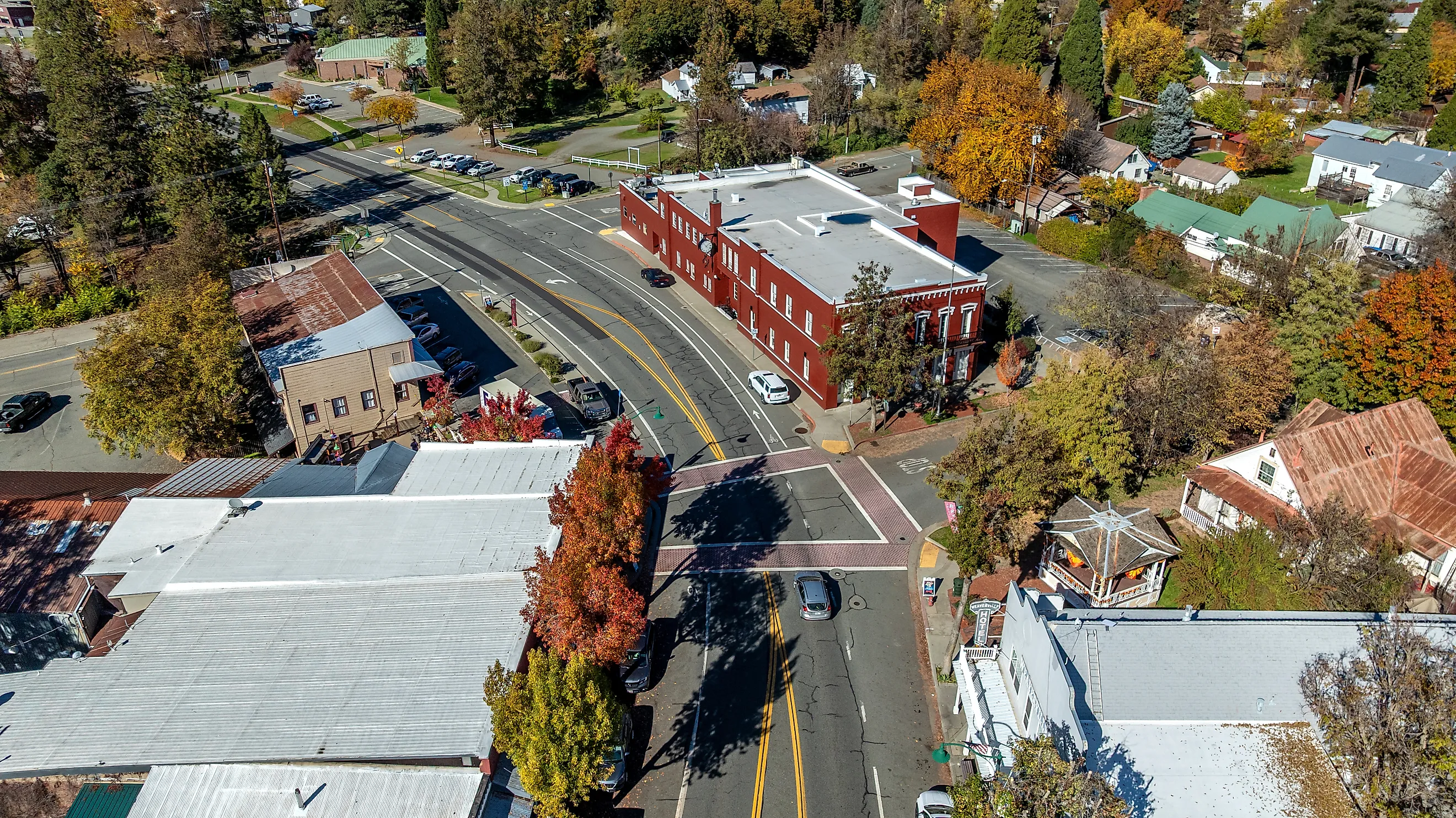
Look up while you walk Main Street in Weaverville. Iron spiral staircases curl against several of the old buildings, built from about 1860 because the upstairs and downstairs of a single storefront often had separate owners who each needed their own entrance. They are one small pleasure in a historic district of 31 contributing structures, where brick commercial blocks stand close to wooden houses and old civic halls. The Jake Jackson Museum lays out the mining and logging history behind them, but the most important site is the Weaverville Joss House, the oldest continuously used Chinese temple in California. Built in 1874, its Taoist temple holds the story of the Chinese miners who made up a large part of the town during the Gold Rush, a perspective that many California mining towns leave out.
History has not pushed the present aside here. Galleries fill during the art walks, seasonal markets set up downtown, and local celebrations bring people into the streets. The Trinity Alps rise within easy reach for an entirely different afternoon, mountain roads leading toward trailheads, forest, and clear water. Few towns this small pass so naturally between nineteenth-century California and serious wilderness.
Graeagle

Graeagle's row of old red buildings looks almost too tidy beneath the tall pines, but the color is a practical inheritance. Most of them tie back to the community's lumber-company past, which still sets the village center apart from other Sierra resort towns. Graeagle Park and the Mill Pond form the heart of local life. During the long-running Independence Day celebration, music fills the park, a parade moves through the village, and fireworks close the night over the water.
Drive a few miles past the red buildings and the landscape shifts hard. The Lakes Basin Recreation Area holds glacial lakes below granite ridges, its forest trails linking shorelines that feel far more remote than the short distance from town suggests. Gold Lake makes an easy first stop, and hikers can push on toward quieter water higher in the basin.
The annual arts and crafts fair brings a second wave of activity to Graeagle Park, this time with handmade work and local vendors under the trees. It makes a fine excuse to spend a morning in town before heading into the mountains for the afternoon.
McCloud

McCloud still reads as a town built around timber. The historic company buildings cluster near the center, the old McCloud Mercantile among them, though restaurants, lodging, and shops now fill many of them. Mount Shasta rises past the rooftops, some mornings so clearly that it seems to take up half the sky. Rather than rush the historic district, walk it early, when the sidewalks are empty and the volcanic peak catches the first light.
The McCloud River is the natural counterpart to all that architecture. Lower, Middle, and Upper McCloud Falls link into a single forest outing, each cascade a different look at the river. Autumn brings yellow beneath the evergreens, and winter can bury town and mountain alike. McCloud draws its biggest crowds over Memorial Day weekend for the Mushroom Festival, when food, foraging tours, cooking demonstrations, music, and local stalls fill Main Street. It belongs to this wooded corner of California in a way a generic small-town fair never could.
Fall River Mills

Fall River Mills rewards a slow look at the landscape more than a hunt for one famous landmark. The Fall River Valley spreads around town in fields cut by spring-fed channels, with volcanic country beyond and, on clear days, views toward Mount Shasta and Lassen Peak. It is an unexpectedly green corner of northeastern California, greenest along the Fall and Pit rivers. The Fort Crook Museum supplies the human story, its grounds built up through donated labor and materials and now home to local buildings and objects from generations of ranching, farming, and settlement. Volunteers still bring the place to life for Pioneer Day and old-fashioned ice-cream socials rather than leaving it a set of locked rooms. Afterward, take one of the quieter valley roads instead of the highway. Barns stand past the irrigation channels, anglers work the river, and the sky seems to widen with every mile. Fall River Mills is at its best when the drive itself is the reason you came.
Mokelumne Hill

Mokelumne Hill missed the polished makeover that turned some Gold Country towns into weekend shopping strips. Its steep streets still run irregular and old, lined with the fireproof stone buildings that went up after a destructive 1854 fire. The Hotel Leger, one of California's oldest operating hotels, draws the eye first, yet the smaller fronts around Main and Center streets reward the same attention, and a coffee or gallery stop can stretch into an hour of poking around the historic core.
The Chinatown Gardens Archaeological Preserve widens the story. Chinese residents once worked commercial gardens on the hillside, and traces of the terraces, water systems, homes, and a temple site remain. The preserve is a rare chance to picture how people actually lived and worked beyond the mining claims that usually stand in for Gold Rush history.
Later, drop toward the Middle Bar Bridge and the Mokelumne River, where the neat historic center gives way fast to rugged foothills and canyon. When a concert or community gathering is on at Shutter Tree Park, there is good reason to climb back up before evening.
Volcano

Volcano has the odd appeal of a place built for far more people than live there now. Thousands came through during the Gold Rush, and today a small cluster of historic buildings stands among the trees in the Amador County foothills. That quiet is what makes the Volcano Theatre Company such a find. Its volunteers still stage productions in the 1856 Cobblestone Theatre, billed as the smallest fixed-seat theater in California, and in an outdoor amphitheater across the street, carrying on a local theatrical tradition that reaches back to the 1850s, when Volcano hosted the state's first amateur company. Catching a show turns a short architecture stop into an evening among the residents keeping that tradition alive.
The rest of the day fills easily. Black Chasm Cavern sits close enough for an underground tour before you circle back, and the Shenandoah Valley wine region spreads across the nearby countryside. Even so, the village earns unhurried time of its own. Wooden porches lean beside rough stonework, narrow roads bend between old trees, and autumn lays deep color around buildings that have stood through generations of California history.
Independence

Few small California towns have a backdrop to match Independence. The Sierra Nevada climbs almost from the edge of town on the west, while the Owens Valley runs east toward the Inyo Mountains. Start inside the Eastern California Museum rather than just admiring the peaks. Founded in 1928, its collections trace the valley through Native American craftsmanship, early settlement, the water history that reshaped the region, and the people who tried to make a life in demanding country. Out in the yard stands the Slim Princess, a narrow-gauge steam locomotive from the valley's railroad era.
A short drive north reaches the Mount Whitney Fish Hatchery. The handsome granite building now serves as a museum, and its tree-shaded grounds make a surprisingly peaceful picnic spot beneath the mountains.
When the heat climbs, Independence Creek runs cool and shaded close to town. The place changes character around the Fourth of July, when a community breakfast gives way to a small-town parade and, after dark, to fireworks. With the Sierra towering over all of it, even a familiar American holiday feels outsized here.
Exeter

Exeter wears its history on its walls. Thirty-one murals across the downtown show farm workers, regional wildlife, historic residents, and scenes from Tulare County's agricultural past, and they turn an ordinary walk through the commercial district into something closer to an outdoor gallery. Skip treating the mural trail as a fixed route. Wander the brick blocks and let the next painting appear around a corner, with cafes and independent shops breaking up the artwork often enough to keep the whole thing feeling like an afternoon in town rather than a formal tour.
Then look past the buildings. Citrus groves begin almost at the edge of Exeter, and after clear winter weather the Sierra Nevada stands sharp behind them. That farming setting gives the murals their context without another museum stop. Farmers markets and downtown art events are the best times to come, when the sidewalks fill and the ties among local growers, artists, shopkeepers, and residents are easy to see. Spring is the prettiest window, green orchards below mountains that may still hold snow.
Kernville

The Kern River runs so close to the middle of Kernville that rafting gear, fishing talk, and the sound of moving water fold into an ordinary stroll through town. Circle Park sits beside the center, a natural gathering spot within steps of the cafes and Western-style storefronts. Summer weekends bring paddlers off the river and cyclists back from the Kernville Bike Park, and local events set musicians and small vendors under the park's trees. The loudest weekend comes in winter, over Presidents' Day, when Whiskey Flat Days revives the town's mining-era roots with a parade, rodeo events, historical reenactments, craft booths, and a Wild West encampment. On quieter days, head toward Lake Isabella or follow the road north into the southern Sierra, where giant sequoia groves make an easy day trip. Coming back still feels like returning somewhere compact, the river, the park, dinner, and a place to sit outside all within a short walk.
Why These Towns Reward a Second Look
What links Etna to Kernville is not scenery, which changes completely across the state, but the size of the effort behind each town's public life. The volunteers who restored the Avery Theatre, the ones who fire up the Slim Princess on special days, the artists who fill Exeter's walls and Weaverville's galleries, all of them do the work that keeps these places worth the drive. The mountains and rivers give you a reason to come. The people are the reason a visit sticks.