10 Victoria Towns Where Time Stands Still
A rusted tobacco kiln beside a working orchard. A quiet main street that isn't worried about reinventing itself. These are two images that reflect the stillness defining Victoria's rural stretches. In Walhalla, the remnants of the 19th-century gold rush and timber booms have not been cleared away for glass frontages. The heavy iron machinery and weatherboard facades remain in active, if slower, use. Across the state, the cannons of Fort Queenscliff keep watch over the entrance to Port Phillip Bay. The preservation of these spaces often owes to the steep topography of the Great Dividing Range or the persistence of the Murray River, where original wharf timbers continue to groan against the current. Further inland, bluestone courthouses and bakehouses still operate from their original quarried stone, and entire streetscapes along routes like Fraser Street in Clunes retain their uniform 19th-century shopfronts. These are the corners of Victoria where the past isn't preserved behind glass; it's still being lived in.
Walhalla

The road into Walhalla twists through the Stringers Creek valley, where the town clings to steep hillsides that long ago prevented the expansion of a traditional street grid. The vertical limitation has kept the settlement small and physically rooted in the 1860s.
Walking up the narrow paved incline leads past the Star Hotel, rebuilt to its original timber specifications, toward the Long Tunnel Extended Mine. The mine entrance remains an impressive puncture in the rock face, open to travelers who take the tour inside to explore the history of the Australian gold rush. Along the valley floor, the old post office stands with its weathered wooden siding, while the precariously perched cricket ground sits on a leveled mountain peak high above the rooftops.
Beechworth

Honey-colored granite serves as the foundation for the government buildings and jails that anchor the higher elevations of Beechworth. The Beechworth Historic Courthouse remains much as it was during the 1880 committal proceedings for members of the Kelly Gang, with its heavy wooden dock and original bench seating. Down the hill, scents from the Beechworth Bakery, in a historic central building, drift across the street. The Old Beechworth Gaol looms over the surrounding parkland, hosting a cafe, tours, and events that draw on the gaol's more than 140 years of operation.
Port Fairy

Salt air scours the bluestone walls of the cottages lining the Moyne River, where the local fishing fleet still ties up to weathered wooden piers. The Merrijig Inn stands across from the wharf, its low ceilings and thick masonry reflecting its status as one of the oldest surviving lodging houses in the region.
Walking toward East Beach, the structures transition from commercial maritime buildings to small, whitewashed residences with tiny windows designed to keep out the Southern Ocean gales. The river flows past the dormant boatyards, disappearing into the mist of the coastline.
Queenscliff

Ornate Victorian hotels with towering turrets and wrap-around balconies overlook the entrance to Port Phillip Bay, signaling the town's past as a premier seaside destination. The Vue Grand Hotel maintains its grand dining room and high ceilings, reflecting the 19th-century hospitality of its opening.
Along the pier, pilot boats wait to guide larger vessels through the narrow entrance known as the Rip, a maritime tradition that has persisted since the town's inception. The sandstone of Fort Queenscliff stands on the cliff's edge, marking more than 150 years of Australian coastal defense history, while its cannons lie unused.
Yackandandah

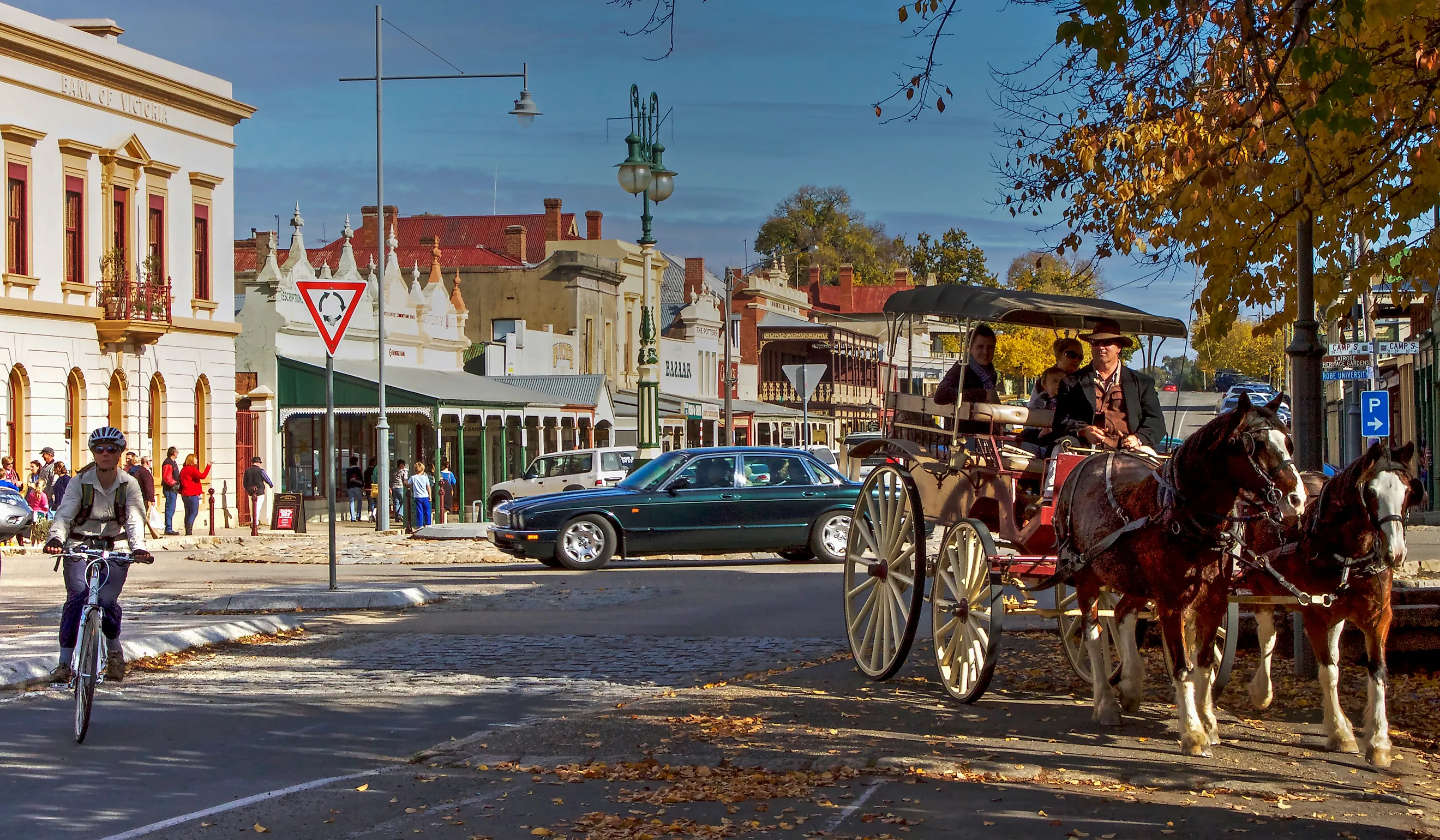
The main street of Yackandandah is shaded by massive European trees that turn a deep gold each autumn. Stone gutters, hand-cut in the 19th century, still channel rainwater past storefronts like the old Yackandandah Motor Garage, which operates out of a mid-19th-century building. Inside the Yackandandah Museum, housed in the old Bank of Victoria building from 1860, local artifacts are displayed with the heavy safe and original teller screens still in place. The surrounding hills are scarred by old hydraulic sluicing sites, such as the Yackandandah Creek Gorge, where water was diverted in pursuit of alluvial gold.
Clunes

The scale of Fraser Street in Clunes is unexpectedly grand, with a long row of uniform 19th-century shopfronts that once served a population of thousands. Many of these buildings now house secondhand bookstores, where the original wooden floorboards creak under the weight of stacks that reach the high ceilings. Fittingly, the town hosts the annual Clunes Booktown Festival in early May.
The Clunes Town Hall and Courthouse stand as a massive bluestone landmark, its clock tower visible from the surrounding volcanic plains. A walk toward the creek reveals the remains of the Port Phillip Mine, where the tall brick chimney stack still rises above the scrub.
Echuca

The massive red gum pylons of the Echuca Wharf rise high above the Murray River, built to accommodate the rise and fall of the winter floods. The PS Pevensey and other timber-hulled paddle steamers continue to churn the muddy water, their steam whistles echoing off the brick warehouses of the Port of Echuca.
Inside the nearby Star Hotel, a former underground bar remains accessible via a dark, cool staircase, where patrons of an earlier era would flee the authorities through a secret escape tunnel. Live music is hosted every weekend as part of the hotel's Winter Blues program.
Daylesford

The architecture of Daylesford is defined by the steep winding roads that lead to the town's natural mineral springs on its periphery. The Convent Gallery, once a 19th-century nunnery, sits on a hill overlooking the town; its stone corridors and gardens are open to the public.
Down in the valley, the Lake Daylesford spillway creates a constant rush of water near the boathouse, where wooden rowboats are tied to a small jetty. As with many small towns in Victoria, Daylesford includes bluestone buildings that have stood with the community since the gold-rush era.
Chiltern

Chiltern's main street feels like a live film set, with its low-slung timber awnings and the preserved facade of the Star Hotel and Theatre, home to a historic grapevine planted in 1867 and often cited as one of the largest of its kind in the Southern Hemisphere.
The local library and heritage building, the Chiltern Athenaeum, serves as a repository for historical documents and objects in a building that has seen little structural change since the 1860s. Nearby, Lake Guyatt reflects the surrounding gums and the quiet residential streets where brick cottages sit behind low picket fences. The town remains small, centered around the single railway line that occasionally rumbles in the distance.
Maldon

The Maldon Vintage Machinery Museum sits on the edge of town, housing massive rusted steam engines that once powered the local quartz mines. Toward the town's center, the smell of boiling sugar drifts from the Maldon Lolly Shop, where glass jars of boiled sweets sit on shelves that have warped under their own weight. Further along, the Kangaroo Hotel offers a heavy timber threshold that has been crossed by locals since the era when Maldon was designated Australia's first Notable Town by the National Trust of Australia in 1966.
Victoria's Preserved Corners
Victoria's regional towns preserve their own fragments of the past. Whether continuing older traditions of classically crafted candy or offering tours of historic prisons and mineshafts (free of inmates and gold, respectively), the state retains a rare concentration of intact 19th-century streetscapes. From Star Hotel to Star Hotel, the rough bluestone, the worn river wharves, and the protective overhangs of shopfront thresholds record an earlier era.