10 Of The Quietest North Carolina Towns
North Carolina’s quiet towns reward a slower look. Beaufort faces the Rachel Carson Reserve across Taylor’s Creek. Manteo puts the Roanoke Marshes Lighthouse at the end of its waterfront boardwalk. Bryson City sends the Great Smoky Mountains Railroad into Nantahala Gorge. Saluda leads to Pearson’s Falls while Brevard opens onto Pisgah National Forest. Little Switzerland lifts the Switzerland Inn above the Blue Ridge Parkway, and Columbia reaches into the cypress wetlands on the Scuppernong River Interpretive Boardwalk. Across these towns, the best views arrive without the biggest crowds.
Bath

Morning arrives quietly in Bath. The first activity often comes from Bath Creek, where anglers cast lines from the docks and sailboats drift across calm water. A few blocks inland, streets lined with centuries-old homes remain remarkably unchanged, giving North Carolina's oldest incorporated town an atmosphere that feels far removed from modern commercial corridors.
That sense of continuity begins at Historic Bath State Historic Site, where guided tours start from the exhibit center. The colonial story belongs to the Palmer-Marsh House, built in 1751 for the merchant and legislator Michael Coutanche and now a National Historic Landmark. It is one of the oldest frame houses left in the state. The Bonner House represents a later chapter. Built around 1830 on land once owned by town founder John Lawson, it is furnished to the 1830s rather than the colonial period, and its lawn holds the picnic tables closest to the water. A short walk away, St. Thomas Church, begun in 1734, is the oldest church building still standing in North Carolina. The landmarks sit close enough together to show how little the original town plan has shifted.
Bath Creek continues that theme. Public docks, shaded benches, and small boats have replaced the merchant ships that once anchored here. Instead of souvenir shops lining the shoreline, the creek offers open views across the water and one of eastern North Carolina's most tranquil waterfront settings, especially as the sun settles behind the trees each evening.
Beaufort

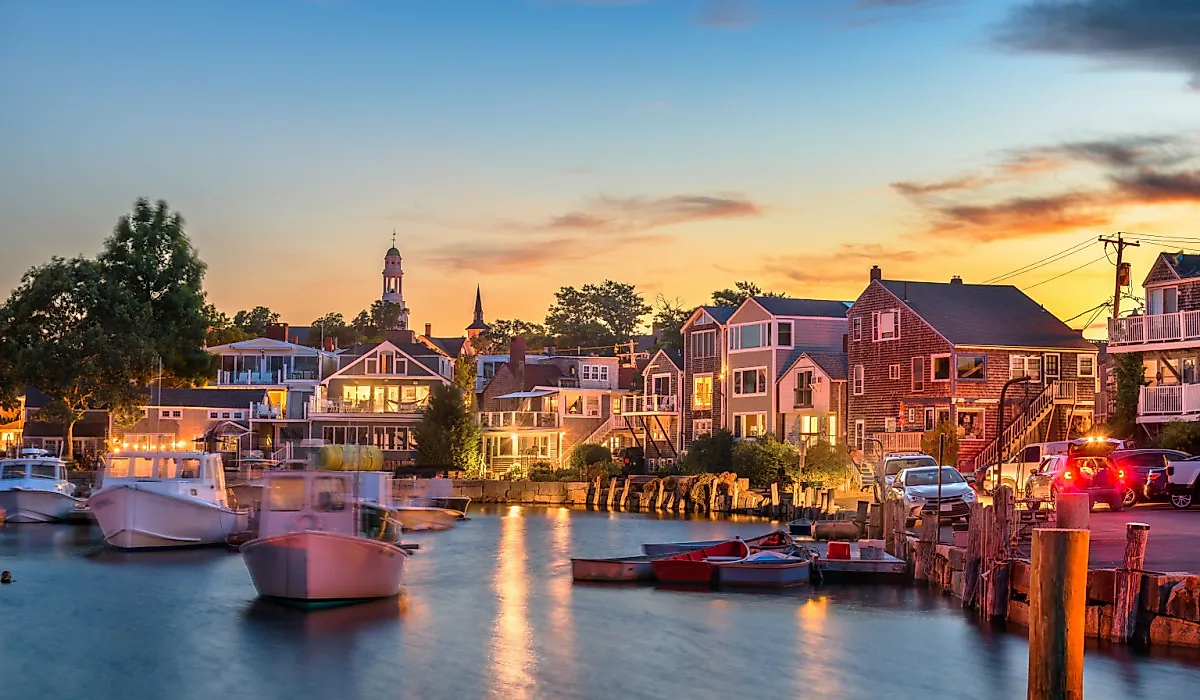
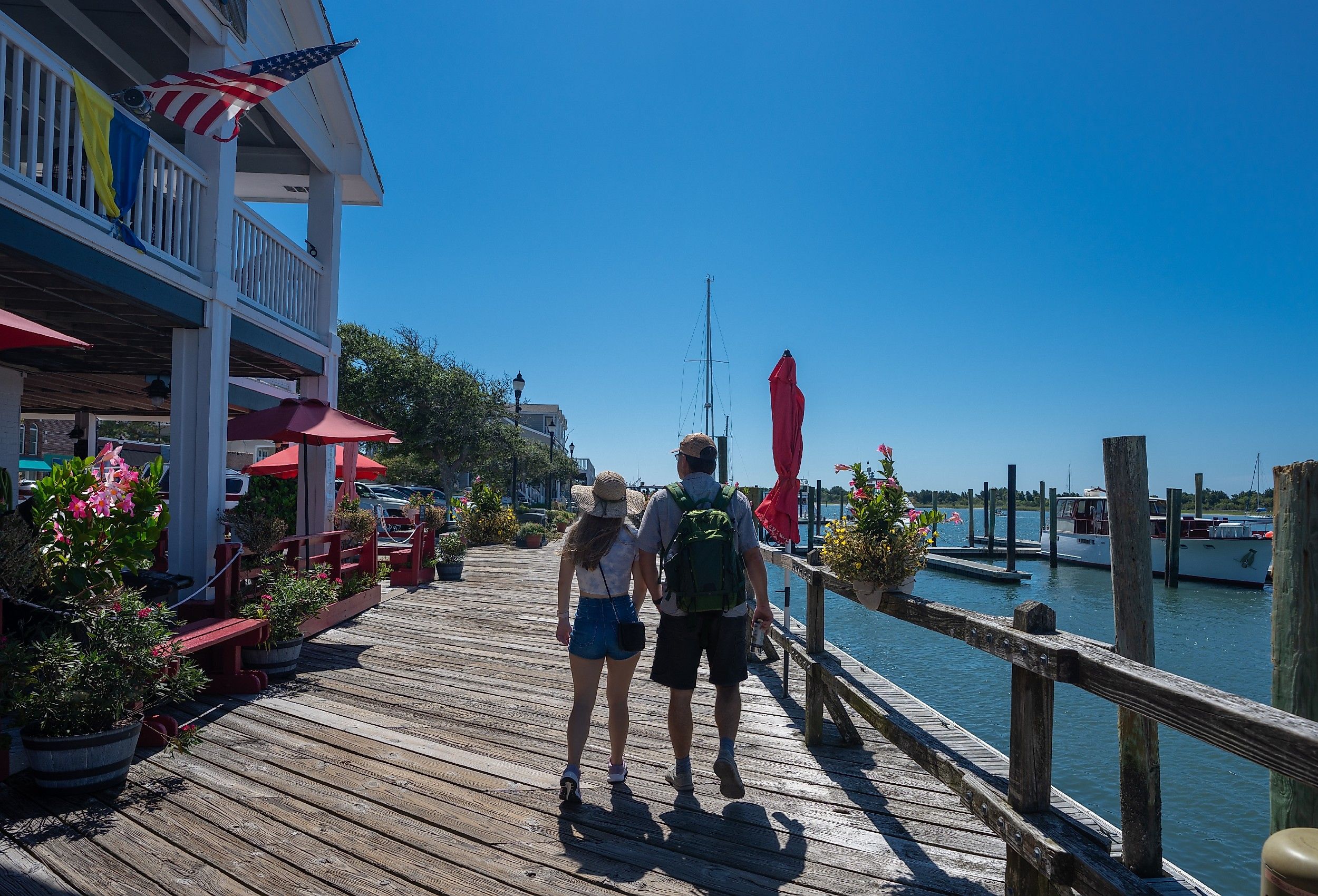
Fishing boats still shape the daily rhythm in Beaufort. Along Taylor's Creek, shrimp trawlers, sailboats, and ferries share the harbor much as working vessels have done for generations. Although the town welcomes visitors throughout the year, it has preserved the character of a historic seaport rather than evolving into a high-rise beach destination.
A walk along Front Street reveals why. Restaurants and galleries occupy restored buildings overlooking the harbor, while the North Carolina Maritime Museum tells stories of shipwrecks, hurricanes, and Blackbeard's flagship, Queen Anne's Revenge. Across the creek, the protected Rachel Carson Reserve stretches across several small islands where marsh grasses sway with the tides and a herd of wild horses has lived for decades. A short ferry ride reaches the reserve, but the bustle of the mainland quickly fades once the shoreline comes into view.
History remains just as visible on land. The Beaufort Historic Site preserves homes, churches, and public buildings dating from the 18th and 19th centuries. The day often ends where it started, with boats returning to Taylor's Creek and dolphins occasionally surfacing near the docks.
Manteo

Life slows noticeably after crossing the bridge onto Roanoke Island. Manteo has long served as the historic heart of the Outer Banks, yet it feels very different from neighboring beach communities. Instead of oceanfront hotels and amusement attractions, the waterfront centers on marinas, local bookstores, shaded parks, and sidewalks where conversations often last longer than shopping trips.
The Roanoke Marshes Lighthouse stands at the end of the boardwalk, recalling the screw-pile lighthouse that once guided ships through Croatan Sound. A few minutes away, Fort Raleigh National Historic Site examines England's first attempt to establish a permanent settlement in North America and the enduring mystery surrounding the Lost Colony. Next door, winding paths through the Elizabethan Gardens lead past seasonal flowers, fountains, and sculptures inspired by 16th-century English landscapes.
Bryson City

The whistle of the Great Smoky Mountains Railroad often echoes through Bryson City before the streets become busy. That sound has become part of daily life in this mountain town, where protected public lands have limited large-scale development and kept the surrounding landscape largely intact.
Rail excursions remain the biggest draw, carrying passengers beside rivers and through the Nantahala Gorge. Even so, many people spend just as much time away from the tracks. Deep Creek, only a few miles from downtown, leads hikers to three waterfalls connected by an easy trail. During warmer months, families float the creek on inner tubes, while anglers search for trout beneath the hardwood canopy. Farther south, the Nantahala River attracts whitewater rafters, yet quieter stretches suit paddlers looking for a slower trip downstream.
Saluda

Few towns owe so much of their identity to the railroad as Saluda. The Saluda Grade, which gained 606 feet in under three miles before cresting at the edge of town, was the steepest standard-gauge mainline railroad grade in the United States. The first train made the climb on July 4, 1878, and the last one ran in 2001. The historic depot still marks that era, and in 2025, a coalition of conservation groups bought the corridor with plans to convert 31.5 miles of it into the Saluda Grade Trail.
Main Street remains compact enough to cover on foot. Independent bookstores, cafés, antique stores, and galleries fill buildings that have served the community for generations instead of giving way to newer commercial development. A short drive beyond downtown leads to Pearson's Falls, where a quarter-mile trail ends at a 90-foot waterfall in a glen the Tryon Garden Club has owned since 1931. A small admission fee funds the upkeep, and the surrounding forest holds more than 300 species of plants and wildflowers. The falls carry the name of Charles William Pearson, the engineer who surveyed the railroad route up the mountain.
Another side of Saluda appears inside the nearby Green River Game Land. Hiking trails wind toward overlooks above the Green River Gorge, while paddlers and anglers spend long afternoons along the river below. Passengers once broke their journey here before continuing through the mountains, and the town still suits an unhurried stop.
Brevard

The sound of rushing water is never far away in Brevard. Streams flow through town, waterfalls surround it, and Pisgah National Forest begins only a few miles from Main Street. While many mountain destinations have grown into busy resort communities, Brevard has held onto a pace shaped by its natural surroundings and long-standing arts community.
Looking Glass Falls, one of North Carolina's most accessible waterfalls, sits directly beside US 276, a short drive up from town. Just beyond it, Pisgah National Forest opens the door to hundreds of miles of hiking and mountain biking trails beneath towering hardwoods and white pines. The forest protects much of the landscape around Brevard, keeping mountain views largely free from large-scale development. Back in town, the Brevard Music Center hosts concerts throughout the summer. Between performances, audiences often linger downtown at local coffee shops and bookstores before heading back into the mountains.
Brevard is also known for its population of white squirrels, celebrated downtown each year at White Squirrel Weekend over the Memorial Day holiday. Local accounts trace the animals to a carnival truck that overturned in Florida in the late 1940s. They are a white variant of the eastern gray squirrel rather than albinos, and Brevard College is the most reliable place to find them.
West Jefferson

Public art and Appalachian heritage shape West Jefferson in ways that feel genuine. The town has become one of the High Country's creative centers, but it has done so without losing the slower pace that defines much of Ashe County.
Downtown's collection of outdoor murals tells stories of farming, music, and mountain life, turning an ordinary walk into a lesson in local history. A few minutes uphill, Mount Jefferson State Natural Area opens onto long views across northwestern North Carolina, southwestern Virginia, and eastern Tennessee. On clear days, the layered Blue Ridge peaks stretch for miles.
Another landmark reflects the area's agricultural roots. Ashe County Cheese has run since 1930, when Kraft consolidated several small mountain creameries into a single plant, and it remains the oldest in the state. The plant still turns out cheddar daisy wheels, known locally as hoop cheese, and a free viewing room lets anyone watch the process on production days. Many people stop there before spending the afternoon along the New River, often described as one of the oldest rivers in North America. Canoes, kayaks, and fishing boats replace the crowds found on more heavily visited waterways, reinforcing the town's easygoing character.
Little Switzerland

Drivers often notice the change before they reach Little Switzerland. The traffic fades, temperatures cool, and long-range mountain views begin to dominate every curve of the Blue Ridge Parkway. Fewer than fifty people live here year-round. The resort also predates the Parkway by a quarter century. Charlotte lawyer Heriot Clarkson, later a justice of the North Carolina Supreme Court, organized the Switzerland Company in 1909 and laid out the village the following year, taking the name from the resemblance between these ridges and the Swiss foothills. The road arrived in the 1930s, and the community has not grown far past its original footprint since.
The Switzerland Inn, open since 1910, still looks out over the escarpment from the ridge above Milepost 334. Nearby, Emerald Village preserves the region's mining history across a dozen historic mines, with underground tours and gemstone exhibits that explain why this part of North Carolina once drew prospectors. Five miles south along the Parkway, a wooded loop trail descends to Crabtree Falls, a 70-foot cascade on Big Crabtree Creek.
Marshall

The French Broad River has shaped Marshall since the town's earliest days, and never more decisively than in September 2024. The river carried trade through the mountains long before highways reached Madison County. When Helene came through, it climbed far past its banks and left nine to 11 feet of water standing inside downtown buildings. Marshall has spent the years since rebuilding, and the town is quiet now in a way it was not before.
The flooded blocks form a National Register historic district of roughly 40 buildings, most of them brick storefronts from the late 19th and early 20th centuries. Recovery has put artists and independent businesses back into many of them. The Madison County Arts Council reopened its Main Street building in June 2026 after a $1.2 million renovation, and the county visitor center now shares the space. Zuma Coffee, which served from a donated truck through the first winter after the storm, reopened its shop in April 2025.
Columbia

Some of North Carolina's quietest places sit far from the mountains. Columbia proves the point. It is the seat of Tyrrell County, the least populous county in the state, and it sits surrounded by forest, wetland, and protected wildlife habitat. Traffic and crowds are rare here through most of the year.
Nature defines nearly every visit. Pocosin Lakes National Wildlife Refuge protects just over 110,000 acres of pocosin peatland, wetland, and forest. It also supports one of the densest black bear populations ever recorded. More than a hundred thousand ducks, geese, and swans gather on the refuge in winter, with tundra swans typically arriving in November and leaving by the end of February. In town, the Scuppernong River Interpretive Boardwalk runs behind the Walter B. Jones Sr. Center for the Sounds and loops through a cypress swamp, where herons and turtles are easier to spot than people.
About a mile from the refuge headquarters, the Red Wolf Center gives Columbia a claim almost no other town can make. The center supports the recovery program for the red wolf, one of the rarest wild canids, and keeps captive wolves that can be seen during scheduled programs. The landscape does most of the talking here, especially at sunrise and sunset when the wetlands come alive with birdsong.
Where North Carolina Slows Down
North Carolina's quieter towns have taken different paths to the same result. Some protected their history. Others grew beside national forests, wildlife refuges, or waterways that limited large-scale development. Together, they show that the state's most memorable destinations are often the ones where the loudest sounds come from rushing rivers, passing trains, church bells, or coastal birds. Slowing down comes naturally in places where the landscape still sets the pace.