10 Nicest Small Towns In Virginia
In 1933, an out-of-work actor named Robert Porterfield opened a theater in Abingdon and let his neighbors pay for tickets with farm goods. The Barter Theatre is still running today. That instinct for keeping something real alive long past its sell-by date is what the best of Virginia's small towns have in common. None of them coast on a pretty main street. One keeps a working ferry to an island crab community. Another guards a 1795 courthouse. A third was built around a cave. The ten towns below were chosen for that kind of staying power, the sort that holds up over a long weekend and over a lifetime.
Culpeper

Set in Virginia's Piedmont region, north of Richmond, this government seat of Culpeper County draws holidaymakers with its cultural attractions, a walkable historic downtown, and family-friendly recreational activities. Visitors here take time to survey the Downtown Historic District, where 19th- and early 20th-century buildings line the streets. These include the Culpeper County Courthouse, the historic train depot that houses the Museum of Culpeper History, and the restored Art Deco-style State Theatre.
Shoppers flock to the downtown to browse locally owned boutiques like the Rusty Willow Boutique and dine in top-rated restaurants like It's About Thyme, which serves a European-American menu. History buffs can learn about the area's Civil War past through tours of the four major battlefields preserved as part of Culpeper Battlefields State Park. The 255-acre Lake Culpeper reservoir offers shoreline fishing and boating, while the Old House Vineyards invites oenophiles to tastings of its award-winning wines.
Middleburg

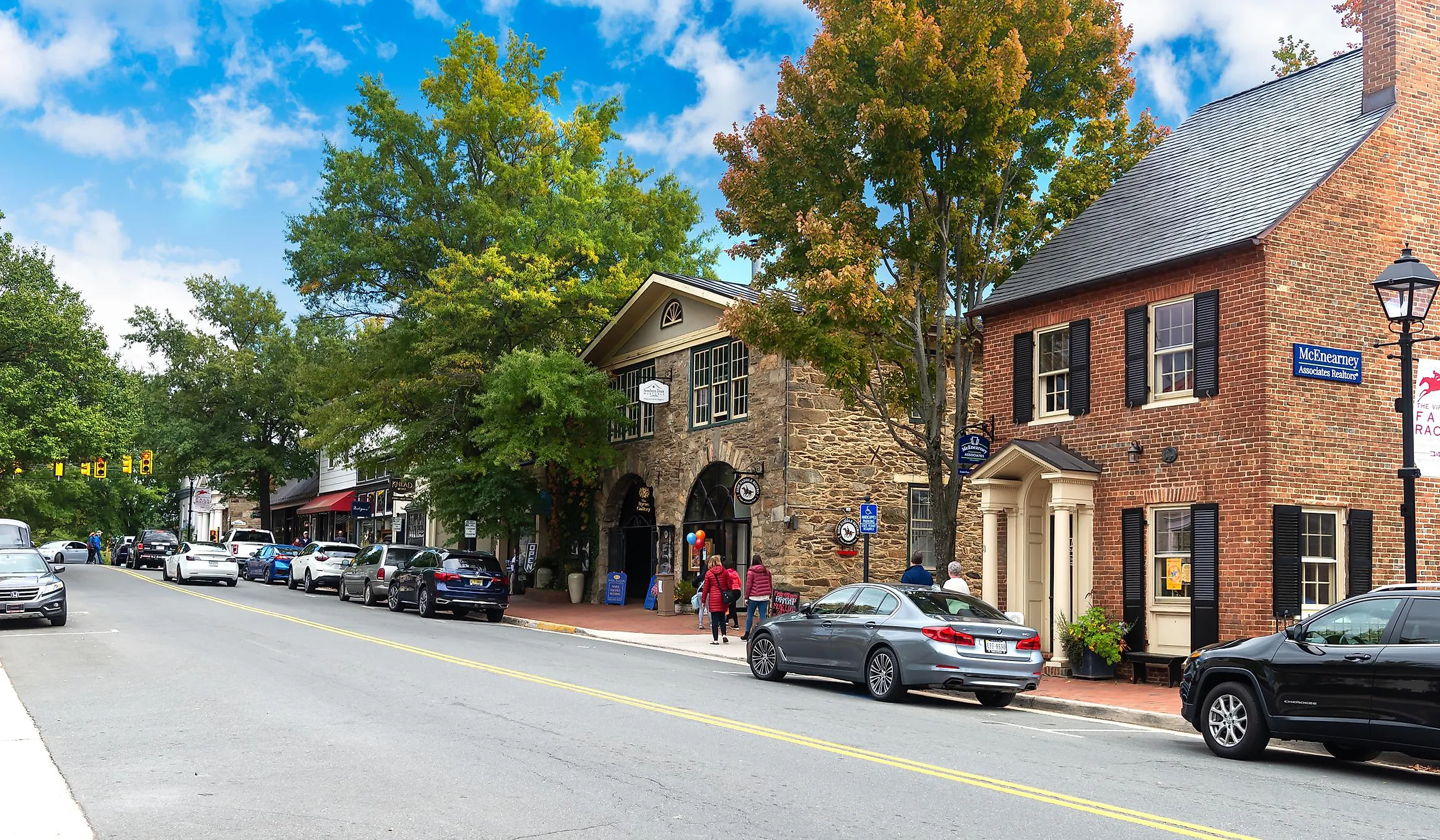
Middleburg, a Loudoun County settlement that straddles U.S. Route 50, is renowned for its rural character, 18th-century architecture, equestrian traditions, countryside vineyards, and luxury accommodations. The town promotes itself as the "Nation's Horse and Hunt Capital" owing to its long-standing history of steeplechase racing, foxhunting, and substantial horse farms. The National Sporting Library & Museum further reflects the region's equestrian culture through the library's more than 20,000 books, archives, and periodicals, as well as exhibits on horse sports and artworks by eminent artists. The Middleburg Historic District, which stretches along the entire downtown section of Washington Street, holds notable landmark properties such as the Red Fox Inn & Tavern, believed to be one of the country's oldest continuously operating inns.
Antique shops like the Middleburg Antique Gallery, boutiques like Crème de la Crème, and casual seafood eateries like King Street Oyster Bar fill the buildings on Washington Street. Also worth the trip is a scenic drive to Chrysalis Vineyards, a few miles from Middleburg, where the 400-acre property produces wines from Virginia's native Norton grape and other European varietals. Every October, cinema lovers, actors, filmmakers, screenwriters, music composers, and guests from around the world come to watch movies screened at the Salamander Resort Ballroom as part of the Middleburg Film Festival.
Cape Charles

An attractive waterfront community close to the Chesapeake Bay's mouth on the Eastern Shore of Virginia, Cape Charles shows a tranquil side of coastal Virginia, with a historic center, abundant water-based recreation, and a small-town atmosphere. The Cape Charles Town Beach is the starting point for most travelers, offering views of the calm waters, sunsets, and ample room for swimming and sunbathing. The wooden Fun Pier with side rails and built-in benches, adjacent to the public beach, is used by residents and visitors alike for sightseeing.
Within walking distance is the town's main street, Mason Avenue, lined by bakeries like the Mason Avenue Bakery, casual eateries like Deadrise Italian Kitchen serving sub sandwiches and thin-crust pies, and art galleries like Lemon Tree Gallery & Studio, which features local artists, in-studio painting sessions, and occasional live music. At the Cape Charles Museum & Welcome Center, visitors can check out the railroad exhibits and the collection of Chesapeake Bay steamship and ferry models, which shed light on the history and development of Cape Charles and the adjoining region. For more time outdoors, the Cape Charles Natural Area Preserve provides a boardwalk for observing the protected coastal habitats and migratory birds.
Luray

Page County's administrative center, Luray, occupies the Shenandoah Valley in northwestern Virginia, and serves as a convenient base for exploring the nearby natural attractions, strolling the traditional downtown, and taking on outdoor adventures. Luray's star attraction is Luray Caverns, a cavern system filled with speleothems such as stalactites, mirrored pools, stalagmites, and flowstone, plus the Great Stalacpipe Organ, open for guided tours along illuminated pathways. Within reach is Shenandoah's Thornton Gap, an entry point for the 105-mile Skyline Drive, which winds through mountain ridges along the full extent of Shenandoah National Park.
Luray's walkable commercial core, the Luray Downtown Historic District, features several contributing 19th- and 20th-century properties, such as the Page County Courthouse, alongside historic brick storefronts that house women's fashion boutiques like Henhouse Shoppe and cafes like Broad Porch Coffee & Cafe. The Luray Valley Museum and the Shenandoah Heritage Village tell the story of the region's 19th-century life through a collection of restored historic buildings, cottage-style gardens with heirloom flowers, a small vineyard, the Stonyman Gemstone Mining Sluice, and the Heartpine Café inside Burner Barn.
Lexington

Located around 50 miles north of Roanoke, within the Shenandoah Valley, Lexington blends scenic settings with college-town energy and a compact downtown closely tied to the town's storied past. This small settlement is home to two higher educational institutions: Washington & Lee University and Virginia Military Institute. Both students and visitors can survey the historic landmarks on campus, including the Lenfest Center for the Arts, which hosts performances and presentations, the Reeves Center, housing a significant ceramics collection, and the Old Barracks at VMI.
Visitors can take a fully narrated carriage ride with the Lexington Carriage Company down Main Street and past time-honored buildings like the Lexington Presbyterian Church and the Stonewall Jackson House, the only residence ever owned by the Confederate general. After the horse-drawn tour, visitors can stop by downtown's locally owned clothing stores like Lexington Pappagallo and gift shops like Sugar Maple Trading Company, or head to The Georges for upscale dining and lodging.
Onancock

Founded in 1680, this Accomack County town on Virginia's Eastern Shore mixes waterfront settings with deep coastal heritage, a robust arts scene, and a slow-paced life around the harbor. The National Register-listed Onancock Historic District along Market Street is lined with contributing properties, including the two-story Hopkins & Brother Store, the Holy Trinity Episcopal Church, and the Federal-style Ker Place, which has period-furnished rooms.
Boaters can spend time at the Onancock Wharf & Marina, from where the Tangier-Onancock ferry runs seasonally between Onancock and the offshore island of Tangier, home to a historic crab-fishing community. Culture buffs should not miss the live theatrical performances at the North Street Playhouse, while The Inn at Onancock, an 8-minute walk from the wharf, is a preferred choice for a comfortable stay in town.
Chincoteague

The island town of Chincoteague in Accomack County draws vacationers in large numbers, thanks to its coastal setting, biodiversity, strong connections to the surrounding waterways, and a leisurely pace of life. Many are especially drawn to the Chincoteague National Wildlife Refuge on the neighboring Assateague Island, which has a mile-long recreational beach, Chincoteague ponies grazing on marsh grass, and critical habitats for thousands of migratory waterfowl. The 142-foot red-and-white Assateague Light rises above the marshes and maritime forest, giving the refuge one of its most recognizable landmarks.
In town, the Museum of Chincoteague Island celebrates the culture and heritage of the island from prehistoric times to the present, with exhibits such as the Assateague Light's first-order Fresnel lens, seafaring artifacts, and "Misty of Chincoteague" memorabilia. Bill's Prime Seafood & Steaks is a good place to relish fresh local seafood, craft cocktails, wines, and Black Angus steaks. Keep room for homemade ice cream from the community favorite Island Creamery.
Williamsburg

Williamsburg, set on a ridge between the York and James Rivers on the Virginia Peninsula, holds a strong connection to the colonial past as the former capital, from 1699 to 1780, of both the Colony and Commonwealth. Colonial Williamsburg is the mainstay of the town's tourism-based economy, an open-air living history museum with restored or recreated 18th-century buildings, three major thoroughfares, and connecting side streets.
Within walking distance is Merchants Square, one of the country's early planned shopping districts, now filled with more than 40 shops and restaurants and used as a venue for farmers' markets and seasonal concerts. Beyond the colonial historic area, the campus of the College of William & Mary adds an academic atmosphere to the town, while the 23-mile Colonial Parkway, which links Williamsburg with the other two historic colonial communities, Jamestown and Yorktown, is ideal for a scenic drive.
Woodstock

The seat of Shenandoah County, Woodstock, set about two hours from Washington, D.C., has held onto its vintage character as one of the foremost towns founded west of the Blue Ridge Mountains. Covering a major portion of the town's historic center, the Woodstock Historic District includes several key landmark structures, the most notable of which is the 1795 Shenandoah County Courthouse, considered the oldest active courthouse west of the Blue Ridge Mountains.
The downtown area also has the Woodstock Museum of Shenandoah County, with local history artifacts housed in the mid-to-late 18th-century Marshall House and Wickham House. A short drive up Massanutten Mountain leads to the Woodstock Tower, a must-stop for those who want to see the "Seven Bends" of the North Fork Shenandoah River from above. Visitors can also sample prize-winning estate wines at the family-owned Muse Vineyards and head to Seven Bends State Park for hiking, biking, fishing, boating, and picnicking.
Abingdon

This Washington County seat, set close to the Tennessee state line, maintains its historic character through its 20-square-block Abingdon Historic District and an arts-and-crafts scene rooted in the Main Street galleries and museums. Founded in 1933 by American actor Robert Porterfield, Abingdon's Barter Theatre is the nation's longest-running professional regional theatre, named for the Depression-era practice of letting patrons pay admission with farm goods.
Art buffs should not miss a tour of the William King Museum of Art, which hosts educational programs and showcases an outdoor sculpture garden, both historic and contemporary regional art, and a permanent record of American decorative arts at the Betsy K. White Cultural Heritage Research Archive. Cyclists, hikers, and equestrians gather at Abingdon to access the 34.3-mile Virginia Creeper Trail, which runs east through Damascus up to Whitetop Station. At the end of the day, visitors can savor American and German cuisine at a 1779 inn, The Tavern, and spend the night at The Martha Washington Inn & Spa.
What Makes These Towns Stand Out
What ties these places together is depth rather than location. Williamsburg and Abingdon preserve history that still draws working theaters and living-history museums, not just plaques. Cape Charles, Onancock, and Chincoteague trade on real maritime heritage, from active ferries to a working refuge. Culpeper, Luray, Middleburg, Lexington, and Woodstock each pair a walkable downtown with a single attraction worth the visit on its own, whether a cavern, a courthouse, or a horse-country tradition. Any one of them rewards a full weekend, and a person who settles in finds the same substance holds up year-round.