10 Famous Ghost Towns Of America
Say "ghost town" and most people picture tumbleweeds, creaking saloon doors, and maybe a spectral gunslinger or two. The reality is usually less supernatural and a lot more brutal: these were real places where real people struck it rich, threw up a town overnight, and then watched the whole thing collapse the second the gold, copper, or coal ran out. No ghosts required - the economics alone are terrifying. Here are ten American towns that boomed hard, busted harder, and are still standing as monuments to bad timing and worse luck.
Kennecott, Alaska

Copper, not gold, is what dragged prospectors into one of the most remote corners of Alaska. In the summer of 1900, two of them - Clarence Warner and a character known as "Tarantula" Jack Smith - spotted a green smear on a mountainside above a glacier, figured it was grass for their horses, and found instead an outcrop of copper ore so pure (roughly 70% chalcocite) it remains one of the richest ever discovered. They filed the Bonanza claim on the Fourth of July. Getting the metal out was another matter, so financiers Daniel Guggenheim and J.P. Morgan formed the "Alaska Syndicate" in 1906, pushed a 196-mile railroad through avalanche country, and eventually folded everything into the Kennecott Copper Corporation in 1915. The mines would ultimately yield more than $200 million in copper and support a self-contained company town where miners unwound on a tennis court and a skating rink, because what else are you going to do at fifty below. When the ore thinned out, the last train rolled away in November 1938 and the place was simply left behind. Today its 14-story, blood-red mill still towers over the ice as a National Historic Landmark, planted in the middle of the free-to-enter Wrangell-St. Elias National Park, where you can walk through it on the official Kennecott Mill Town Tour. (And yes, the spelling is a mess: the mine and town are "Kennecott," while the glacier next door is "Kennicott." Blame a century-old clerical typo.)
Batsto Village, New Jersey

Batsto got going in 1766 as an iron- and glass-making town, and for a stretch it was indispensable. During the American Revolution, Charles Read's furnace - the largest in the region - cranked out housewares and ammunition for the Continental Army. Then came 1874, when a fire tore through the glassworks and took 17 houses and the surviving furnaces with it. Residents scattered, and the town sold at auction for $14,000 to industrialist Joseph Wharton, who revived it as a farming operation and kept it going until his death in 1909, after which it slid into a second decline. Its third act is the one you can actually visit: a restored historic village preserved for tourists, historians, and anyone who appreciates a town that flatly refuses to stay dead.
Blue Heron, Kentucky

Blue Heron, also known as Mine 18, sat along the Big South Fork River and ran on coal, not gold - this was Appalachian coal country, and the Stearns Coal & Lumber Company owned every inch of it. The mine opened in 1937, the company controlled everything (the houses, the store, even the scrip the miners were paid in), and the whole operation shut down in 1962 once the coal stopped being worth digging. Here is the clever part: instead of rebuilding the rotted-away buildings, the National Park Service erected open steel-frame "ghost structures" on the original footprints, each rigged with audio recordings of former residents describing what life was actually like. You can drive in, or do it properly and ride the Big South Fork Scenic Railway out from Kentucky's town of Stearns. It may be the only ghost town that talks back.
Bodie, California

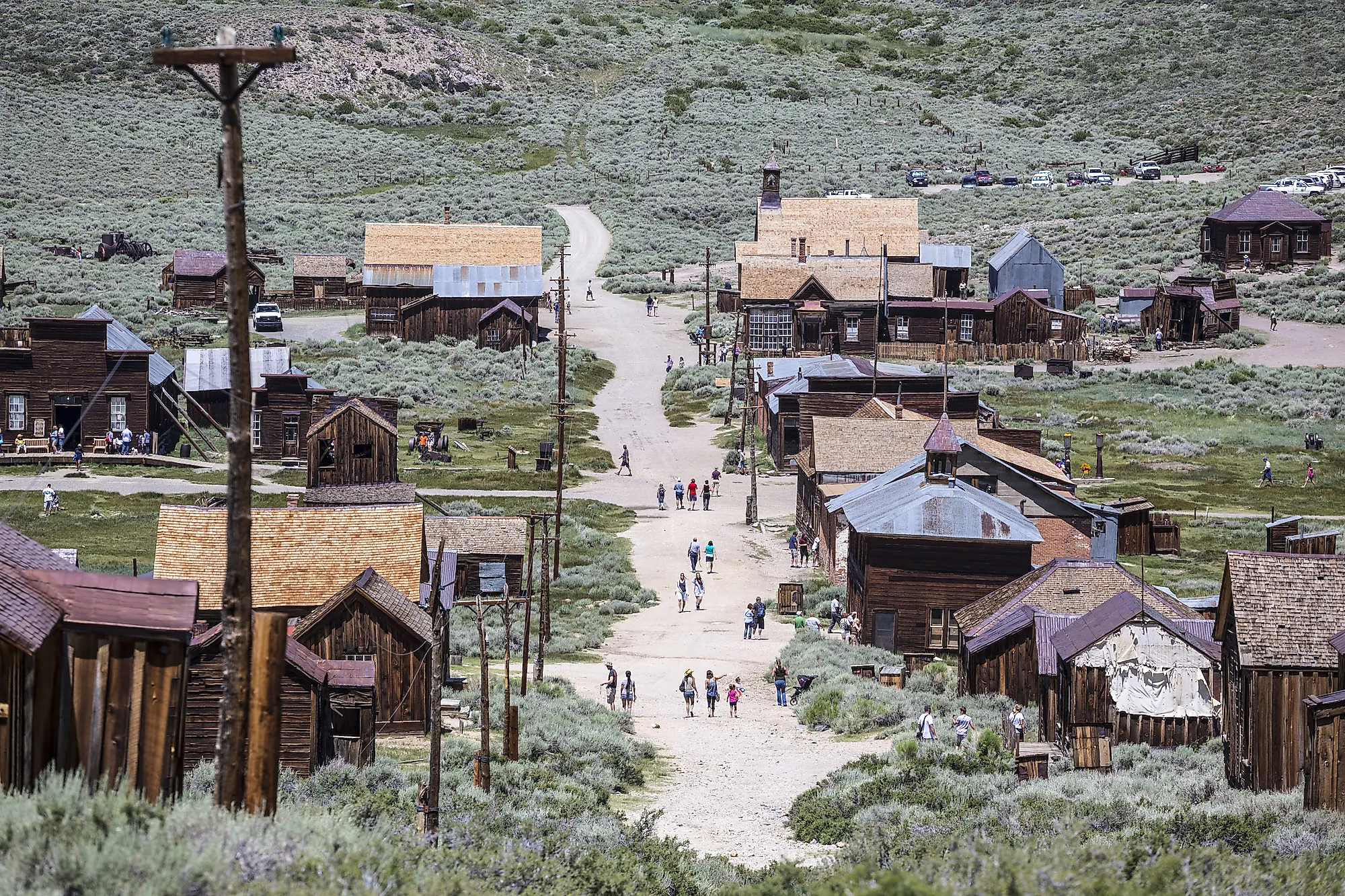
Bodie turned notorious in record time. Gold surfaced in the hills in the late 1870s, prospectors poured in (reportedly more than two dozen new arrivals a day at the peak), and the population swelled into the thousands, with some accounts pushing it close to 10,000. The crowd brought a reputation: Bodie earned a "sea of sin" nickname for its saloons, brothels, opium dens, and the brand of whiskey-fueled gunplay that kept the cemetery busy. The boom outran the infrastructure, the savage winters finished the job, and the last residents cleared out around the 1940s. What survives is one of the best-preserved ghost towns in America, roughly 200 buildings held in a state of "arrested decay" by California State Parks - shelves still stocked, pool tables still racked, chairs still sitting where someone left them. Decay, but make it tasteful.
Nelson, Nevada

Spanish explorers were prospecting the canyon they called El Dorado for gold as far back as 1775, but Nelson did not really erupt until a century later, when miners - including a healthy number of Civil War deserters - flooded the area. It became one of Nevada's biggest booms and one of its deadliest. The infamous Techatticup Mine produced gold, silver, copper, and lead, and the endless disputes over who owned what were frequently settled with a bullet rather than paperwork. The ore held out until 1945, the regular flash floods made staying miserable, and people left, but the buildings stuck around. They photograph so well that Nelson now moonlights as a backdrop for films, photo shoots, and music videos. A ghost town with a side hustle.
Dogtown, Massachusetts

Nobody fully agrees on how Dogtown got its name - either the living conditions were genuinely dog-rough, or the local war widows kept dogs around for protection. Either way, the hardscrabble settlement was abandoned long ago and swallowed by forest. Then the Great Depression handed it an unlikely second life. Roger Babson, the wealthy entrepreneur who famously called the 1929 crash and later ran for president, hired out-of-work stonecutters to carve inspirational mottoes into roughly two dozen boulders scattered through the ruins. The results are equal parts earnest and surreal: hikers today trek out to read commands like "Prosperity Follows Service," "Get a Job," and "Help Mother" chiseled into the granite. It is part ghost town, part open-air motivational poster.
Frisco, Utah

At its peak, Frisco packed in around 6,000 people and one of the most profitable mines in the region, hauling out gold, silver, zinc, and copper - some $60 million worth by 1885. Naturally, all that money attracted the usual ecosystem of saloons, gambling halls, and brothels, and just as naturally, the cocktail of cash and liquor turned the town violent. Frisco got so lawless that a murder was reportedly committed nearly every day, until a no-nonsense marshal showed up to clean house. The boom could not survive the 1885 collapse of the Horn Silver Mine and the sliding price of silver, and the town stood empty by the 1920s, leaving the old mines and mills behind as some of the West's eeriest ruins. Turns out unlimited money plus zero rules is not a stable long-term plan.
Santa Claus, Arizona

Santa Claus, Arizona, was never a mining town - it was a marketing stunt. Established in the 1930s in the middle of the Mojave Desert, it existed to lure tourists (and real-estate buyers) into the dust with a year-round Christmas theme. Santa himself was on hand daily, the inns and restaurants were drenched in holiday kitsch, and in the later years the real draw was the post office, which let kids nationwide receive letters postmarked not from the North Pole, but from Arizona. The novelty wore off, interest dried up, and the town went up for sale in 1983. These days it is a peculiar roadside relic on the way to Kingman or the Hoover Dam, where vandalized buildings, an old wishing well, and the rusting remains of the pink "Old 1225" kiddie train make for some genuinely unsettling holiday cheer.
St. Elmo, Colorado

Founded in 1880, St. Elmo rocketed to around 2,000 residents and more than 150 mines, helped along by its role as a busy whistle-stop on the railroad. The inns and dance halls did a roaring trade until the Alpine Tunnel closed in 1910 and the bottom fell out. Falling silver prices had already done damage, the last train left in 1922, and a handful of stubborn holdouts hung on for another 30 years - until the postmaster died and the post office shut, which was effectively the town's death certificate. For good measure, the place was hit by fires even after everyone left, as if something up there held a grudge. Yet the buildings survived, making St. Elmo one of America's best-preserved ghost towns. Visitors can stay in historic cabins, rip around the old mining roads on ATVs, and fish Chalk Creek between history lessons.
Rhyolite, Nevada

Rhyolite, named for the silica-rich volcanic rock all around it, sits near the edge of Death Valley and was founded in 1905 on a promise of gold that mostly never materialized - even after the steel magnate Charles M. Schwab poured a small fortune into trying to make it pay. For one brief, optimistic stretch it had everything: a school, a hospital, a symphony, a stock exchange, and a thriving red-light district. Then the gold failed to appear in the quantities everyone had banked on, and the town emptied almost as quickly as it had filled. It found a second career as an old-West movie set in the 1920s, and its photogenic ruins - including the famous Bottle House, built from thousands of liquor and beer bottles - still pull in visitors. A town built on optimism, recycled into a photo op.
What The Ruins Remember
Walk into any of these places and the same arc plays out: a frantic boom, a few gilded years, and a collapse so total that the town simply stopped. What makes them worth the trip is not ghosts in any literal sense but the residue of all that ambition - the mills, the mottoes, the Christmas kitsch, the saloons gone silent. Each one tells the same cautionary tale in its own accent, which is exactly why they are so hard to look away from.